

A family emergency communication plan is a one-page answer to a question nobody wants to work out in the dark: when the phones stop working, how does everybody find everybody?
It’s 4:40 on a weekday. A storm line has come through, the power’s out across the county, and your phone shows one bar that keeps disappearing. Your spouse is somewhere between work and home. One kid is at practice across town. You call and get a fast busy signal. You text and watch it sit on “Sending.”
Most days that clears up in an hour and everybody laughs about it at supper. The plan is for the day it doesn’t. And the hard part isn’t buying radios. It’s deciding ahead of time who calls whom, on what, and when, so nobody has to improvise while they’re worried.
Here’s the short version. Write down four ways to reach each other, in order: phone, text and an out-of-area contact, a GMRS radio on a channel you picked ahead of time, and a meeting place. Put it on a card everyone carries. Then test it once before you need it.
What Is a Family Emergency Communication Plan?
It’s an agreement, written down, about how your household reconnects when you’re separated and the usual ways of reaching each other aren’t working. Ready.gov has a fill-in family emergency communication plan form that covers the basics: contacts, schools, workplaces and meeting places. That form is a fine start.
This guide adds the piece most templates leave out: a second way to talk that doesn’t depend on a cell tower. For most families that’s GMRS, a licensed two-way radio service the FCC set aside for exactly this kind of short-range personal and family use. It sits at Level 4 of the five levels of preparedness, the “second way to do it” level, and it’s on the stock-up list for building depth for that reason.
Reasons You Need a Family Emergency Communication Plan
- Cell networks get crowded fast. After a storm or a big local event, everyone calls at once. The FCC’s own emergency communication tips tell you to text instead of calling and to keep calls short so the network has room.
- Cell sites need power too. Many towers ride out an outage on batteries or a generator. A long outage can outlast that backup.
- Nobody remembers phone numbers anymore. If a phone dies or gets lost, the numbers go with it.
- Kids need a script. A ten-year-old who knows “go to the library and wait” is calmer than one who has to decide what to do.
- Guessing wastes the window. Two people driving to find each other on different roads is how families stay apart longer.
None of that requires fear. It’s the same logic as a fire escape plan: you hope you never use it, and it costs one evening.
Step-by-Step Instructions to Build Your Family Emergency Communication Plan
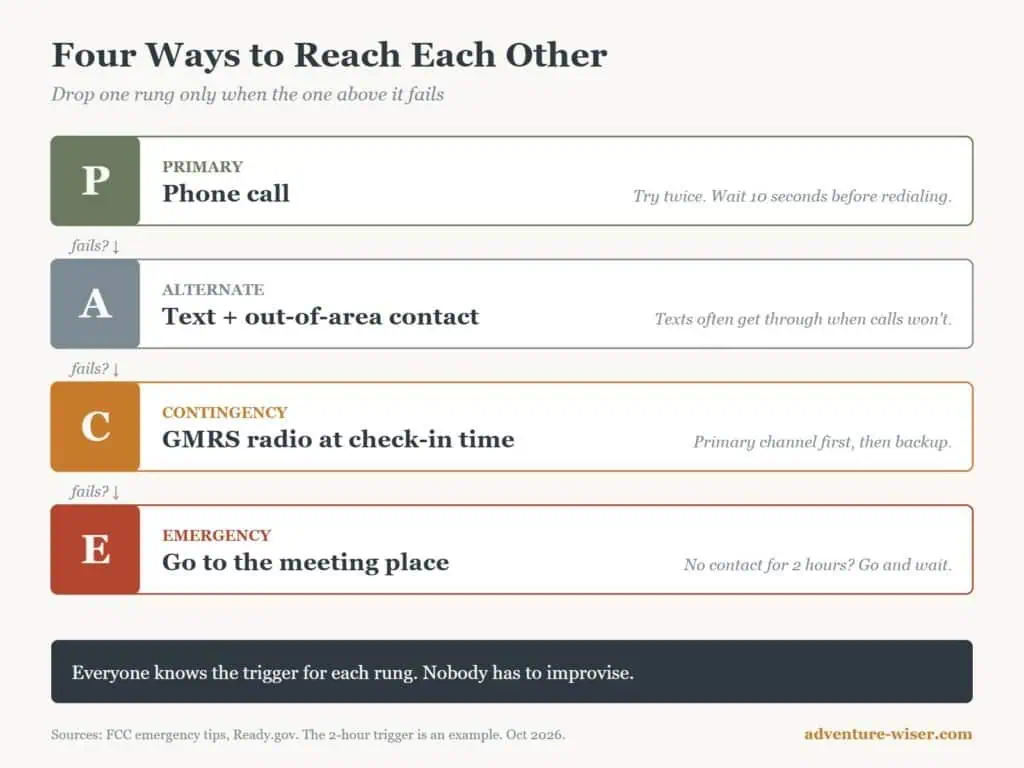
The method below borrows a structure military planners call PACE: Primary, Alternate, Contingency and Emergency. Each layer only matters when the one above it fails, and everybody knows when to drop to the next one.
- Test the range first, before you buy anything else
- Build your PACE ladder: four ways to reach each other, in order
- Get the GMRS license that covers the whole family
- Pick a primary and backup channel and set every radio the same
- Set check-in times so radios don’t have to stay on all day
- Choose three meeting places: close, across town and out of town
- Write the comms card and put one in every wallet and backpack
- Run a drill on a quiet Saturday
Step 1 is first on purpose. It’s the step that saves you money and the one that tells you whether the radio layer of your plan is real.
Step 1: Test the Range Before You Trust It
Radio range is the most oversold number in the whole category. Packaging promises 30 or 36 miles. That figure comes from ideal line-of-sight conditions, like one radio on a mountaintop and the other on open water. In wooded, hilly country, a pair of handhelds talking directly to each other may only manage a mile or two. That’s a rough estimate, not a measurement, and your terrain will decide the real number.
So test before you build a plan around it. Borrow a pair, or buy one inexpensive pair you can return. Leave one at the house and drive the routes that matter: to the school, to work, to the church. Note where you lose each other. If the gap is too wide, you have three honest options:
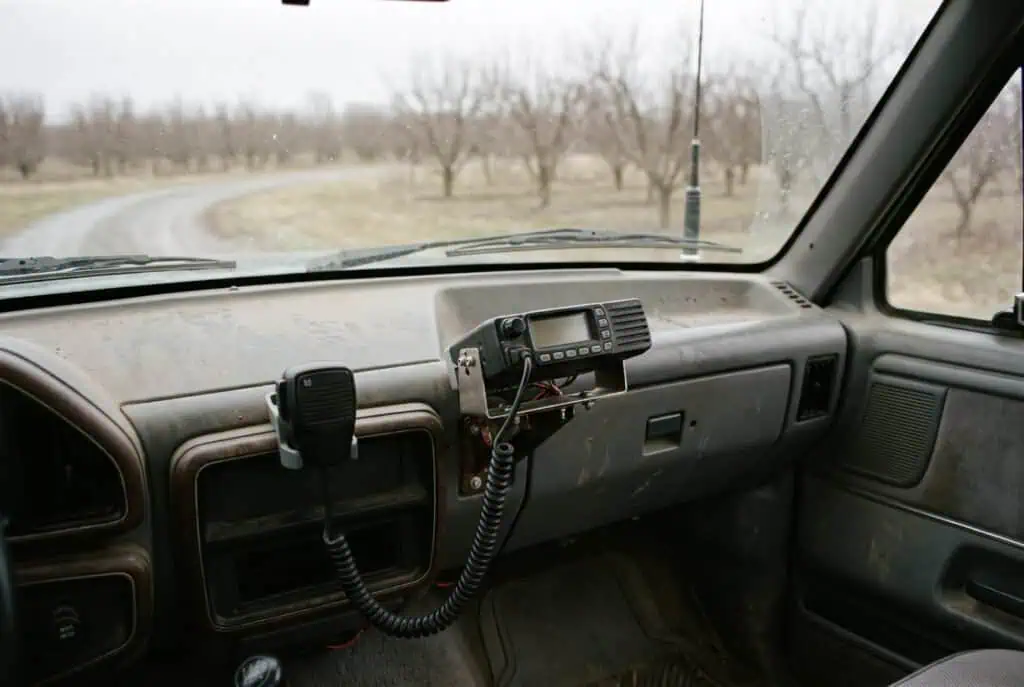
- A mobile radio with a roof antenna. More power and a better antenna in the truck or at the house closes a lot of distance. The GMRS radio picks for 2026 cover the handheld and mobile options with current prices.
- A local repeater. A repeater on a tower or ridge rebroadcasts your signal much farther. Search the myGMRS repeater directory for one near you, and ask the owner for permission, which the FCC requires.
- Accept the limit. If radio can only cover the neighborhood, plan it as the neighborhood layer and let the meeting place handle the rest.
Step 2: Build Your PACE Ladder
Write down four layers, in order, and the trigger that moves everyone down a rung. Here’s a version that works for most households:
- Primary: phone call. Try twice. If it doesn’t connect, wait 10 seconds before redialing, per the FCC’s tips, and don’t keep hammering it.
- Alternate: text, plus the out-of-area contact. Texts often get through when calls won’t. Pick one relative in another region that everyone texts with a status. Long-distance connections can work when local ones are jammed, and that person becomes the family message board.
- Contingency: GMRS radio. Primary channel at the next check-in time. Backup channel if the primary is busy.
- Emergency: go to the meeting place. If there’s been no contact for a set time, say two hours, everyone heads to the agreed spot and waits.
The trigger matters as much as the layers. “If you can’t reach anyone in two hours, go to the meeting place” is a decision a kid can follow. “Use your judgment” isn’t.
Step 3: Get the GMRS License for the Family
GMRS requires a license, and it’s one of the easier ones the government offers. The FCC’s GMRS page spells it out: you must be 18 or older, there’s no test, the license runs ten years, and once you hold it, any family member regardless of age can operate within your licensed system. The fee is $35, paid when you apply through the FCC’s online licensing system.
You’ll get a call sign. The station identification rule requires you to say it at the end of a transmission or series of transmissions, and at least every 15 minutes during a long one. Write it on the comms card so the kids can say it too.
A note on FRS: the bubble-pack radios sold as “walkie-talkies” are often FRS radios, which need no license. They can talk to GMRS radios on the shared channels, just at lower power. Plenty of families mix both, and that’s fine.
Step 4: Pick a Primary and a Backup Channel
This is the step people botch. They pick channel 1 because it’s first, or leave each radio on whatever it was set to in the box. Then on the bad day, half the family is on one channel and half on another.
Power limits are what make the choice matter. Under the FCC’s GMRS power rules, channels 15 through 22 allow up to 50 watts from a mobile or base station, channels 1 through 7 are capped at 5 watts, and channels 8 through 14 are held to half a watt on a handheld. FRS radios, under their own power limit, top out at 2 watts on 1 through 7 and 15 through 22 and half a watt on 8 through 14.
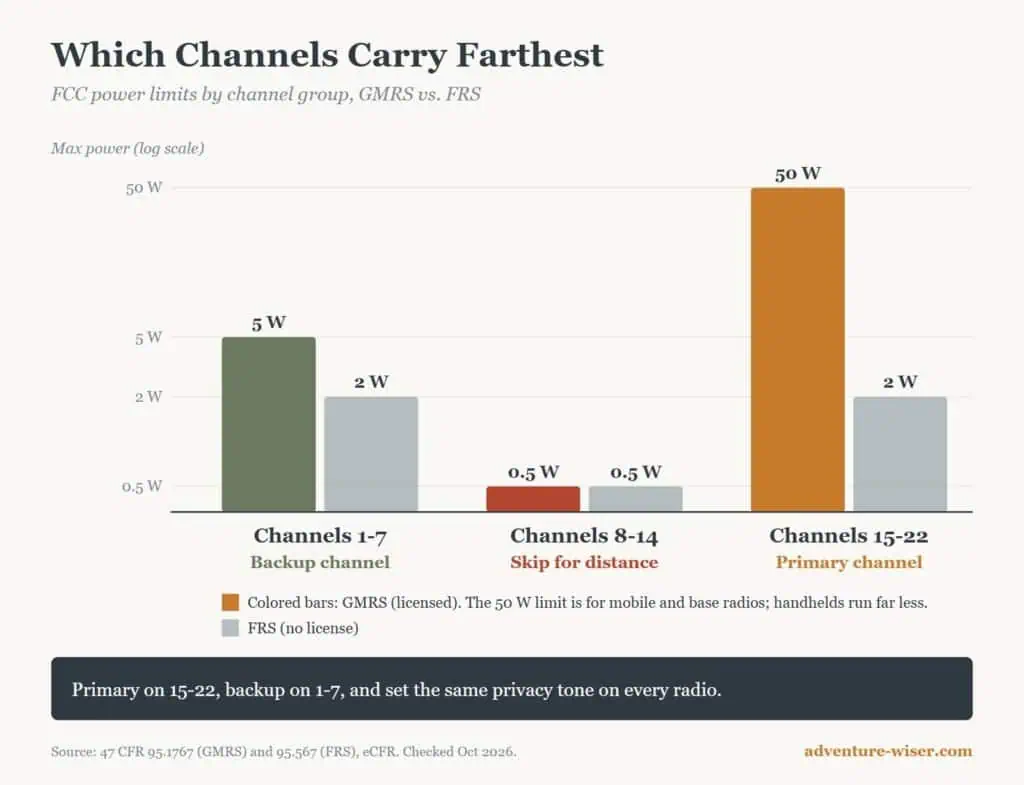
So for most families: pick a primary from 15 through 22, which gives GMRS radios their full power and still lets FRS radios join. Pick a backup from 1 through 7. Skip 8 through 14 for anything that needs distance. Set the same privacy tone on every radio and write it down.
Two honest notes. A privacy tone only filters what you hear. It does not keep anyone else from hearing you, so don’t say anything on the radio you wouldn’t say in a parking lot. And many GMRS users treat channel 20 as an informal calling and emergency channel. That’s a community habit, not an FCC designation, and nobody is guaranteed to be listening. If you want help programming tones or repeater offsets, the GMRS programming walk-through takes it one menu at a time.
Step 5: Set Check-In Times
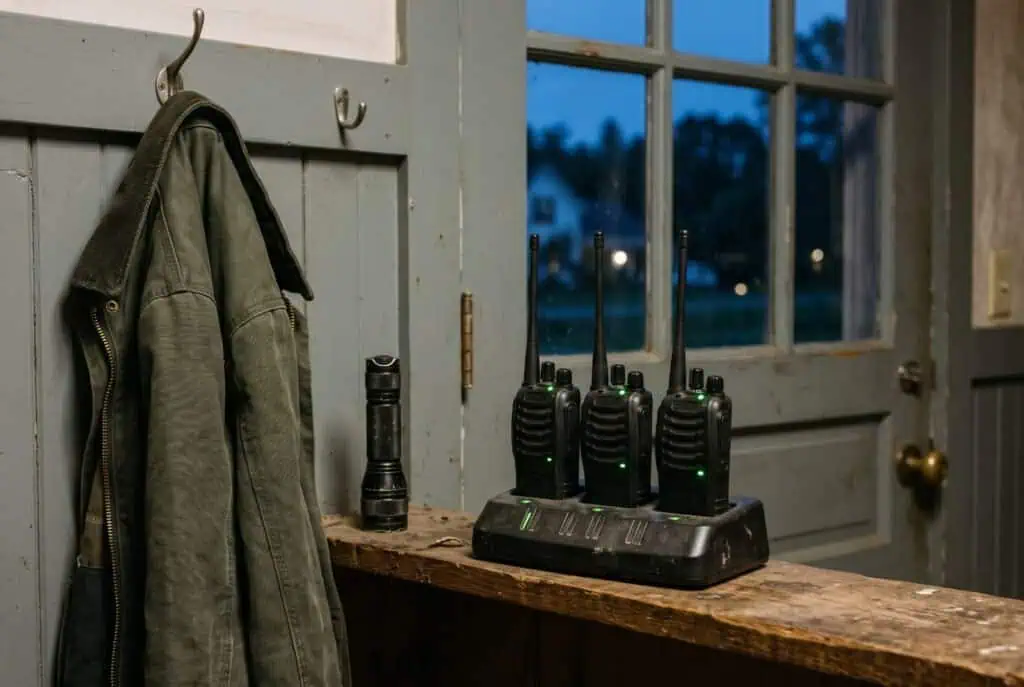
A radio left on all day is a dead radio by evening. Instead, agree on check-in windows: the top of every hour for five minutes, for example. Everyone turns on, calls in, and turns off. That stretches batteries for days, and it means nobody has to guess whether the other person is listening right now.
Keep the radios charged before trouble starts, and know how you’ll charge them during it. A small power station or solar setup or a car charger keeps the contingency layer alive when the grid isn’t, and the outage preparedness guide covers the rest of the house.
Step 6: Choose Three Meeting Places
Pick one spot near the house, like the neighbor’s porch or the end of the driveway, for a fire or a gas leak. Pick one across town, somewhere public and easy to find, like a library or a church parking lot. Pick one out of town, usually a relative’s house, for the day you can’t go home.
If somebody might be on foot, the meeting places should line up with their route. The get-home plan guide walks through choosing routes and stopping points that work with this.
Step 7: Write the Comms Card
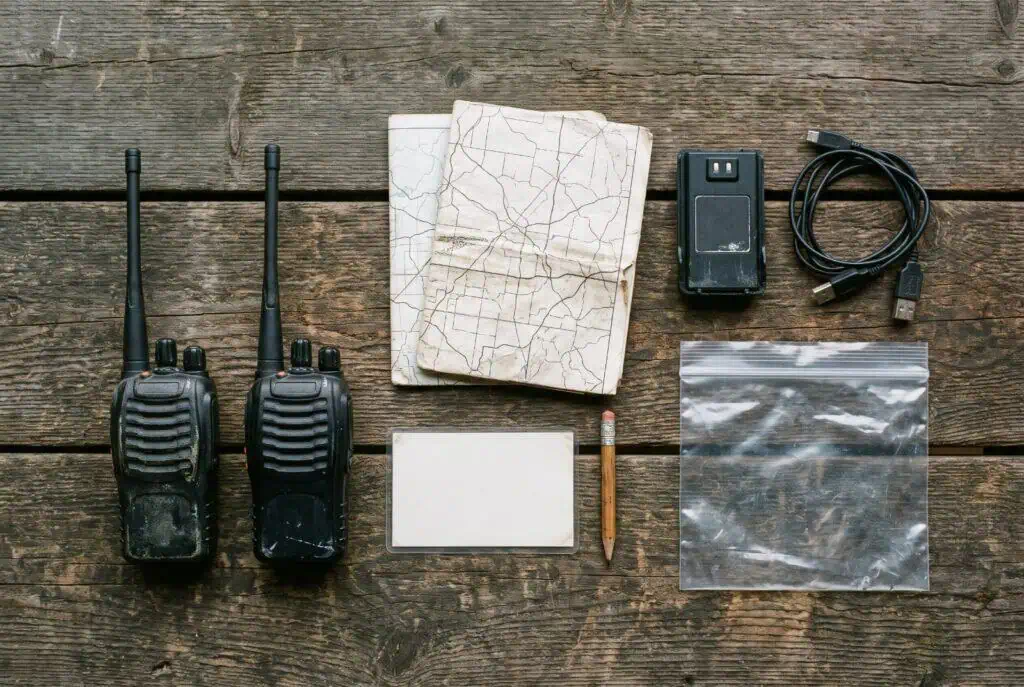
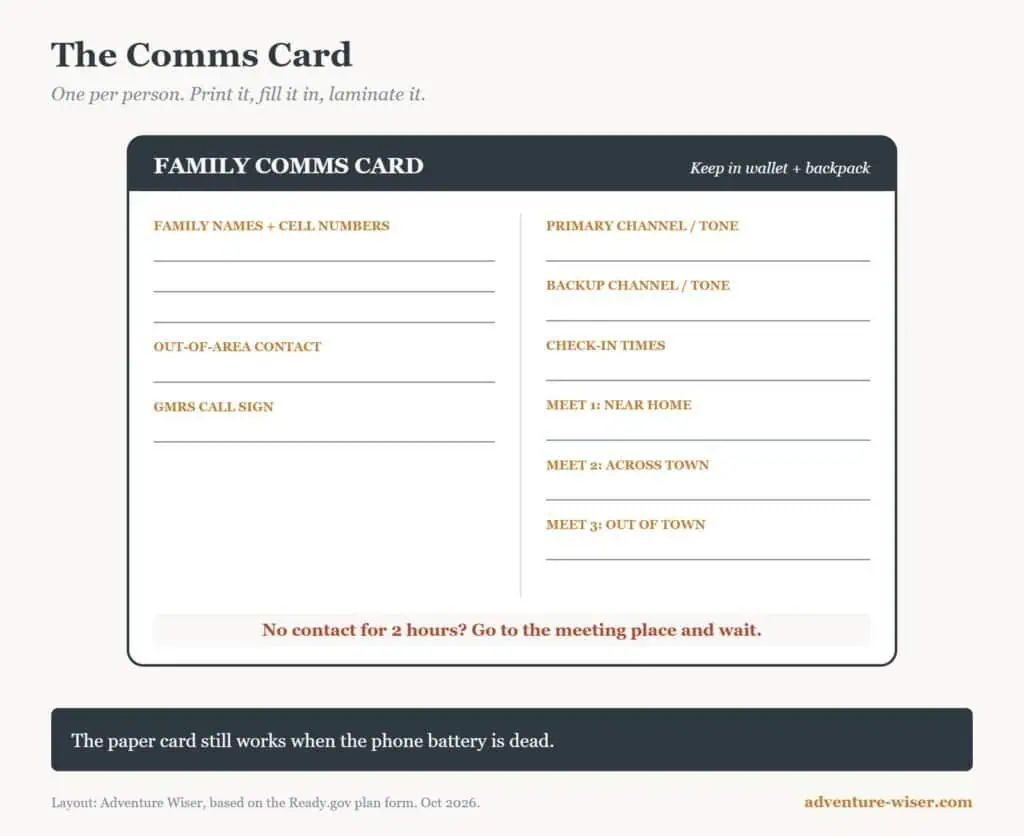
Every person gets the same card: names and numbers, the out-of-area contact, the GMRS call sign, the primary and backup channel with the privacy tone, the check-in schedule and the three meeting places. Laminate it or slide it into a zip bag. One goes in each wallet, purse and school backpack, and one goes in the glovebox.
Keep a copy in your digital go-bag too, but the paper card is the one that works when the phone battery is gone.
Step 8: Run a Drill
Pick a quiet Saturday. Send one person to the across-town meeting place with a radio and have them call in at the check-in time. Have a kid text the out-of-area contact. Walk the driveway with the youngest and point at the close meeting spot. It takes an hour, and you’ll find the dead battery, the wrong channel or the forgotten tone now instead of later.
Key Considerations for a Family Emergency Communication Plan That Works
Simple beats clever. A plan with four layers and one card that a ten-year-old can follow will hold up better than a binder of frequencies. If a step needs the adult who wrote it to explain it, simplify it.
Say your location in a way that survives a bad signal. “By the big oak past the second gate” is worse than a crossroad or a grid reference. If you use maps, the MGRS grid system gives a location in fewer spoken characters than latitude and longitude, which matters when the radio is crackling. And keep a hand-crank weather radio in the plan for the other direction of traffic: news and alerts coming in. The NOAA Weather Radio network keeps broadcasting when the internet doesn’t.
Taking It to the Next Level: Beyond the Family Radio
Once the basics work, the next steps are about reach. A repeater gets you county-wide. Local GMRS nets, regular scheduled check-ins run on many repeaters, are good practice and a way to meet the people who’d hear you on a bad day. And if someone in the house catches the radio bug, amateur radio adds far more range in exchange for an exam. The ham radio guide for preppers is the place to start.
Alternatives to GMRS for Family Communication
GMRS isn’t the only second way to talk. Each option trades something:
- FRS radios: no license, lower power, fine for the yard and the campground.
- Meshtastic: small, cheap mesh radio nodes that pass text messages node to node. Great for text, no voice, and it needs other nodes around to reach far.
- Amateur radio: the most capable, the steepest learning curve, and a license exam.
- Satellite messengers: work almost anywhere with sky view, need a subscription, and are slow for back-and-forth.
For a household that needs voice between home, school and work, GMRS is usually the best fit. The backcountry communications guide compares these in the field context.
Frequently Asked Questions
What should a family emergency communication plan include?
Names and phone numbers, an out-of-area contact, the radio call sign and channels, check-in times, three meeting places and what to do if nobody can be reached. Put it all on one card each person carries.
Do I need a license for GMRS radios?
Yes. The FCC license costs $35, needs no test, lasts ten years and covers your family members of any age. FRS radios need no license.
What is the best channel for a family to use on GMRS?
Pick a primary from channels 15 through 22, which allow the most power, and a backup from 1 through 7. Avoid 8 through 14 for distance, since handhelds are limited to half a watt there.
Is there an emergency channel on GMRS?
Not an official one. Many users treat channel 20 as an informal calling and emergency channel, but no one is required to monitor it, so don’t build your plan around a stranger hearing you.
How far will GMRS radios reach?
It depends on terrain, antenna and power far more than the box. Handheld to handheld in wooded hills may be a mile or two. A mobile radio with a good antenna, or a repeater, can reach much farther.
Should kids carry radios?
Older kids can, and the family license covers them. Younger kids do better with a simple card and one rule: if you can’t reach us, go to the meeting place and wait.
Wrapping Up: Your Family Emergency Communication Plan This Weekend
I haven’t field-tested a GMRS setup for this guide, so everything above is researched from the FCC rules, Ready.gov and the gear makers, and labeled that way. The plan itself doesn’t need a test lab. It needs one evening at the kitchen table and one Saturday drill.
So this weekend, fill out the card for every person in the house, pick your channels and your meeting places, and run the drill once. Your family emergency communication plan is done when the youngest person in the house can tell you where to go if the phones go quiet. If you want the printable version of every checklist on the site, grab the free prep checklist.
Gear on Adventure Wiser is labeled for what it is: Tested, Owned or Researched. Here’s how that works.
