


What Actually Separates a Good GMRS Radio From a Bad One
Before the list: Adventure Wiser labels how much hands-on time sits behind a recommendation. Unless a section says otherwise, treat the picks below as researched — compared on published specs, long-term owner reports and current street price, not personal field time. Here’s exactly what that means and why we do it.
When cell towers go down, your phone becomes an overpriced pocket brick. GMRS radios don’t.
Whether you’re hiking, convoying, coordinating during storms, or keeping your family connected when the grid hiccups, a GMRS radio is one of the most practical pieces of gear you can own. Unlike FRS walkie-talkies from the bargain bin, the best GMRS radios deliver real range, real clarity, and real reliability when communications matter most.
What follows is built from published specifications, FCC certifications and the range physics that the blister pack ignores — not from a field test. Where that leaves a question open, it says so.
Below are the picks for 2026 — the simple, legal, reliable units that hold up when things get loud, dark, or chaotic.
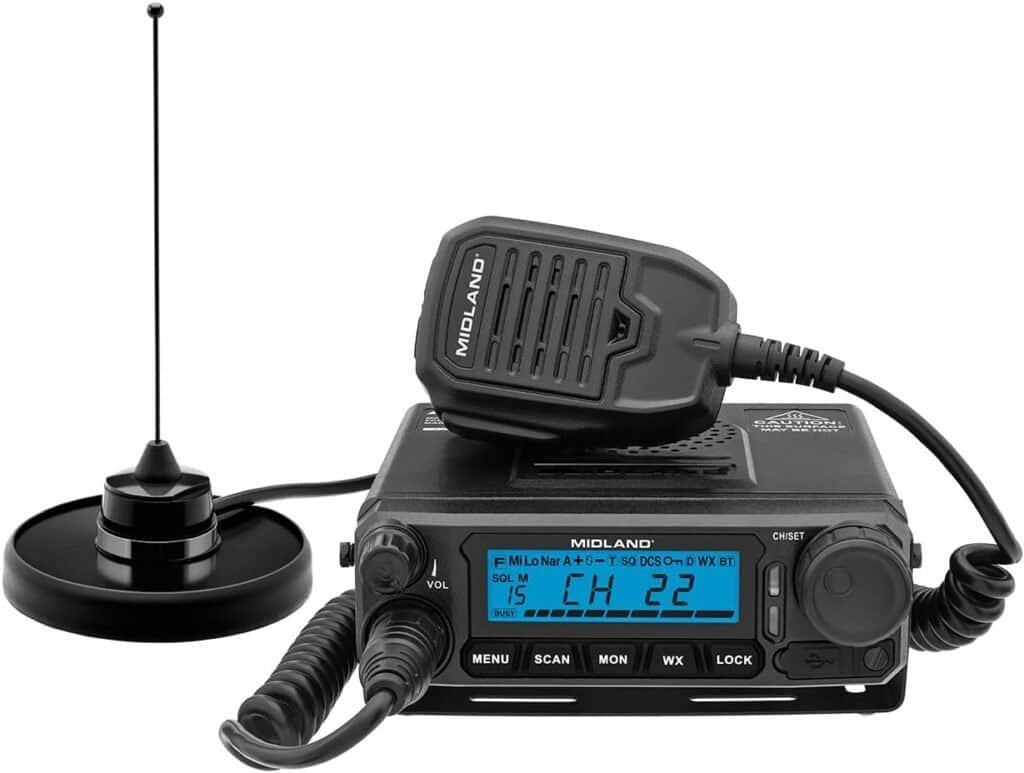
Midland® MXT500
Why it’s solid for preppers: The MXT500 pushes the legal max 50W for GMRS, supports 15 GMRS channels + 8 repeater channels, has IP66 water resistance, NOAA Weather Radio, USB-C on the front, and split tones/142–154 privacy codes for flexible repeater use. It’s built for vehicles, base camps, ranches, and overlanding where handhelds fall short.
Pros:Cons:
What Is a GMRS Radio? (Quick Explainer)
GMRS stands for General Mobile Radio Service, a U.S.-legal communication system regulated by the FCC that uses higher power than FRS radios and allows detachable antennas—meaning better range, better clarity, and better performance in real terrain.
Understanding why the best GMRS radios outperform consumer walkie-talkies comes down to three factors: power output, antenna flexibility, and repeater access.
Why GMRS Beats “Toy Walkie-Talkies”
The best GMRS radios offer significant advantages over FRS (Family Radio Service) units you’ll find at big-box stores:
| Feature | GMRS | FRS |
|---|---|---|
| Max Power Output | 5–50 watts | 0.5–2 watts |
| Detachable Antennas | Yes (upgradeable) | No (fixed) |
| Repeater Access | Yes | No |
| Effective Range (real-world) | 5–15+ miles | 0.5–2 miles |
| License Required | Yes ($35/10 years) | No |
| Emergency Reliability | High | Low-Medium |
Key Performance Advantages:
✅ Better penetration through trees, hills, and buildings ✅ Optional repeaters for extended-range communication (25+ miles) ✅ Detachable antennas for boosted performance and upgrades ✅ Family-wide license — one license covers your whole crew ✅ Higher power options for vehicle-mounted units (up to 50W)
License Note: A $35 FCC license is required, good for 10 years, and covers your entire household. No test. No hassle. Just register online.
Why GMRS Matters for Preppers & Hikers
When I’m evaluating the best GMRS radios for emergency preparedness, I’m looking at scenarios where traditional communication infrastructure has failed or is unavailable.
Real-World GMRS Applications:
🔹 Works when cell towers fail (hurricanes, wildfires, grid-down scenarios) 🔹 Works off-grid with solar power banks and vehicle charging 🔹 Great for convoys, family camps, hunting groups, and storm season coordination 🔹 Reliable local communication during emergencies when minutes matter 🔹 Perfect bridge between “simple walkie-talkie” and “full HAM radio life commitment”
According to FEMA emergency communication guidelines, having alternative communication methods is critical during disasters. The best GMRS radios provide that redundancy without requiring technical expertise.
GMRS Communication Range Factors:
| Terrain Type | Handheld Range (5W) | Mobile Range (15-50W) | With Repeater |
|---|---|---|---|
| Open flat terrain | 2–5 miles | 10–20 miles | 25–50+ miles |
| Urban/suburban | 0.5–2 miles | 3–8 miles | 15–30 miles |
| Wooded/hilly | 0.5–1.5 miles | 5–12 miles | 20–40 miles |
| Mountains/valleys | 0.25–1 mile | 3–8 miles | Variable (depends on repeater placement) |
GMRS is the sweet spot: simple, legal, reliable, effective.
The 2026 Picks, by Use Case
Below are the picks, sorted by what you are actually trying to do with the radio.
✅ 1. Midland MXT500 MicroMobile — Best Overall GMRS Radio
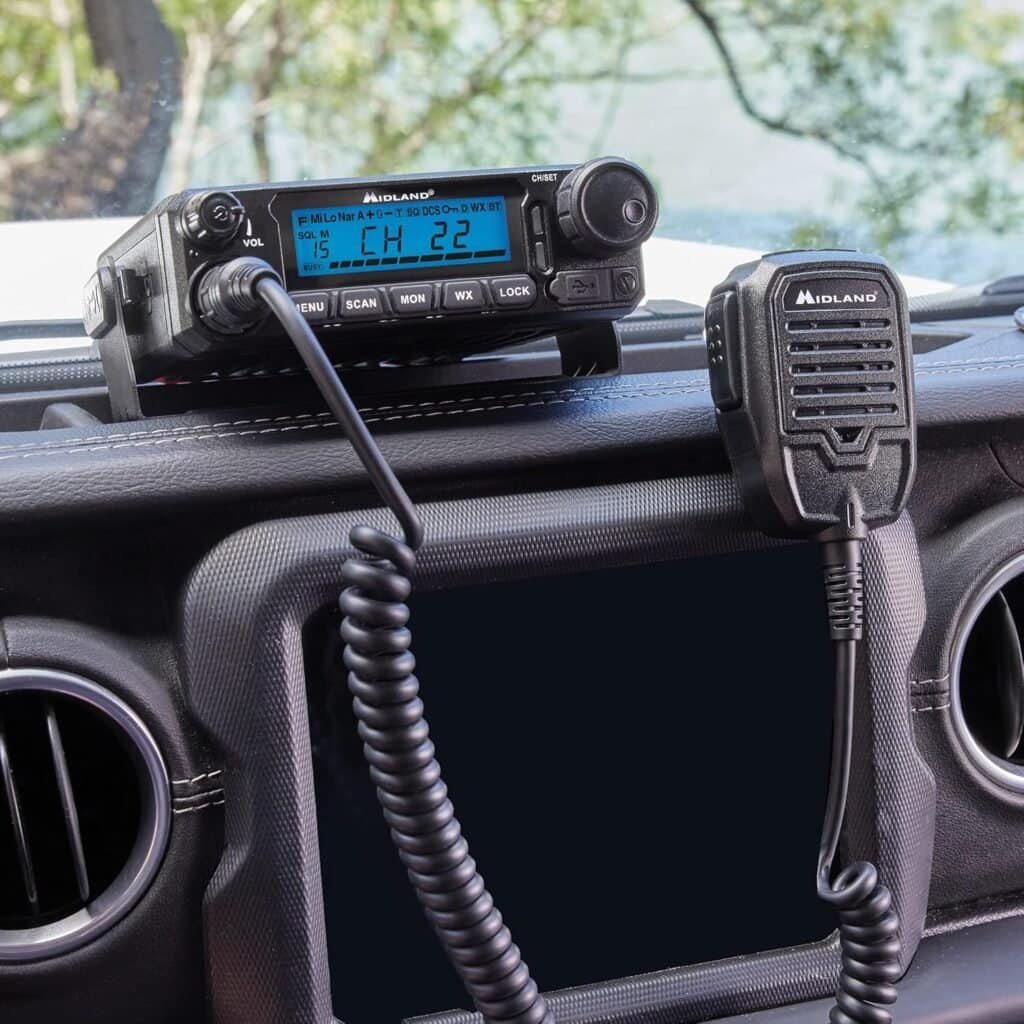
Why It Wins: Because power matters—and this beast pushes 50 watts, the legal GMRS maximum. If you want truck-to-truck or homestead-to-homestead communication that punches through hills and trees, this is one of the best GMRS radios you can mount in a vehicle.
Best For: Preppers, off-roaders, rural homeowners, convoy communication, emergency response teams.
Key Features:
✅ 50-watt output (maximum legal GMRS power) ✅ 142 privacy codes for channel security ✅ Repeater-capable for extended range ✅ NOAA weather channels with emergency alerts ✅ Large bright display (readable in direct sunlight) ✅ Ideal for vehicle mounting with included hardware ✅ External speaker compatible ✅ Dual-watch mode monitors two channels simultaneously
Technical Specifications:
- Channels: 15 GMRS + 8 repeater
- Power modes: 5W / 15W / 50W
- Operating temp: -22°F to 140°F
- Dimensions: 5.5″ × 5.5″ × 1.8″
- Weight: 1.9 lbs
What the specs mean in terrain:
At 50 W into a roof-mounted antenna this is the most power GMRS law allows, and antenna height matters more than the wattage does. Vehicle-to-vehicle over open terrain sits in the 10–20 mile band in the table above; hills cut that hard. The 8 repeater channels are where the real range lives — a well-sited GMRS repeater does more for you than another 35 watts ever will.
Adventure Wiser Take: If you want the radio that makes “No bars? No problem” a lifestyle, you buy this. Among the best GMRS radios for serious preparedness.
Price Range: $180–$220
✅ 2. Midland GXT1000VP4 — Best Handheld for Beginners
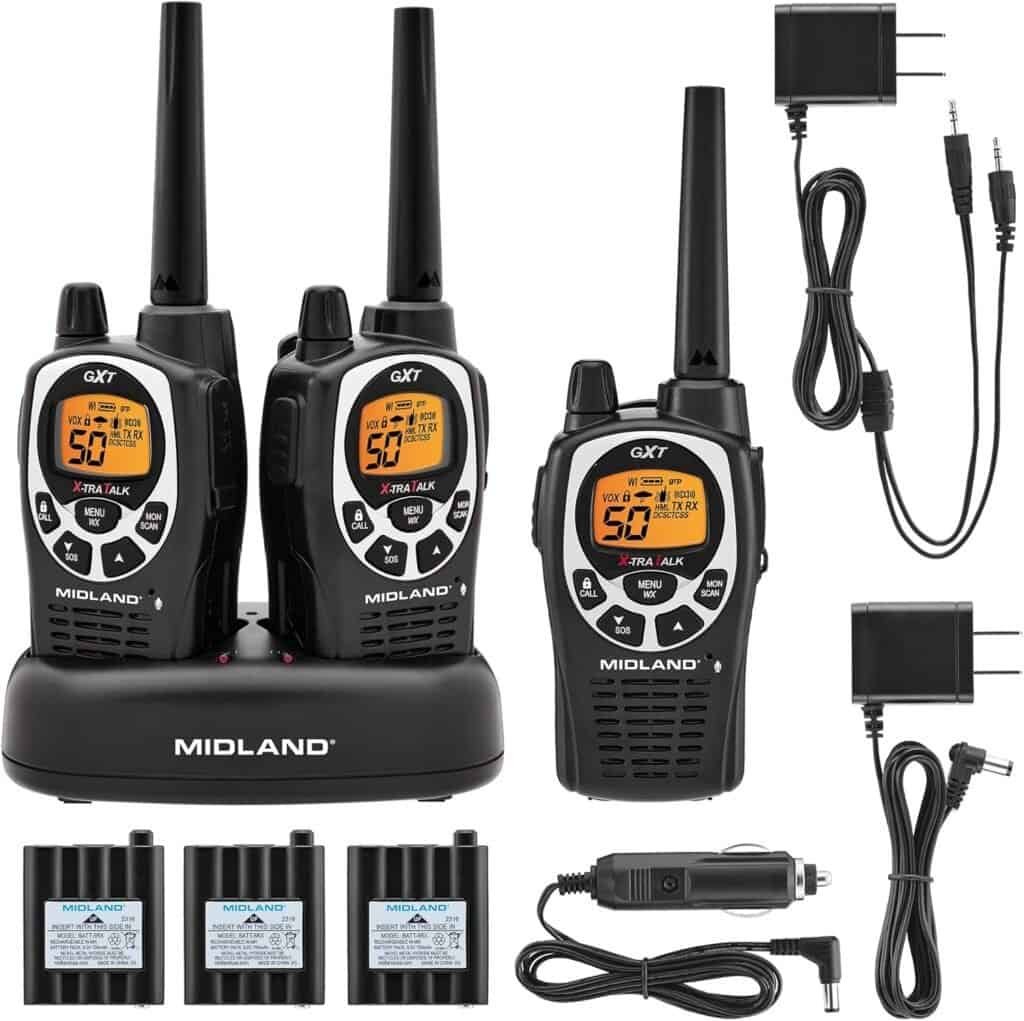
Why It Wins: This is the easiest, most reliable entry-level GMRS handheld on the market. When people ask me for the best GMRS radios to start with, this is always my first recommendation for families, emergency kits, and anyone who wants to start simple.
Best For: Storm kits, camping, general emergencies, family communication, bug-out bags.
Key Features:
✅ 5 watts (max handheld GMRS power) ✅ JIS4 waterproof rating (splash and rain resistant) ✅ 36-mile advertised range (2-4 miles real-world) ✅ Dual charging options (desktop charger + micro-USB) ✅ 142 privacy codes ✅ NOAA weather scan with alerts ✅ VOX hands-free operation ✅ Vibrate mode for silent alerts
Battery Performance:
- Alkaline: 8–10 hours
- Rechargeable NiMH: 10–12 hours
- Battery level indicator: Yes
What Comes in the Box:
- (4) GXT1000VP4 radios
- (4) Belt clips
- (4) Rechargeable battery packs
- (1) Desktop charger
- (1) AC adapter
- (4) Earpiece/mic combos
- Owner’s manual
What the specs mean in terrain:
The box says 36 miles. In forest, a 5 W handheld on a fixed antenna is a 0.5–1.5 mile radio, and no amount of packaging changes the physics. What you are actually buying here is four radios, four battery packs and a charger in one box — the convenience, not the range.
Adventure Wiser Take: It’s the “don’t overthink it” radio. Straightforward, durable, dependable. Consistently ranks among the best GMRS radios for new users.
Price Range: $120–$150 (4-pack)
✅ 3. Wouxun KG-935G — Best Handheld for Serious Users
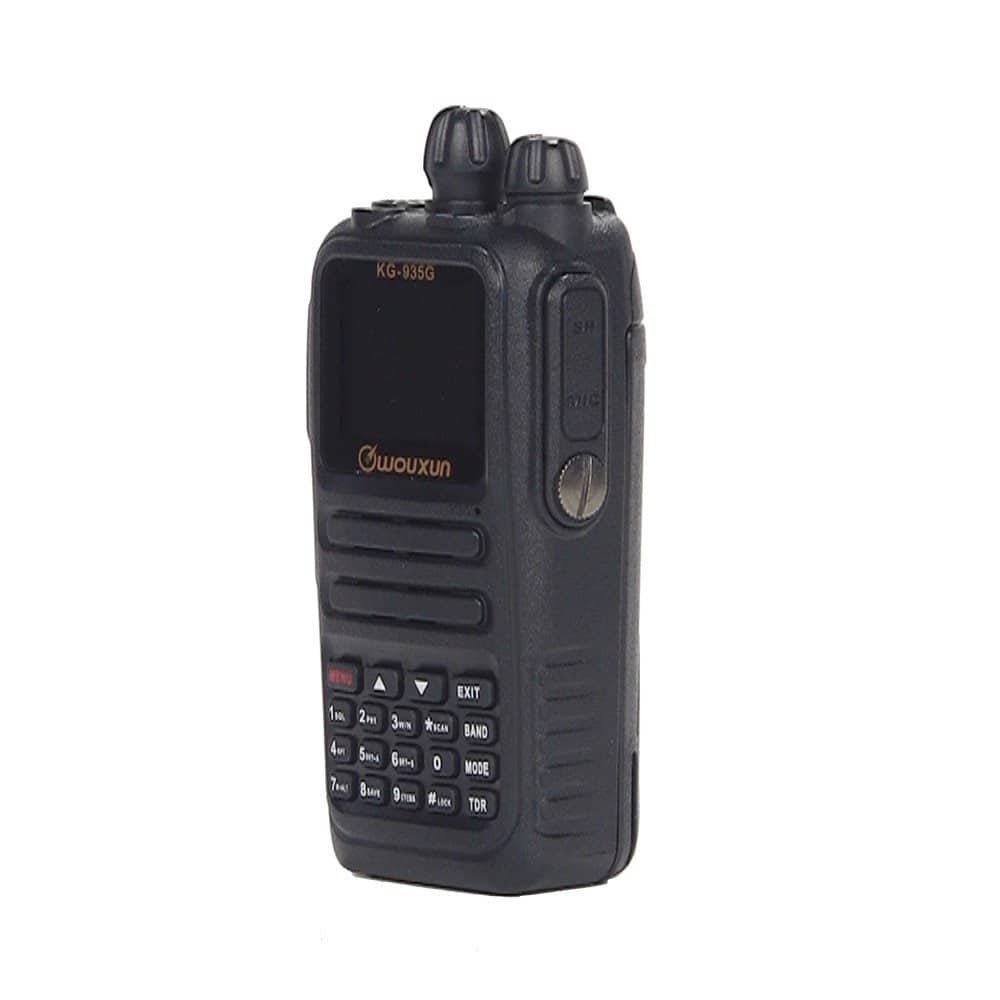
Why It Wins: This is the prepper favorite among the best GMRS radios. Rugged, clear audio, great battery life, and one of the most customizable GMRS handhelds on the market. If you’re serious about emergency communications, this radio deserves your attention.
Best For: Preppers, radio enthusiasts, hikers who want reliability, community emergency response teams.
Key Features:
✅ Full-color display with intuitive menu system ✅ High/low power modes (5W / 1W for battery conservation) ✅ Solid battery endurance (2200mAh Li-ion) ✅ Repeater-capable with tone programming ✅ Exceptional audio quality with noise reduction ✅ Programmable via PC with free software ✅ Type-C USB charging ✅ IP55 dust and water resistance ✅ Emergency alert function
Advanced Features:
- Dual-band display (monitor two channels)
- Scan function with priority channel
- CTCSS/DCS tone squelch
- Wide/narrow bandwidth selection
- Battery saver mode
- Time-out timer
- Busy channel lockout
Technical Specifications:
- Frequency range: 462–467 MHz (GMRS)
- Channel capacity: 999 memory channels
- Operating temp: -22°F to 140°F
- Dimensions: 4.5″ × 2.3″ × 1.4″
- Weight: 9.5 oz (with battery)
What the specs mean in terrain:
The 2200 mAh pack and the 5 W / 1 W power switch are the specs that decide a long day — running low power for close-in traffic is what stretches a charge, not the battery size on its own. Repeater tone programming goes through the PC software rather than the keypad, which is the right call on a radio carrying 999 memory channels.
Adventure Wiser Take: If the GXT1000 is a Toyota Tacoma, the Wouxun KG-935G is a fully upgraded 4Runner with armor and a winch. Easily one of the best GMRS radios for users who want professional-grade performance.
Price Range: $90–$110
✅ 4. Baofeng GM-15 Pro — Best Budget GMRS Radio
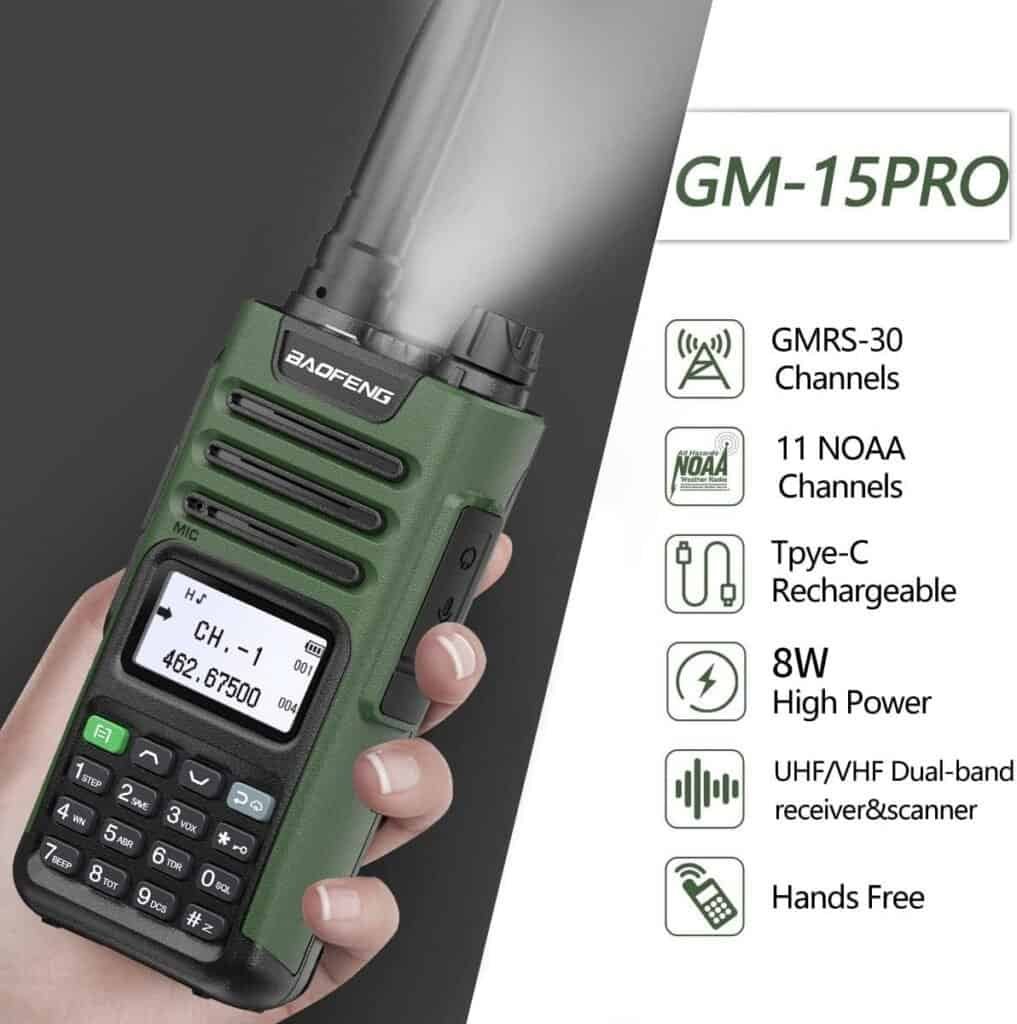
Why It Wins: Because it’s cheap, functional, and perfect for gloveboxes, backup bags, and “extras for the group.” When you need multiple best GMRS radios on a budget, this is your answer.
Best For: Budget builds, backup radios, loaner gear, getting started without big investment.
Key Features:
✅ FCC-certified for legal GMRS use ✅ Repeater capable with CTCSS/DCS tones ✅ USB-C charging (modern convenience) ✅ Lightweight at 7.4 oz ✅ 1800mAh battery (6-8 hours typical use) ✅ VOX hands-free ✅ Emergency alarm ✅ Flashlight built-in
What You Get:
- GM-15 Pro radio
- 1800mAh Li-ion battery
- USB-C cable
- Belt clip
- Wrist strap
- User manual
Limitations to Know:
❌ Display is basic (not full-color) ❌ Programming requires PC software for advanced features ❌ Build quality is functional but not premium ❌ Audio quality is good but not exceptional
What the specs mean in terrain:
At this price the question is not whether it is the best radio, it is whether a spare in the glovebox beats no radio at all. It is FCC-certified for GMRS, it is repeater-capable, and it charges over USB-C. The 1800 mAh pack is the compromise you are accepting.
Adventure Wiser Take: Is it the best? No. Is it the best value among best GMRS radios for the price? Absolutely. Perfect for equipping a whole family or group without breaking the bank.
Price Range: $35–$50
✅ 5. Midland MXT115 — Best Vehicle Radio for Everyday Users
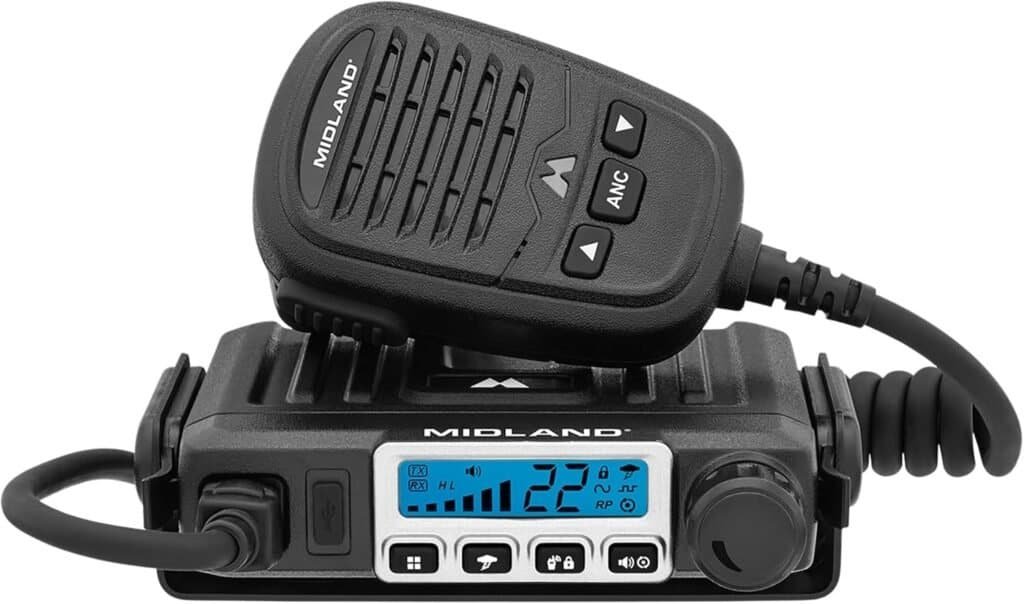
Why It Wins: Compact, clean audio, great for overland rigs or storm-country trucks. A prepper staple that consistently ranks among the best GMRS radios for practical daily use.
Best For: Convoys, farm work, everyday driving in rural areas, homestead communication, backup emergency comms.
Key Features:
✅ 15-watt output (good balance of power and efficiency) ✅ Repeater support with programmable tones ✅ Weather alerts with NOAA channels ✅ Compact design fits easily in vehicle ✅ Affordable without sacrificing quality ✅ External speaker jack ✅ Magnetic antenna mount included ✅ Easy installation with all hardware
Technical Specifications:
- Channels: 15 GMRS + 8 repeater
- Power output: 15W
- Display: Backlit LCD
- Dimensions: 4.5″ × 4.5″ × 1.5″
- Weight: 1.3 lbs
- Operating voltage: 13.8V DC
Installation & Mounting:
The MXT115 includes everything needed for quick vehicle installation. According to Midland’s installation guide, average installation time is 30–45 minutes for users with basic tools.
What the specs mean in terrain:
15 W is the sensible middle. You give up top-end range against the MXT500 and get back a smaller footprint, lower current draw, and a magnetic mount that goes on and comes off without drilling anything.
Adventure Wiser Take: If the MXT500 is “full send,” the MXT115 is “smart and simple.” One of the best GMRS radios for people who want reliable vehicle communication without the maximum power price tag.
Price Range: $90–$120
Best GMRS Radios Comparison Chart
| Radio Model | Type | Max Power | Repeater Capable | Price Range | Best Use Case |
|---|---|---|---|---|---|
| Midland MXT500 | Mobile | 50W | ✅ | $180–$220 | Preppers, convoys, maximum range |
| Midland GXT1000VP4 | Handheld | 5W | ❌ | $120–$150 | General emergencies, families |
| Wouxun KG-935G | Handheld | 5W | ✅ | $90–$110 | Preppers, serious users, hiking |
| Baofeng GM-15 Pro | Handheld | 5W | ✅ | $35–$50 | Budget, backups, group equipping |
| Midland MXT115 | Mobile | 15W | ✅ | $90–$120 | Everyday truck use, farm work |
How to Choose the Right GMRS Radio (Simple Guide)
Selecting from the best GMRS radios depends on your specific use case and communication needs.
Pick Handheld if You Want:
✅ Camping/hiking communication ✅ Family emergencies ✅ Grab-and-go reliability ✅ Lightweight gear ✅ Portability between locations ✅ Budget-friendly options
Recommended: Wouxun KG-935G (serious use) or Midland GXT1000VP4 (beginners)
Pick Mobile (Vehicle-Mounted) if You Want:
✅ Maximum range ✅ Emergency response setups ✅ Rural, wooded, or mountainous terrain ✅ Convoy communication ✅ Permanent installation ✅ Higher power output
Recommended: Midland MXT500 (maximum power) or MXT115 (balanced performance)
Pick a Repeater-Capable Radio if You Want:
✅ Multi-mile range from one town to the next ✅ Homestead-to-homestead communication ✅ Rural emergency preparedness ✅ Extended coverage in difficult terrain ✅ Connection to existing repeater networks
Recommended: Midland MXT500, Wouxun KG-935G, or Baofeng GM-15 Pro
To find repeaters in your area, check MyGMRS.com for a comprehensive repeater directory.
GMRS Radio Accessories That Matter
Even the best GMRS radios benefit from quality accessories:
Essential Accessories:
Better Antennas
- Mobile: High-gain 5dBi or 6dBi antennas ($30–$60)
- Handheld: Upgraded whip antennas ($15–$25)
- Range improvement: 20–40%
Power Solutions
- Vehicle-to-handheld charging cables ($10–$15)
- Solar-compatible power banks ($40–$80)
- Extra rechargeable batteries ($15–$30)
Audio Equipment
- Surveillance-style earpieces ($12–$25)
- Speaker microphones for vehicle use ($25–$50)
- Throat mics for high-noise environments ($30–$60)
Protection & Carry
- Hard cases for transport ($20–$40)
- Radio chest harnesses ($25–$50)
- Weatherproof bags ($15–$30)
GMRS Radio FAQs
Do I need a GMRS license?
Yes. A $35 FCC GMRS license is required, good for 10 years, and covers your entire family. No test required. Apply online through the FCC’s Universal Licensing System (ULS).
License covers:
- You and your immediate family members
- Spouses, children, grandchildren, parents, grandparents, siblings
- Step-family members in your household
How far do GMRS radios reach?
Real-world range expectations:
Handhelds (5W): 0.5–3 miles typical
- Open terrain: 2–5 miles
- Urban: 0.5–2 miles
- Forested: 0.5–1.5 miles
Mobiles (15-50W): 5–15+ miles typical
- Open terrain: 10–20 miles
- Urban: 3–8 miles
- Mountainous: 5–12 miles
With Repeaters: 25–50+ miles (terrain and repeater placement dependent)
According to FCC GMRS regulations, range varies significantly based on terrain, antenna height, and interference.
Can GMRS talk to FRS?
Yes—GMRS and FRS share channels 1–22, so the best GMRS radios can communicate with basic FRS walkie-talkies. Just match the channel numbers.
Important note: GMRS will always outperform FRS due to higher power output and better antenna systems.
Are GMRS radios good for emergencies?
Absolutely. The best GMRS radios work when phones don’t. GMRS is one of the top emergency communication tools for preppers, according to FEMA’s emergency communication guidelines.
Emergency advantages:
- No cellular infrastructure required
- Works off-grid indefinitely with solar charging
- Instant communication (no dialing, no apps)
- Weather alert capability
- Family-wide coverage with single license
- Repeater access extends range dramatically
What’s the difference between GMRS and HAM radio?
| Feature | GMRS | HAM (Amateur Radio) |
|---|---|---|
| License difficulty | Simple ($35, no test) | Complex (requires exam) |
| Range | Local to regional | Local to worldwide |
| Learning curve | Low | High |
| Equipment cost | $35–$220 | $100–$5,000+ |
| Business use | No | No |
| Family sharing | Yes (one license) | No (individual licenses) |
| Encryption allowed | No | No |
The best GMRS radios offer the ideal balance for most preppers: legal, effective, and simple to operate without extensive training.
Can I use GMRS radios for business?
No. GMRS is strictly for personal use. For business communication, you’ll need commercial radio licenses. However, volunteer emergency response and community safety organizations can use GMRS under the family license structure.
What channels should I avoid?
Channels 1–7 are shared with FRS radios and tend to be crowded. Channels 15–22 are GMRS-only and typically have less traffic. Always monitor before transmitting, and use privacy codes to reduce interference.
GMRS Operating Tips for Maximum Performance
Even the best GMRS radios require proper operating technique:
Range Optimization:
✅ Get height – Elevation dramatically improves range ✅ Line of sight matters – Direct visual path is ideal ✅ Upgrade antennas – Better antennas = better performance ✅ Use repeaters – Extend range by 5-10x ✅ Battery matters – Low batteries reduce power output
Communication Protocol:
- Monitor before transmitting (make sure channel is clear)
- Keep transmissions brief and clear
- Use tactical brevity codes in emergencies
- Program privacy codes to reduce interference
- Establish communication schedules during extended operations
Battery Management:
- Carry spare batteries for extended operations
- Lower power mode for nearby communication conserves battery
- Turn off when not in use (obvious but often forgotten)
- Test batteries regularly (replace annually for emergency kits)
Final Thoughts: Which GMRS Radio Should You Buy?
Here’s the short version for the best GMRS radios by use case:
For Maximum Range & Power: → Midland MXT500 ($180–$220)
For Beginners & Families: → Midland GXT1000VP4 ($120–$150 for 4-pack)
For Serious Preppers: → Wouxun KG-935G ($90–$110)
For Budget Builds: → Baofeng GM-15 Pro ($35–$50)
For Everyday Vehicle Use: → Midland MXT115 ($90–$120)
The best GMRS radios aren’t determined by specifications alone—they’re proven in real-world conditions when communication actually matters. Whether you’re coordinating a convoy through mountain passes, keeping tabs on family during a hurricane, or maintaining contact during a backcountry hunt, these radios have earned their reputation through performance, not marketing.
When cell towers fail, satellite phones are out of budget, and HAM radio feels like overkill, GMRS fills the gap perfectly. Simple enough for anyone to use, powerful enough to trust in emergencies, and legal enough to operate without worry.
Start with one. Build your network. Test your range. Practice your protocols.
When things go sideways, you’ll be glad you did.
How this list was built: This is a specification and compliance roundup, not a field test. Every wattage, IP rating and repeater figure here comes from the manufacturer’s published spec or the FCC certification, and the range numbers are what the physics allows rather than what the box claims. Some links are sponsored or affiliate links; if you buy through one, I may earn a small commission. Where I have had a radio in hand, I say so — and on this list, I have not.
Before you compare handsets, it is worth being clear about what any of them will actually reach and which licence you need — the service comparison is here.