

The honest answer on GMRS range: the box says 36 miles, the hills say otherwise, and your antenna matters more than your watts.
Every GMRS box makes the same promise. Thirty miles. Thirty-five. Sometimes “up to 50,” in small print, on a radio that fits in your shirt pocket.
Then you key up from one end of a hollow to the other and get static.
Nobody lied, exactly. Those numbers come from mountaintop-to-mountaintop conditions you’ll never stand in. Real range is set by three things, in this order: how high your antenna is, how good it is, and what’s between you and the other radio. Power comes fourth.
A note before we start: I haven’t field-tested GMRS yet, so this guide is Researched. It’s built on FCC rules, radio physics and owner reports. What I do know first-hand is terrain. Anyone who’s walked the Ouachitas knows how fast a ridge swallows a signal.
What Is GMRS Range, Really?
GMRS (General Mobile Radio Service) is UHF radio around 462 and 467 MHz. UHF travels roughly in line of sight. It bends a little over the horizon and bounces off things, but it does not go through hills.
So range isn’t a property of the radio. It’s a property of the path between two antennas. That’s why one radio can reach 20 miles from a ridge and half a mile in town.
Reasons to Know How Far Your Radio Really Reaches
- Your family plan depends on it. If your rally plan assumes you can reach home from work by radio, test that before you need it.
- Buying more watts is the most common waste. Doubling power gains less than most people think.
- The cheapest upgrades are the ones nobody mentions. Height and coax are cheap compared with a new radio.
- Repeaters change the whole picture. A good repeater turns a 1-mile handheld into a 15-mile one.
Step-by-Step Instructions to Get More GMRS Range
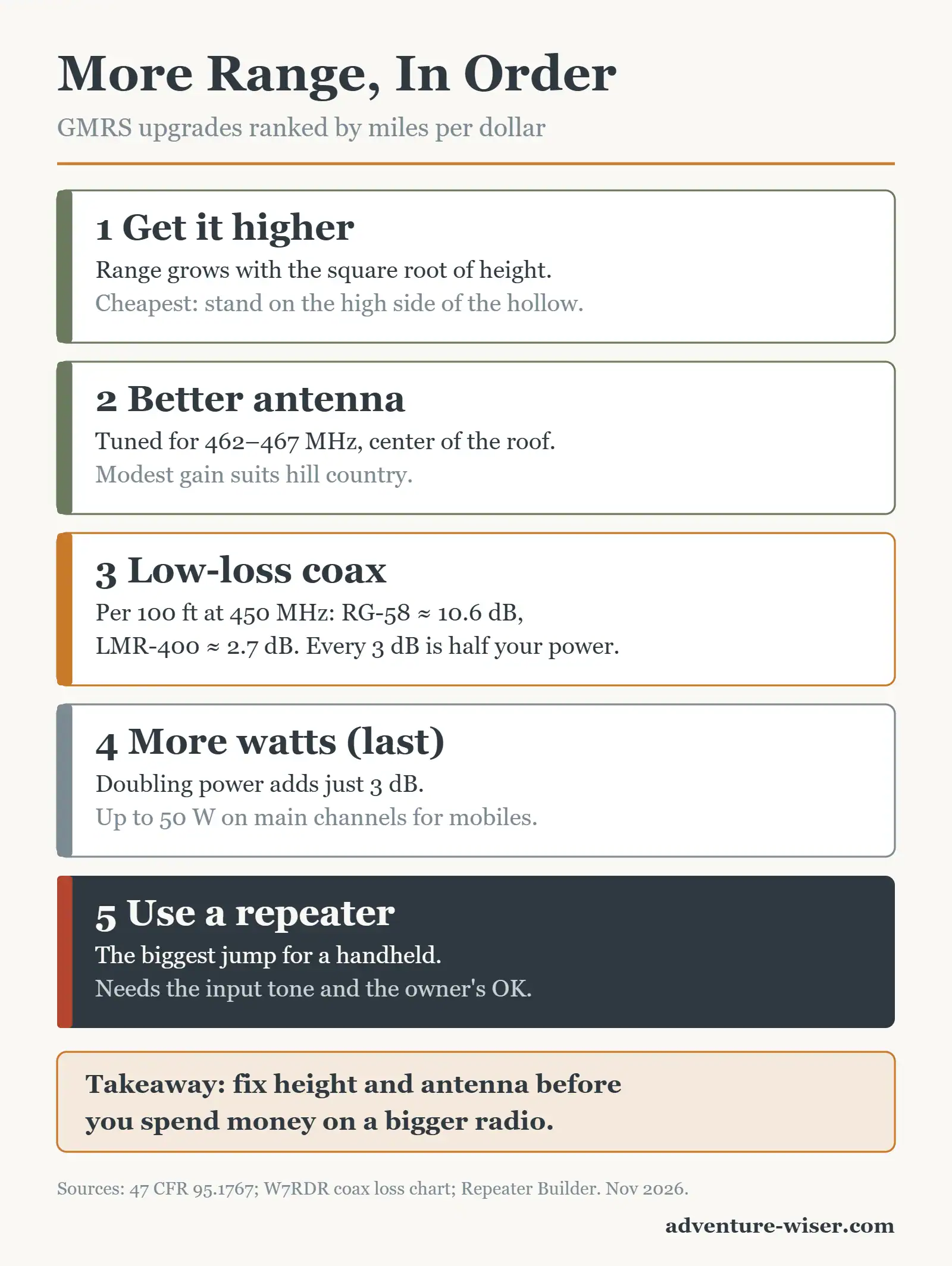
Work through these in order. They’re ranked by miles gained per dollar, not by what the box advertises.
- Do the horizon math first
- Get the antenna higher
- Use a better antenna
- Fix the coax before buying watts
- Then, and only then, add power
- Use a repeater
- Test it on purpose
Step 1: Do the Horizon Math First
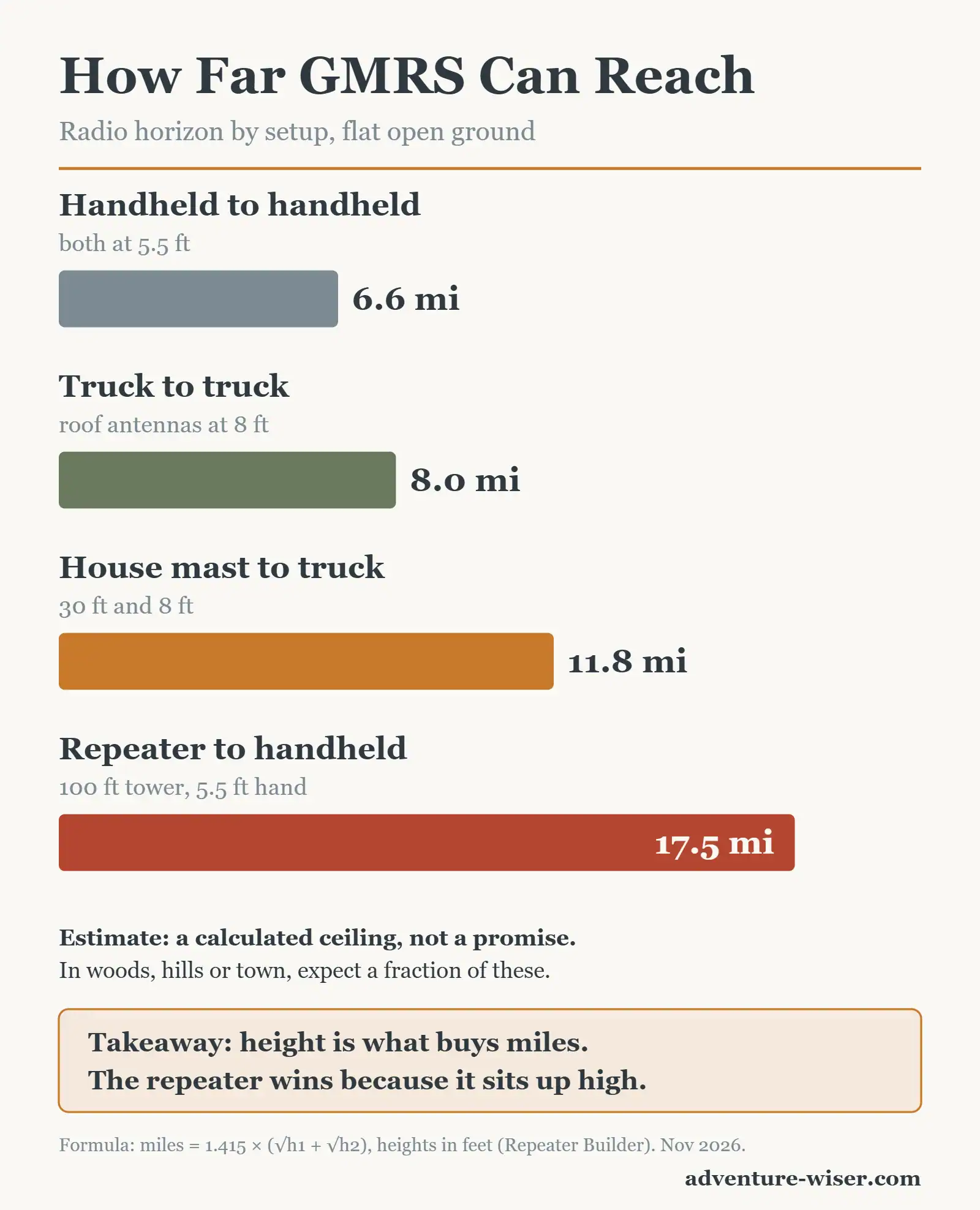
Before spending a dime, find your theoretical ceiling. The radio horizon formula from Repeater Builder is:
Miles = 1.415 × (√height 1 + √height 2), with each antenna height in feet.
Two people holding handhelds at about 5.5 feet get a horizon of roughly 6.6 miles. That’s on perfectly flat, open ground with nothing in the way. In woods, hills or town, real range is a fraction of that.
Put one antenna on a 100-foot tower and the other on a truck roof at 8 feet, and the horizon jumps to about 18 miles.
That gap is the whole lesson. Height wins.
Step 2: Get the Antenna Higher
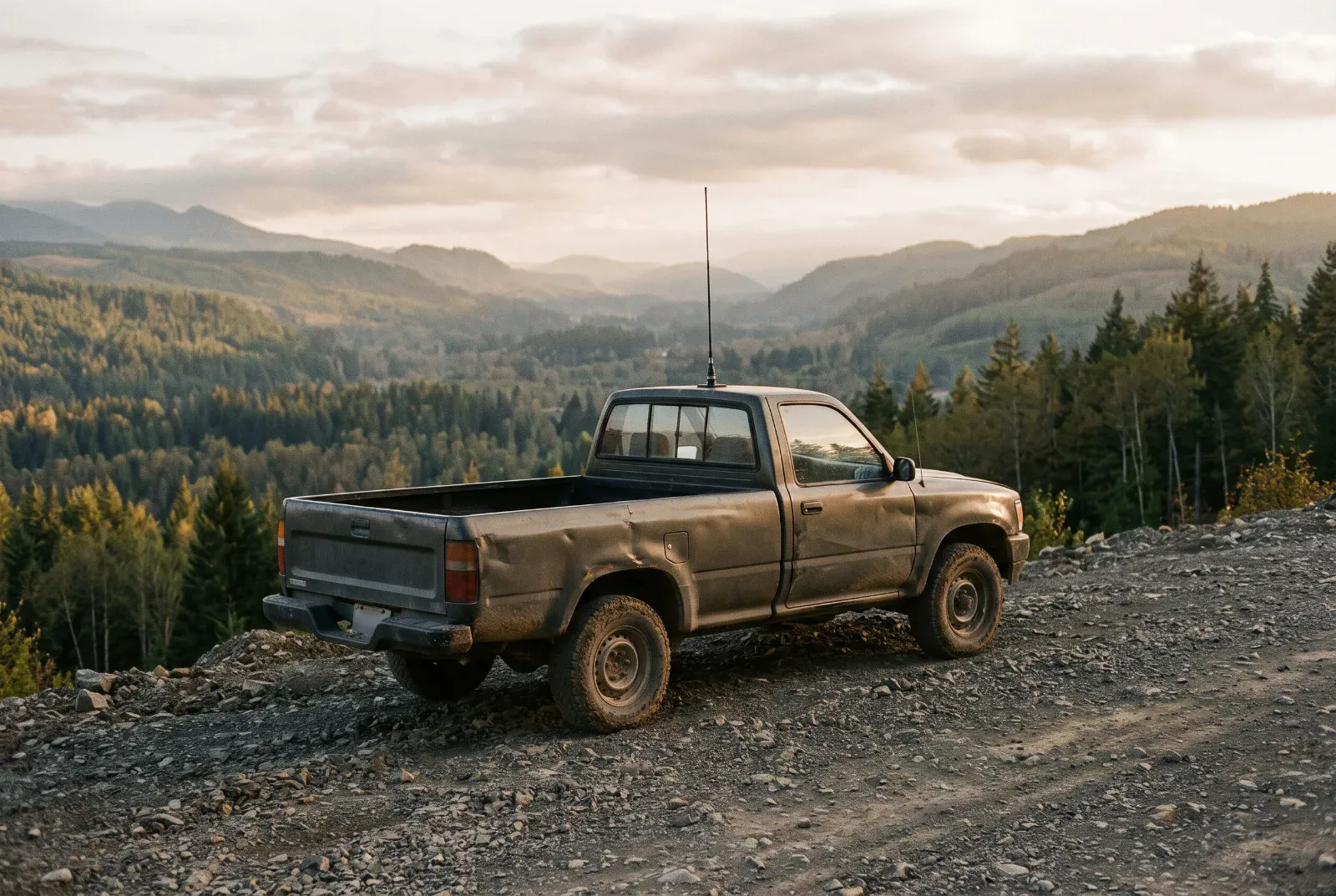
Because range grows with the square root of height, the first few feet are worth the most. Raising an antenna from 5 feet to 25 feet more than doubles your side of the radio horizon.
Ways to get height:
- Stand on high ground. The cheapest upgrade there is.
- Mount a mobile antenna in the center of the truck roof, not on a bumper.
- Put a base antenna on the house, a mast, or a tall tree.
The old GMRS “20 feet above the structure” rule is gone. Today the FCC points GMRS antennas to the general Part 95 height rules: extra requirements kick in above 200 feet, or above 20 feet if you’re on or near an airport. For a house mast, that’s rarely a problem.
Step 3: Use a Better Antenna
The stubby antenna on a cheap handheld is a compromise. On radios with a detachable antenna, a longer whip often helps more than any setting.
For a vehicle or base, an antenna tuned for GMRS (around 462–467 MHz) with modest gain is the sweet spot. High-gain antennas flatten the signal toward the horizon. That’s great on flat ground and worse in steep hill country, where you sometimes need signal going up or down.
Mount it with a proper ground plane. A magnet mount on a metal roof works far better than one stuck to a fiberglass cap.
Step 4: Fix the Coax Before Buying Watts
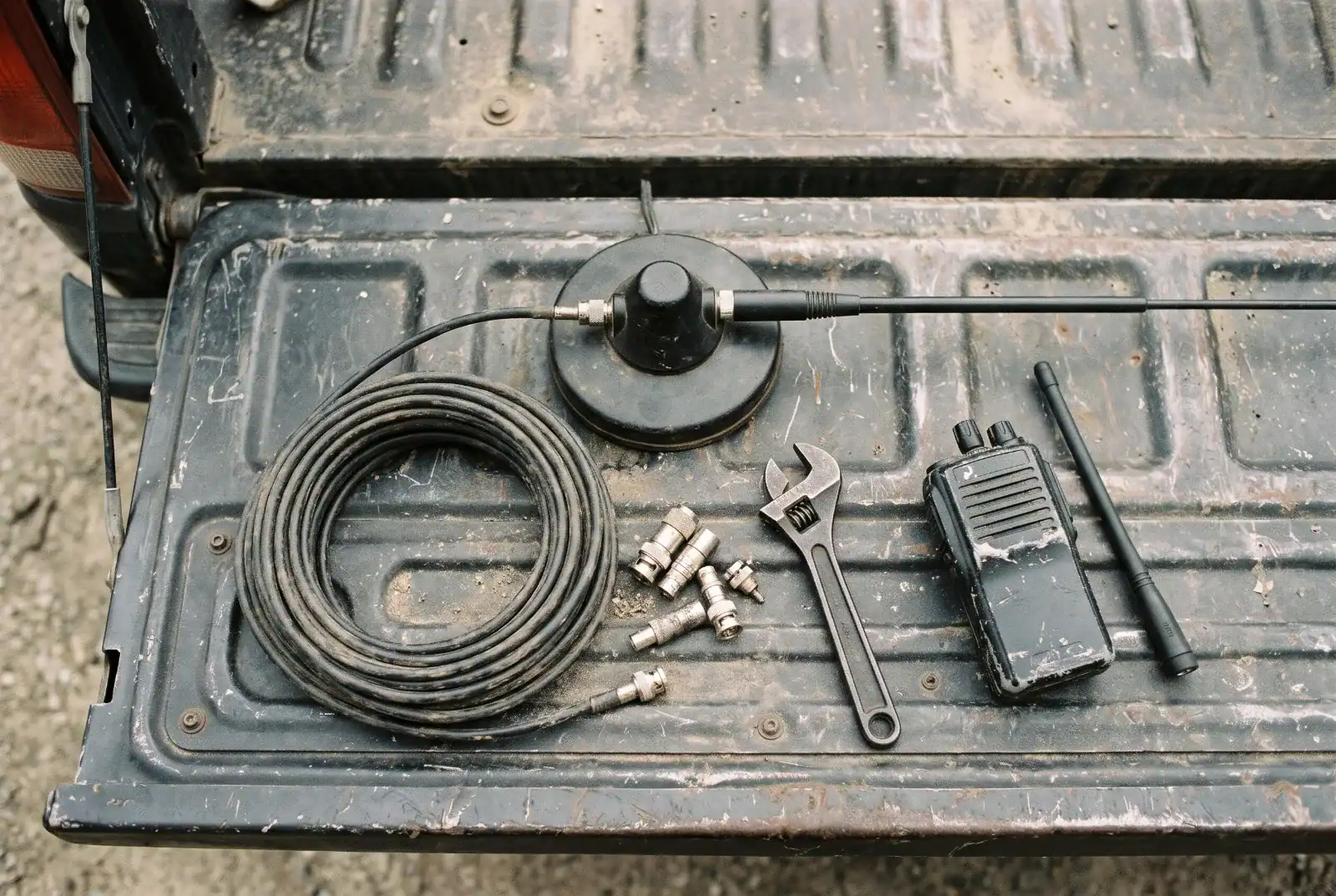
Coax quietly eats signal. At GMRS frequencies, thin RG-58 loses about 10.6 dB per 100 feet, while LMR-400 loses about 2.7 dB.
Every 3 dB lost is half your power. On a 50-foot run up a house mast, cheap coax can throw away more than half your signal before it reaches the antenna. Short runs in a truck matter less, but good connectors still do.
Step 5: Then, and Only Then, Add Power
Power helps, but less than you’d think. Doubling watts adds 3 dB. It’s a real gain, but it won’t double your range.
The FCC sets the ceilings in 47 CFR 95.1767: up to 50 watts output for mobile, base and repeater stations on the main channels, 5 watts ERP on the 462 MHz interstitial channels, and 0.5 watt ERP on the 467 MHz interstitials.
A 50-watt mobile like the ones in our GMRS radio roundup earns its keep when the antenna and height are already right. Bolted to a bad setup, it’s just a bigger radio with the same range.
Step 6: Use a Repeater
A repeater is a radio on a tall tower that listens on one frequency and retransmits on another. Because its antenna is high, it can hear your handheld from miles away and repeat you to everyone else.
This is the single biggest range upgrade for handhelds. You’ll need the repeater’s input tone and permission from its owner. Our GMRS programming walk-through covers offsets and tones, and the GMRS frequency chart shows which channels repeaters use.
Step 7: Test It on Purpose
Don’t trust a number from a box or from this post. Test your actual path.
Pick the places you’d really need to talk between: home and work, home and the family’s rally point, two vehicles in a convoy. Try each on a calm day. Write down what worked. That list is worth more than any spec.
Key Considerations Before You Count on the Miles
Terrain beats everything. A ridge between you and the other radio can cut range to almost nothing. In hill country, getting onto the high side of a hollow can matter more than any upgrade.
Your radio has to be legal for GMRS. Under FCC equipment rules, GMRS transmitters must be certified for GMRS, and radios that can also transmit on amateur bands can’t get that certification. I own a Baofeng UV-5R, and it’s a great example: handy for listening, but it isn’t a certified GMRS radio, so it’s not the one to transmit on GMRS with.
You need the license. GMRS requires an FCC license. It covers your immediate family and doesn’t require a test.
Taking It to the Next Level: Building a Family Radio Plan
Range only matters if everyone knows the plan. Pick channels, set check-in times, and decide who calls whom when cell service drops. Here’s how to build a family communication plan that works without signal.
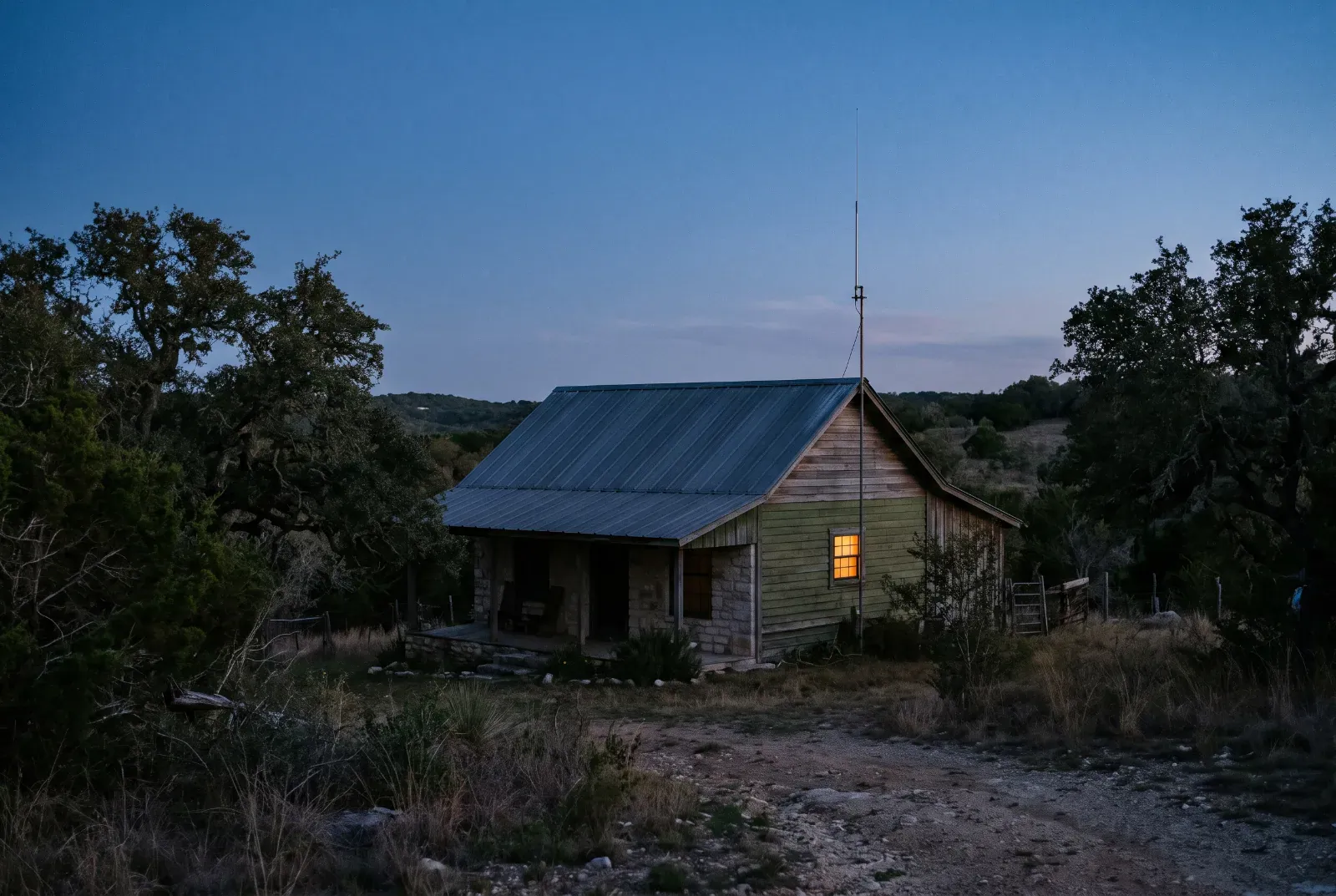
Alternatives When GMRS Can’t Reach Far Enough
- Ham radio reaches much farther with the right band and antenna, but requires a test. See the best ham radios for preppers.
- Meshtastic passes short text messages node to node across a mesh, no license needed. Here’s how to set up a Meshtastic node.
- A satellite messenger works almost anywhere with a view of the sky, at a monthly cost.
For a wider look at what works when the grid is down, see which radios actually matter when the grid goes down.
Frequently Asked Questions
What is the real GMRS range for handheld radios?
Often 1 to 2 miles in woods or town, and several miles across open ground or water. The 30-mile claims assume ideal hilltop conditions.
How far can a 50-watt GMRS mobile radio reach?
Several miles to radio-to-radio, more with a good roof antenna and high ground. Through a repeater, 20 miles or more is possible.
Does a better GMRS antenna add distance?
Yes. A better antenna mounted higher usually adds more range than adding power.
Does GMRS reach farther than FRS?
Yes. GMRS allows much more power on most channels, detachable antennas, and repeaters. FRS radios are limited to low power and fixed antennas.
Can I use a Baofeng on GMRS?
Radios that also transmit on amateur bands can’t be certified for GMRS, so they’re not legal for GMRS transmitting.
How do I get more distance without a new radio?
Get the antenna higher, upgrade the antenna, use low-loss coax, and use a local repeater.
Wrapping Up: My Experience With GMRS Range
I haven’t field-tested GMRS yet, and I’d rather tell you that than invent a story about it. What I know from the woods is that terrain decides who can hear you. A radio is no different.
So here’s the order that actually buys you GMRS range: height, antenna, coax, then power, then a repeater.
This weekend, pick the two places your family would most need to talk between, and test that exact path. Then grab the free preparedness checklist and add the result to your plan.
Gear on Adventure Wiser is labeled for what it is — Tested, Owned, or Researched. Here’s how that works.
