

Choosing backcountry communications is mostly a question of who you need to reach, and almost everyone answers it by buying the wrong thing first.
The blister pack says thirty-five miles. You bought two, handed one to your hunting partner, watched him walk over the first ridge, and discovered they stop working at about a mile and a half.
That’s not a defective radio. That’s physics working exactly as designed, and it’s the single most common disappointment in this entire category. The fix isn’t a more powerful radio. It’s understanding what each service can actually do before you spend money.
What Backcountry Communications Actually Covers
Backcountry comms is any way of reaching another person when cell service isn’t there — which, in the Ouachitas and most other places worth walking, is most of the time.
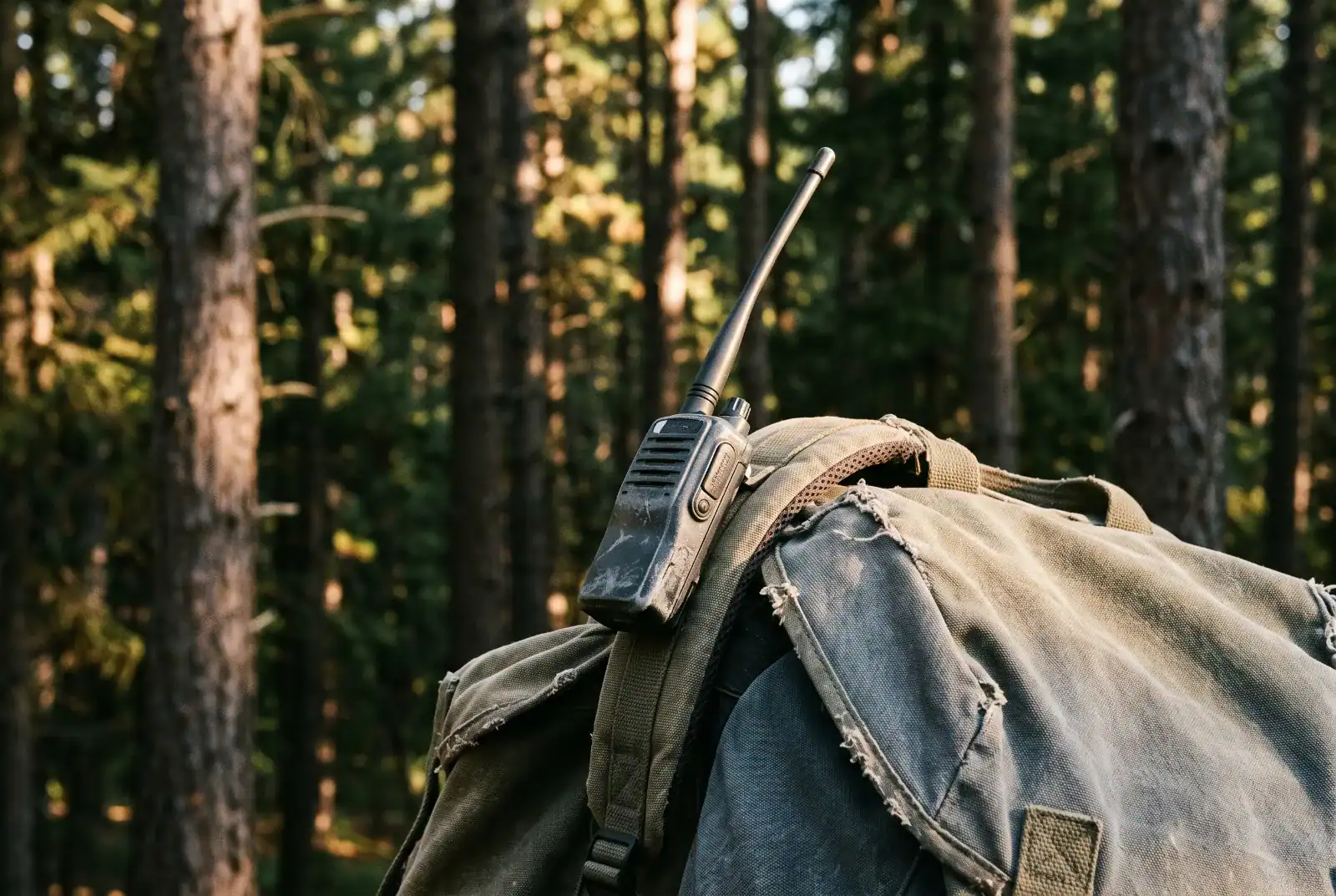
There are four real options for civilians, and they are not interchangeable. Two need no licence and are limited by law. One needs a cheap licence and no exam. One needs a test. And separately there’s satellite, which is the only category that reaches somebody who isn’t already carrying your kind of radio.
That last distinction is the one that matters most, and we’ll come back to it.
Reasons You Need to Know This
- Range claims on packaging are calculated mountaintop to mountaintop. Your money buys a number you will never see.
- Buying unlicensed to stay legal usually means buying underpowered. FRS is capped by regulation, not by product tier.
- The licence that covers your whole family costs $35 and has no exam — and most people don’t know it exists.
- Radios only reach people carrying the same radios. If your plan is “call for help,” a radio is the wrong tool.
Step-by-Step: Choosing a Backcountry Comms Setup
Five steps. The first one eliminates most of the confusion.
- Decide who you’re reaching — your group, or the outside world
- Pick the service — the licence question, settled
- Set a realistic range expectation — then plan around it
- Build a comms plan — the part gear cannot replace
- Test it on real terrain — not in the driveway
Step 1: Decide Who You Are Actually Reaching
Two completely different problems live under one heading.
Reaching your own group — the other truck, the person on the far side of the draw, the family at camp. Radios solve this well, and cheaply.
Reaching the outside world — search and rescue, a spouse two hundred miles away, an ambulance. Radios solve this badly or not at all, unless somebody happens to be listening on your frequency. This is satellite territory: a messenger, or the satellite SOS built into recent phones.
Almost everyone who is disappointed by radios bought them to solve the second problem. Answer this question first and the rest gets easy.
Step 2: Pick the Service
For a family or a hunting party, GMRS is nearly always the answer. Thirty-five dollars, ten years, no exam, and under FCC rule 95.1705 one licence covers your spouse, children, parents, grandparents, siblings, aunts, uncles, nieces, nephews and in-laws. That’s the whole point of it. Handhelds run up to 5 W, mobile and base units up to 50 W, and you get repeater access and detachable antennas, which FRS does not allow.
FRS is what’s actually inside almost every bubble-pack walkie-talkie. No licence, 2 W on most channels and 0.5 W on channels 8 through 14, fixed antennas only. Fine for keeping track of kids at a campground. Not fine for ridgelines.
Ham gives you dramatically more capability and requires passing a Technician exam. The catch for families is that it licenses one individual — there’s no household coverage, so everyone who transmits needs their own. Worth it if you’re genuinely interested in radio. Overkill if you just want to talk to the other truck. Our ham radio picks for preppers covers the hardware end.
One correction worth making because it’s everywhere: the GMRS fee is $35, not $70. It dropped in April 2022. Any page still quoting the old figure hasn’t been updated since.
Step 3: Set a Range Expectation You Can Actually Plan Around
Here is the number that ends the argument: at handheld height, the curve of the earth alone limits line of sight to roughly 3.6 miles. Everything advertised beyond that assumes you are standing somewhere you are not.
In practice, plan on one to three miles in forest and hills. Less in town. More over water. A repeater changes everything — 25 to 50 miles inside its coverage — but that depends entirely on somebody else’s tower existing, working, and being within reach.
Two things that genuinely improve range, in order: height, then antenna. Moving up a hundred feet does more than moving from 5 W to 50 W. A better antenna does more than more power. Power is the third lever and it’s the weakest one.
Step 4: Build a Comms Plan
This is the step that costs nothing and gets skipped by everyone.
A radio without a plan is two people transmitting at different times on different channels, hearing nothing, and each assuming the other’s radio failed. Write down four things before you leave:
- Primary and backup channel, agreed and written on paper, not remembered
- Scheduled check-in times — top of the hour, radios off in between to save battery
- What to do on no contact — how long you wait, then what
- A rally point everyone can find without a map
Scheduled check-ins matter more than people expect. Leaving radios on all day flattens batteries by afternoon, which is exactly when something goes wrong. Agreeing to key up at the top of each hour costs nothing and doubles your usable runtime.
If your plan involves reading a location aloud over a bad connection, the format matters. MGRS versus lat/long is worth ten minutes for exactly this reason — the compact format is far easier to read and copy correctly under stress than the one your phone shows by default.
Step 5: Test It on Real Terrain
Driveway tests prove nothing. Two radios three feet apart will always work.
Take them where you’ll actually use them. Walk one over the ridge you’re worried about and find out where contact breaks. Do it once, and you’ll know your real range on your ground — which is worth more than every spec sheet in this category.
Check battery life honestly too. Most handhelds are rated on a duty cycle far gentler than real use, and cold weather makes it worse.
Key Considerations For Comms That Work When It Matters
Mesh is a different animal, and worth understanding. Meshtastic and MeshCore use cheap LoRa radios to pass short text messages between nodes, hopping through each other to extend reach. It’s genuinely clever and genuinely limited: text only, slow, and it needs other nodes to be useful. Setting up a first node costs about $25, and the honest comparison of the two networks will stop you buying the wrong hardware.
Satellite is the only thing that reaches strangers. A messenger, or the satellite SOS in recent iPhones and Pixels, will summon help when no radio can. If your actual fear is a broken leg five miles in, that’s the category to spend money on — not a bigger handheld.
A weather radio is not a two-way radio and everyone should own one anyway. NOAA broadcasts don’t care whether the grid is up. The crank radio roundup covers the ones worth having.
Your licence record is public. GMRS call signs are searchable in the FCC database along with the address you registered. If that bothers you, use a P.O. box when you create your FRN. Changing it later is free.
Taking It Further: Repeaters
A repeater sits high, listens on one frequency and rebroadcasts on another, turning a three-mile handheld into something that covers a county.
Most are club-owned and many welcome GMRS licence holders, sometimes for a small membership. Find the ones covering your area before you need them, program them in, and — this is the part people skip — actually key up and confirm you can hit them. A repeater you’ve never tested is a line on a map.
Alternatives to Carrying a Radio at All
A satellite messenger if the real worry is summoning help. It does the one job radios cannot.
Your phone, used properly. Downloaded offline maps and a charged battery cover more scenarios than people admit, and recent handsets do satellite SOS without any subscription. Worth reading what happens when the phone dies anyway.
A written trip plan left with somebody. Free, weighs nothing, and it is the single most effective piece of backcountry safety equipment in existence. If you tell a reliable person where you’re going and when you’ll be back, someone starts looking on the right day, in the right drainage. No radio does that.
Frequently Asked Questions
Do I need a licence for backcountry radios?
Not for FRS or MURS. GMRS requires an FCC licence — $35, ten years, no exam, and it covers your entire immediate family under one call sign. Amateur radio requires passing a Technician exam and licenses one individual only.
How far do handheld radios really reach?
One to three miles in forest and hills, a quarter to three quarters of a mile in a town, and ten to twenty miles only across open water or flat desert with clear line of sight. The curve of the earth caps handheld line of sight at about 3.6 miles regardless of power.
Is GMRS better than ham radio?
For a family, usually yes — because one $35 licence covers the whole household with no exam. Ham offers far more capability and far more frequencies, but licenses individuals, so everyone who transmits needs to pass their own test.
Will a radio let me call for help?
Only if somebody is listening on your frequency, which in the backcountry is unlikely. For reaching emergency services, a satellite messenger or satellite SOS on a recent phone is the right tool.
Does more power mean more range?
Barely. Height and antenna quality both matter more. Going from 5 W to 50 W mostly improves clarity at the edge of the range you already had — it does not push signal through a ridge.
What about mesh networks like Meshtastic?
Useful for short text between people who both have nodes, and cheap to try. It will not reach anyone outside the mesh and it will not get you into your bank or summon an ambulance. Treat it as a supplement, not a plan.
Wrapping Up: What I’d Do First
Buy the GMRS licence before you buy a radio.
It’s thirty-five dollars, takes about fifteen minutes on the FCC’s site, needs no exam, and it covers everyone in your household for a decade. Doing it first means you shop for radios you can legally use at full power, instead of buying bubble-pack FRS units and then finding out the good ones were licensed all along.
Then pick a channel, write it on something that isn’t a phone, and walk one radio over the nearest ridge to find out what you actually own.
If you want the rest of the kit on the same footing, the free 30-Day Preparedness Plan works through it a day at a time.
Adventure Wiser tests gear in the field before it goes on the site. If it doesn’t hold up on the trail, it doesn’t make the cut.