

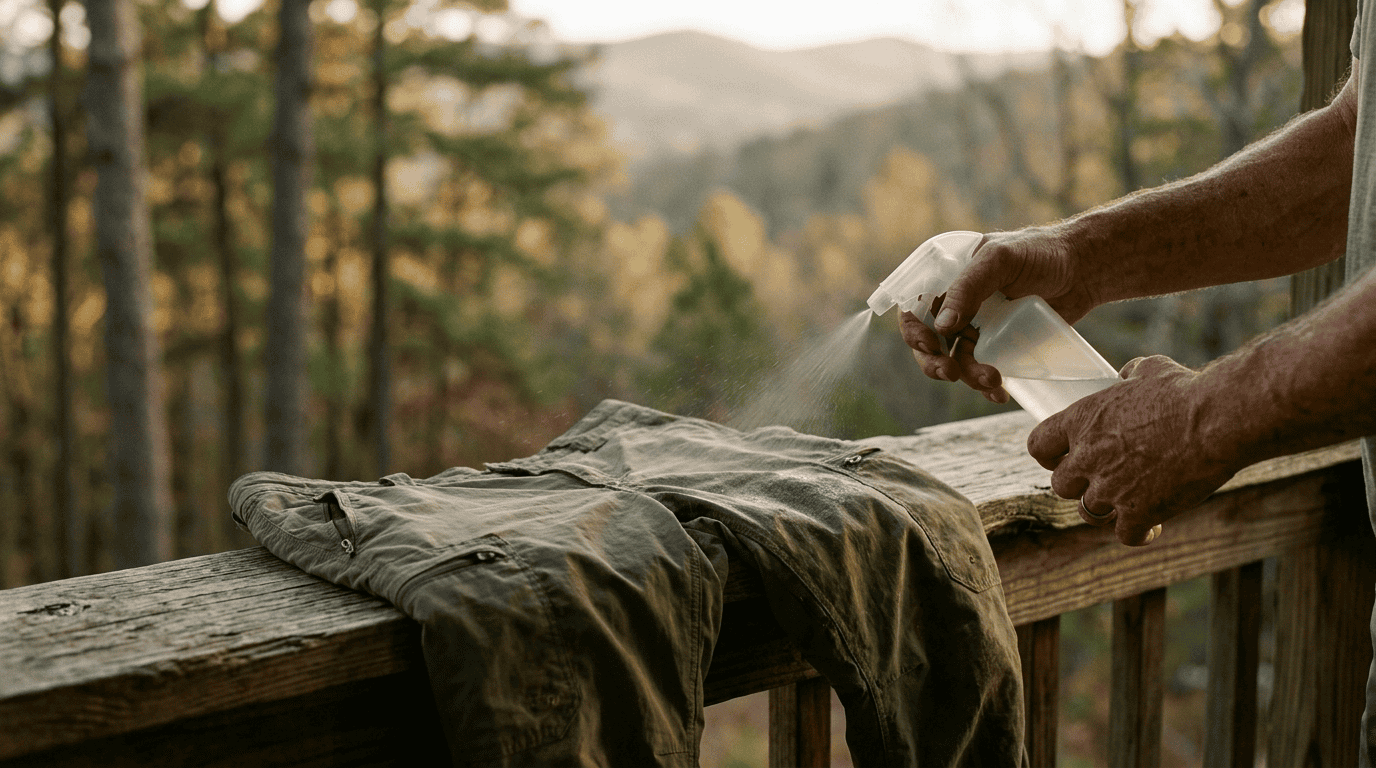

A bottle of clear liquid promises six weeks of tick protection. Arkansas humidity has other plans.
You’ve seen the tick. You didn’t feel it land. That’s the whole problem with ticks — they’re not loud, they’re not fast, and by the time you spot one working its way up your sock, it’s already been riding along for an hour. Sawyer permethrin spray for clothes is the answer most serious hikers land on eventually, and it’s the one product on this site that’s gone through more seasons of real use here than almost anything else we cover — just never gotten its own post. That changes today.
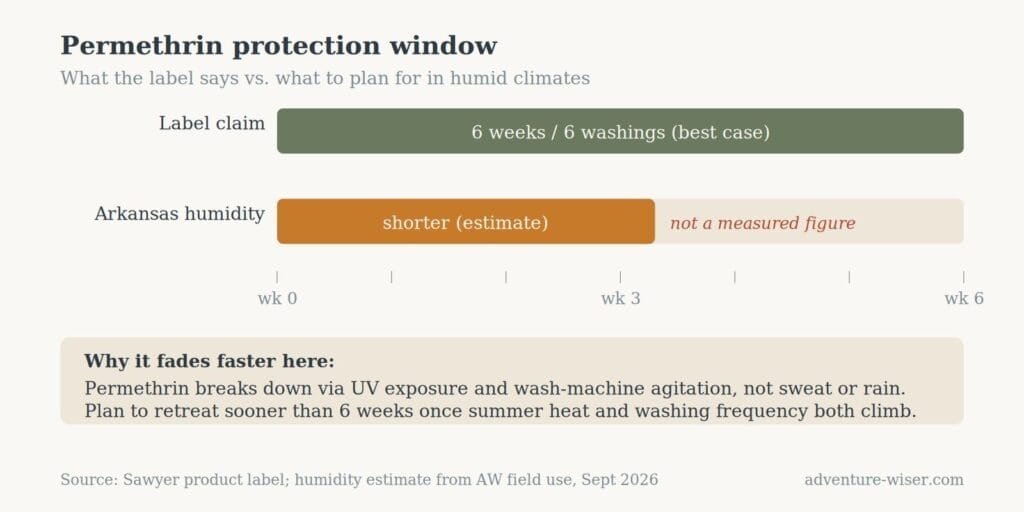
Quick take: Sawyer’s Premium Permethrin (SP657, 24 oz trigger spray) treats clothing, packs, and tents with a compound that kills ticks and mosquitoes on contact rather than just repelling them. It’s about $18–19, treats roughly five outfits per bottle, and the label claims six weeks or six washings, whichever comes first. In Ouachita humidity, plan on the shorter end of that — this review explains why, and what to actually do about it. This post follows how we label Tested, Owned, and Researched gear — the short version below.
Affiliate disclosure: this post contains affiliate links. If you buy through one, we may earn a commission at no extra cost to you.
What Is Sawyer Permethrin Spray?
Permethrin is a synthetic version of a compound that naturally occurs in chrysanthemum flowers. It’s not a skin repellent like DEET or picaridin — it’s a contact insecticide you apply to fabric, where it bonds to the fibers as it dries and keeps working through the fabric itself. Sawyer’s version comes premixed at 0.5% concentration in a trigger-spray bottle, registered with the EPA (registration number 50404-3-58188) for use on clothing, boots, tents, sleeping bags, and gear — never directly on skin. It’s the same active ingredient the CDC’s own field trials have tested against Lyme-carrying ticks.
Who Makes It?
Sawyer Products has been making field-use gear — mostly water filters and insect protection — since the 1970s, and it’s the same company behind the Sawyer Squeeze water filter we’ve covered elsewhere on this site. Sawyer’s own product education backs up the six-week / six-wash claim in plain language, not just fine print. That matters more than it sounds like it should: a company that’s stayed in one lane for fifty years and still sells parts for products from a decade ago is a company that expects you to keep using its gear, not replace it every season.
Top Benefits
- 1. Kills on contact rather than just repelling — ticks that touch treated fabric don’t survive long enough to bite.
- 2. Works on more than 55 species: ticks (including the ones carrying Lyme), mosquitoes, chiggers, mites, and spiders.
- 3. Bonds to fabric instead of skin, so there’s no reapplication every few hours like DEET.
- 4. One bottle stretches across a season if you’re only treating what you’re actively wearing.
The same “skip the tactical stuff, carry what you’ll actually use” logic behind a realistic everyday carry setup applies here — one bottle, used consistently, beats a drawer of gear that never leaves the house.
Best Features of Sawyer Permethrin Spray
It Bonds to the Fiber, Not the Surface
During the drying process the permethrin tightly bonds with the actual fibers of the fabric rather than just sitting on top of it. That’s the mechanical reason it survives sweat and rain in a way a surface spray wouldn’t — the compound is embedded in the weave, not floating on it. What breaks it down instead is UV exposure and the mechanical agitation of a washing machine. That distinction is the whole ballgame for how long it actually lasts, and it’s the part most product listings gloss over.
It Doesn’t Stain, and It’s Odorless Dry
Unlike a lot of DEET-based sprays, this won’t degrade synthetic fabrics, discolor gear, or leave a chemical smell once it’s dried. You can treat a pack, a tent, and three days of hiking clothes in one afternoon and not notice it later.
The Efficacy Data Is Real, Not Marketing CopyThe Efficacy Data Is Real, Not Marketing Copy
A University of Rhode Island study, published in the Journal of Medical Entomology, found that subjects wearing permethrin-treated sneakers and socks were 73.6 times less likely to have a tick bite than those in untreated footwear — treated shorts and shirts also cut bites, but by a far smaller margin. That’s not a Sawyer marketing number — it’s an independent peer-reviewed study, and it’s the reason most permethrin coverage focuses so heavily on lower-body treatment even though the spray works on any fabric. It’s a natural companion to proper footwear and water-resistant layers on the broader survival items checklist — that list calls out insect protection as a seasonal priority and never names what to actually use.
Sawyer Permethrin Spray for Clothes: Pricing
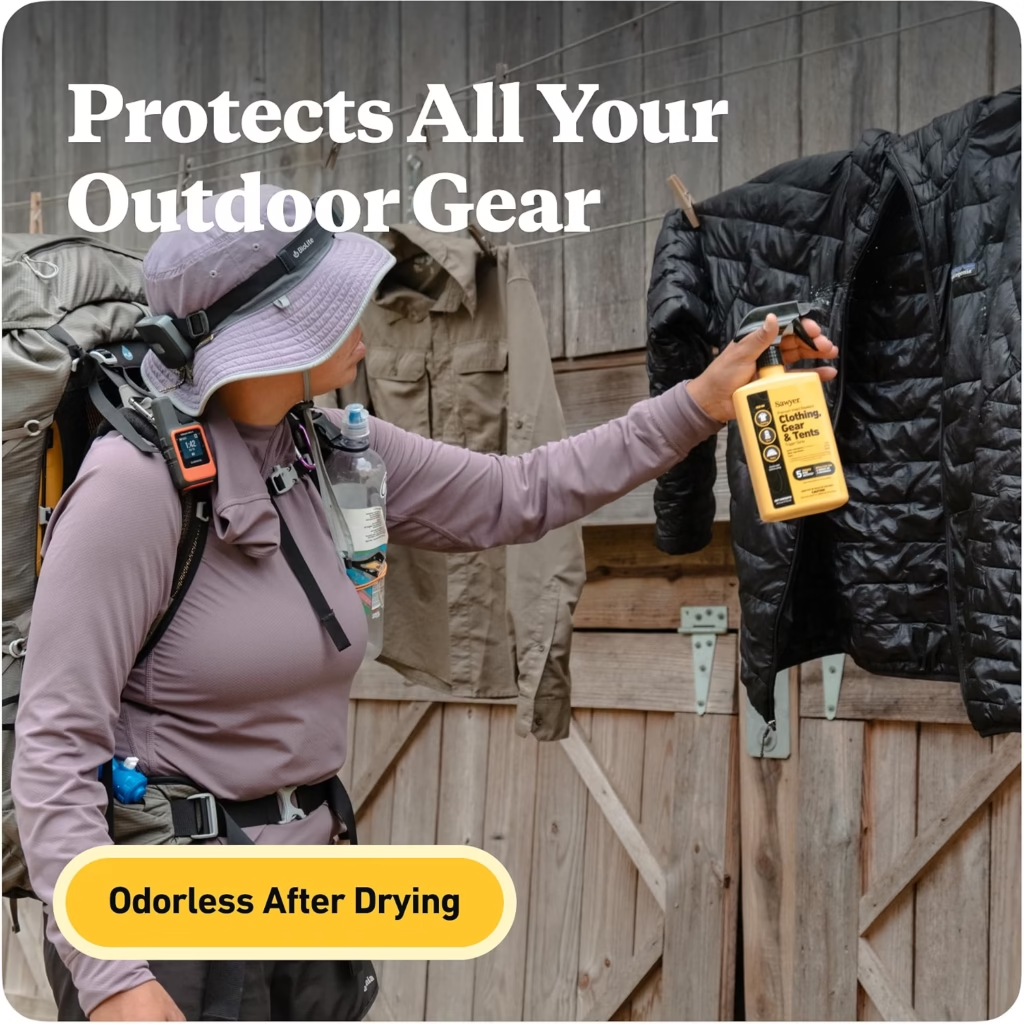
As of September 2026, the 24 oz trigger spray (SP657) runs $18–19 at most retailers, treating roughly five outfits at the EPA-recommended rate of 4.5 oz per outfit (shirt, pants, socks). A 6-pack of single-application 4.5 oz bottles (SP645) runs slightly higher per-ounce but is worth it if you’d rather treat one outfit at a time without measuring. There’s no subscription, no proprietary refill, and no battery — the only recurring cost is buying another bottle when you run out, which for one person treating a rotating set of field clothes is roughly once or twice a season.
Sawyer Permethrin Spray for Clothes: Pros and Cons
Pros
- Genuinely effective — this isn’t a product where the mechanism is in question, it’s backed by independent tick-bite-reduction data.
- Treats gear as well as clothing: packs, tents, and boots all take the spray the same way.
- No reapplication mid-hike the way skin repellents need.
- Cheap relative to what a single tick-borne illness costs in time, money, and misery.
Cons
- The “six weeks” on the label is a best-case number, not a promise — in high-humidity climates it holds up shorter, and Sawyer doesn’t say that anywhere on the packaging.
- Requires a dedicated treatment session (spray, hang, dry 2–4 hours) rather than a quick pre-hike spritz.
- Only works on fabric — you still need a skin-applied repellent for exposed hands, neck, and face.
- Aerosol version aside, the trigger spray takes a steady hand to get even coverage without soaking the fabric.
What Sawyer Permethrin Spray Is Not
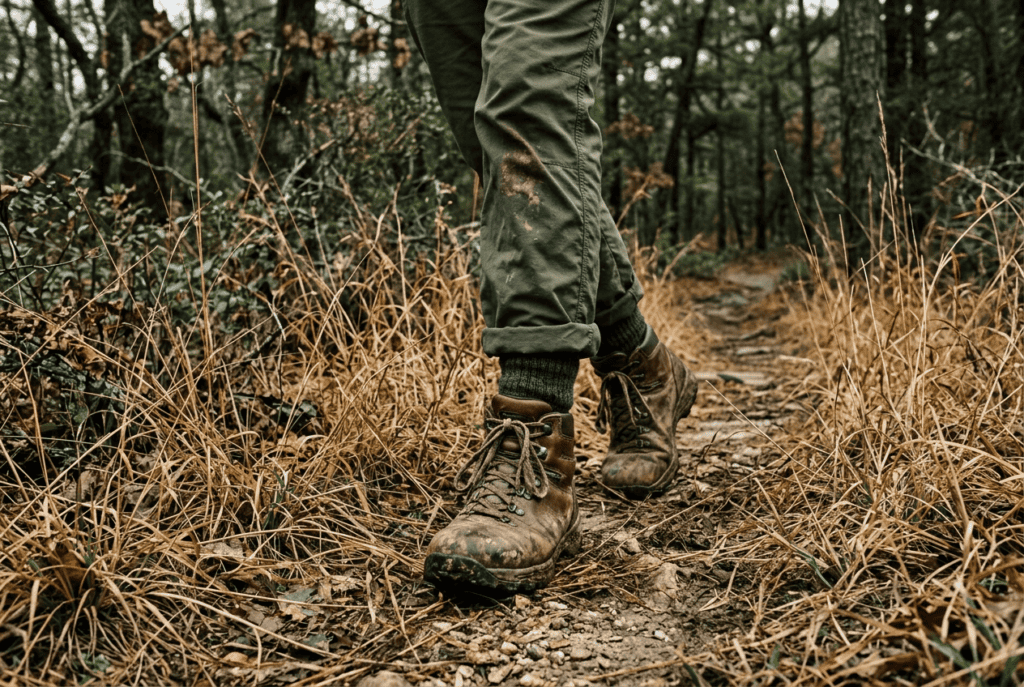
This is not a skin repellent, and it’s not a substitute for one. If you’re not layering a DEET or picaridin product on exposed skin, permethrin-treated clothing alone leaves gaps — wrists, neck, hairline. It’s also not a one-and-done seasonal treatment the way the six-week claim on the box might suggest to someone skimming it. And it’s not going to save a garment that’s already soaked through with sweat and mud before you treat it; permethrin bonds best to clean, dry fabric. If you’re stocking a parent’s everyday carry kit for trail days with kids, a travel-size bottle belongs in the bag next to the band-aids — it’s the same instinct, just aimed at bugs instead of scraped knees.
Sawyer Permethrin Spray Alternatives
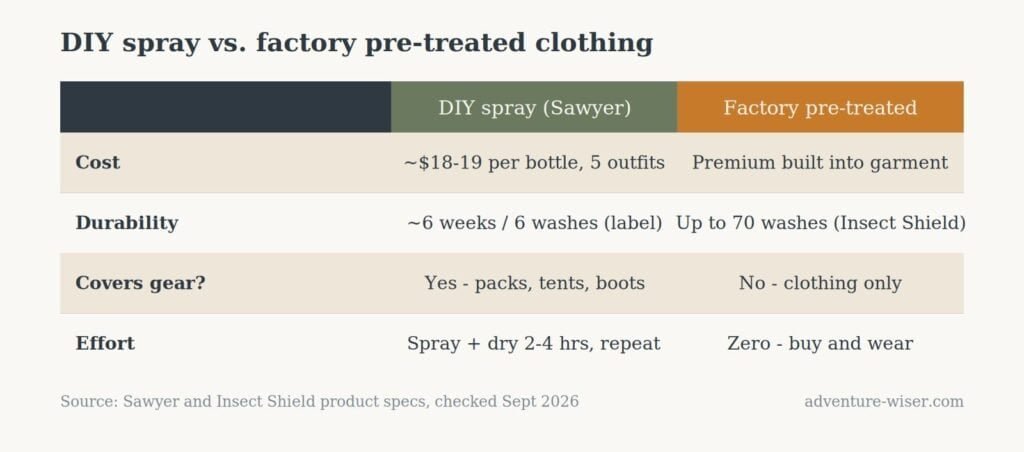
If you’d rather not deal with spraying and drying clothes yourself, factory-treated clothing is the other real option. Insect Shield licenses the same permethrin-bonding process to clothing manufacturers and guarantees it through 70 washes — well beyond what a DIY spray job holds up to. ExOfficio’s BugsAway line and Craghoppers’ NosiLife are the two most common retail versions of factory-treated permethrin apparel.
The tradeoff is straightforward: factory treatment lasts longer and needs zero effort, but you’re paying a premium built into the garment price and you’re limited to whatever’s actually made in that line. DIY spray treats gear you already own — including the pack, tent, and boots factory-treated clothing doesn’t touch — for a fraction of the cost, and it’s worth adding to the list before packing a bug-out bag, since treated gear doesn’t take up any extra space once it’s dry.
Sawyer Permethrin Spray in the Field: Three to Five Arkansas Seasons
My Experience Using Sawyer Permethrin Spray
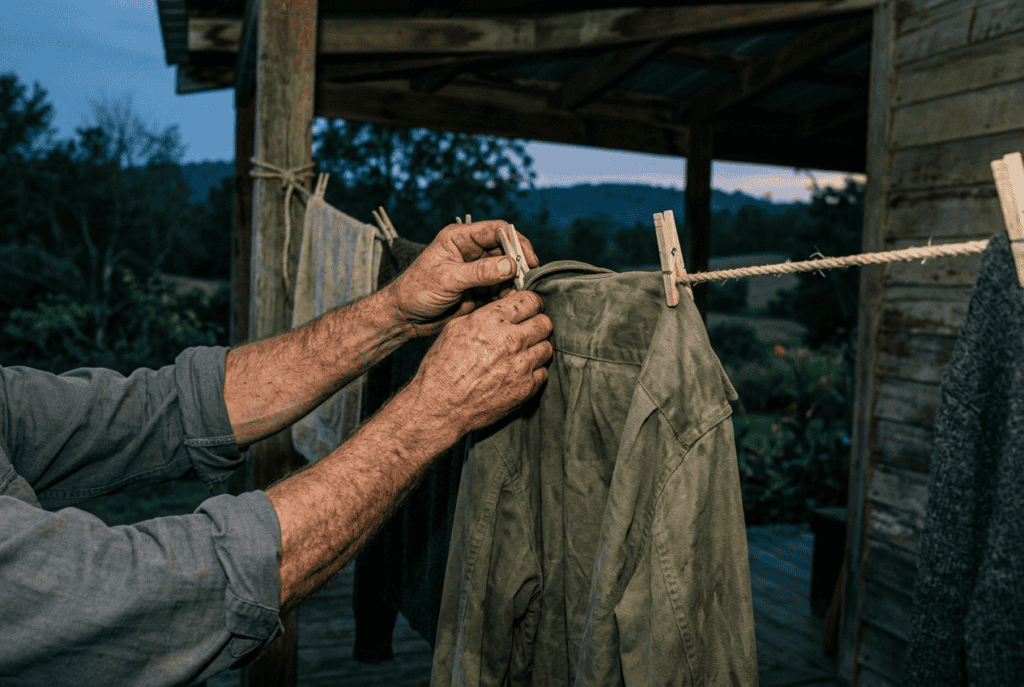
Tested. I’ve been treating clothes and gear with this — pack included, sometimes a tent — for three to five seasons now, mostly ahead of Ouachita trips where tick exposure is a given rather than a maybe. The tick-stopping part of the claim holds: it’s stopped ticks almost entirely in that time, which is the reason I keep buying it over anything else.
Where the label and reality diverge is the six-week number. In Arkansas summer humidity, the protection window runs noticeably shorter than that. I don’t have a lab number for you — Sawyer doesn’t publish a humidity-adjusted figure and I haven’t measured it precisely myself — but the practical result is that I don’t run on a fixed reapplication schedule.
I retreat when I notice something’s changed, which in practice usually means I’m getting bit through fabric I thought was still covered. It’s not a rigorous system. It works, but a reader who wants a hard number instead of “when I remember” should build in a buffer and treat more often than the box suggests, especially for anything worn in June through August.
The other honest note: I treat clothes and gear together, not just clothes. A pack that rides against your back all day is exactly the kind of surface a tick transfers onto before it ever reaches skin, and it doesn’t get the same wash-cycle degradation a shirt does — so in some ways gear treatment holds up longer than the clothing does. See the full camping gear guide for how this fits alongside the rest of a season’s kit.
Conclusion: Should You Buy Sawyer Permethrin Spray for Clothes?
Buy it if you’re spending real time in tick country and you’re currently relying on skin repellent alone. The independent efficacy data is strong, the price is low relative to the alternative, and it covers gear that factory-treated clothing never will. Skip the six-week label claim as a planning number — in humid climates, treat more often than that, especially through peak summer.
If you’d rather not manage reapplication at all, factory pre-treated clothing from Insect Shield, ExOfficio, or Craghoppers is the lower-effort alternative, just at a higher per-garment cost and with no coverage for packs or tents. Like the water filter we actually carry, this is a small, inexpensive item that earns its place through consistent use, not a spec sheet. Sawyer permethrin spray for clothes earns its place in the kit precisely because it treats what factory-treated apparel can’t.
Want the rest of a season’s kit dialed in the same honest way? Grab the free preparedness checklist.
Frequently Asked Questions
Is Sawyer permethrin spray for clothes safe to use? Yes, when used as directed on fabric rather than skin. It’s EPA-registered for clothing and gear treatment, and once it’s dried it’s odorless and doesn’t leach into skin the way a skin-applied repellent does. It should never be sprayed directly on skin.
How long does permethrin actually last on treated clothes? The label claims six weeks or six washings, whichever comes first. In humid climates that window tends to run shorter — plan to retreat more often through peak summer rather than trusting the full six weeks.
Can I use permethrin spray on my tent and backpack? Yes — it’s labeled for clothing, gear, boots, and tents. It bonds to synthetic and natural fabrics the same way regardless of what the item is.
Does permethrin spray kill ticks or just repel them? It kills on contact. That’s the core difference from DEET or picaridin, which only repel — permethrin-treated fabric is lethal to ticks and mosquitoes that land on it.
Do I still need a skin repellent if my clothes are treated? Yes. Permethrin only protects treated fabric — exposed skin (hands, neck, face) still needs a separate DEET or picaridin product.
Is the aerosol or trigger spray version better? Both apply the same compound at the same concentration. Trigger spray gives more control over even coverage; aerosol is faster for larger items like tents but easier to oversaturate a small area.
Adventure Wiser tests gear in the field before it goes on the site where we can, and labels clearly when we can’t. If it doesn’t hold up on the trail, it doesn’t make the cut.