

In a blackout, your phone flashlight is a battery drain with one free hand. A headlamp gives you two.
The best headlamp for power outages proves itself about ten minutes after the lights go out. You’re in the basement looking for the breaker panel, holding your phone in your teeth, and the phone is at 31% with no idea when it’ll charge again. Then you need to carry a candle, a kid and a flashlight up the stairs at the same time, and you discover you have only two hands.
A headlamp fixes that. It’s also the same light you’ll use at camp, in the truck, and every time something breaks after dark. So it’s worth buying the right one once.
I own a Petzl Actik Core, which is on this list. I haven’t put it through a real multi-day outage or field-tested it hard, so I’m labeling it Owned, not Tested. The others are researched.
The Petzl Actik Core is labeled Owned: I have one, but I haven’t field-tested it. The other headlamps are labeled Researched. Specs come from the manufacturers and retailers, and prices were checked at OpticsPlanet in November 2026.
This post contains affiliate links. If you buy through them, Adventure Wiser may earn a commission at no extra cost to you.
What Are the Best Headlamps for Power Outages?
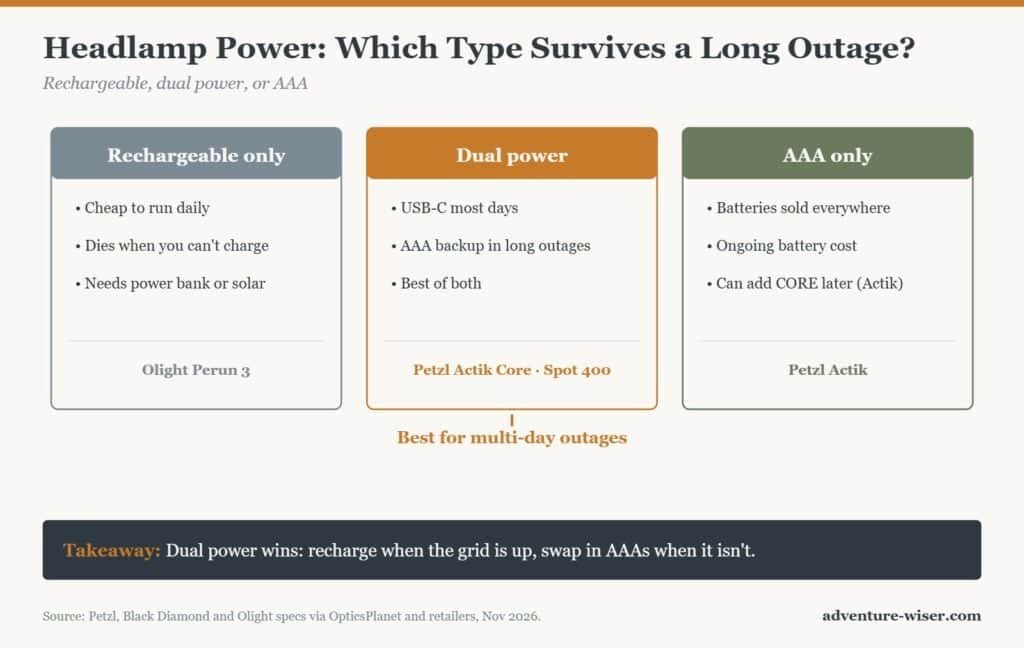
The short answer: get a headlamp that runs on both a rechargeable battery and standard AAAs. When the grid is down for days, the AAA backup is what keeps it working. My top pick is the Petzl Actik Core. The budget pick is the Black Diamond Spot 400.
| Headlamp | Best for | Price (Nov 2026) | The spec that decides it |
|---|---|---|---|
| Petzl Actik Core | Best overall | $87.95 | 625 lm, rechargeable + AAA backup |
| Black Diamond Spot 400 | Best value, best for long outages | $47.96 | 3x AAA, 200 hr on low, IPX8 |
| Petzl Actik | AAA-first, upgradable | $64.95 | 450 lm on AAA, CORE-compatible |
| Olight Perun 3 | Brightest, doubles as a flashlight | $89.99 | 3,000 lm, right-angle body |
1. Petzl Actik Core
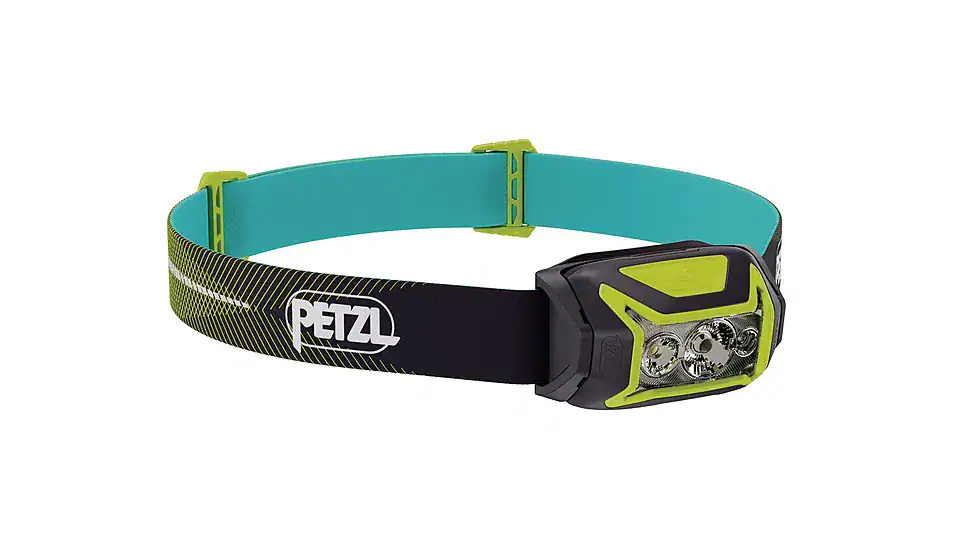
Label: Owned · Best overall
The Actik Core is the one I own and the one I’d recommend first. The current version is rated for 625 lumens, weighs 3.1 ounces, and ships with Petzl’s 1,250 mAh CORE rechargeable battery. The key feature for outages is Petzl’s Hybrid Concept: the same headlamp also runs on three standard AAA batteries. Petzl rates it IPX4, meaning splash-resistant, not submersible.
Key Benefits
- Two power sources. USB-C rechargeable when you have power, AAAs when you don’t. Reviewers note output drops to about 450 lumens on AAAs.
- Red light mode to keep your night vision and avoid blinding people across the table.
- Up to 130 hours on the lowest setting, per the OpticsPlanet spec sheet.
- Flood and mixed beam options for close work and walking.
Pricing
$87.95 at OpticsPlanet when checked. Check the Actik Core.
Pros & Cons
Pros: Light, bright, comfortable, dual power.
Cons: It’s IPX4, so it’s not the one for heavy rain or a drop in a creek. It’s the priciest pick that isn’t a flashlight hybrid. And if you lose the CORE battery, a replacement isn’t cheap.
2. Black Diamond Spot 400
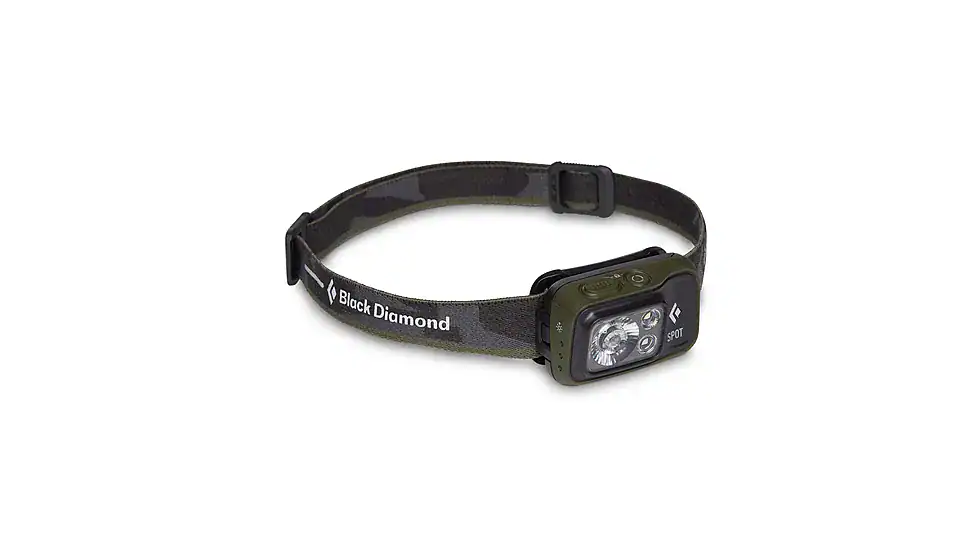
Label: Researched · Best value and best for long outages
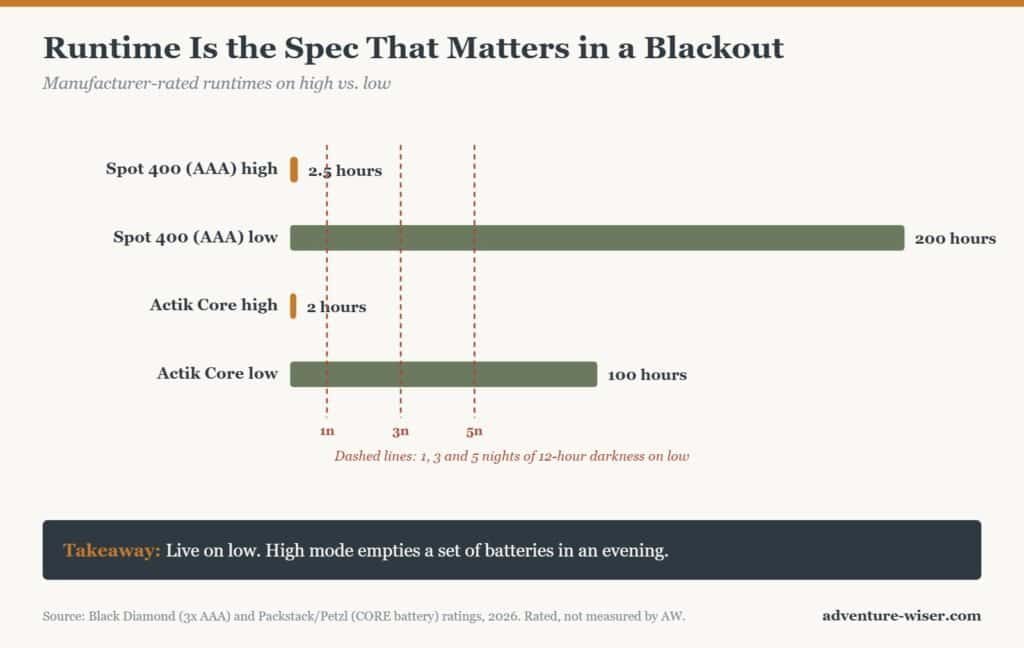
The Spot 400 is the headlamp I’d buy for a kitchen drawer, a go-bag and a truck. It puts out 400 lumens on high, 200 on medium and 6 on low, and Black Diamond rates it for 200 hours on low with three AAA batteries. It also takes BD’s 1500 rechargeable battery. It’s rated IPX8, which means BD tested it underwater at 1.1 meters for 30 minutes.
Key Benefits
- 200 hours on low on alkaline AAAs, the longest low-mode runtime here
- Dual-fuel: AAA or BD’s rechargeable battery
- IPX8 waterproofing
- Lock mode and a battery meter
Pricing
$47.96 at OpticsPlanet when checked. Check the Spot 400.
Pros & Cons
Pros: Cheap, waterproof, runs forever on low, uses batteries you can buy anywhere.
Cons: Only 2.5 hours on high with AAAs. Less refined beam and band than the Petzl. The rechargeable battery is sold separately.
3. Petzl Actik
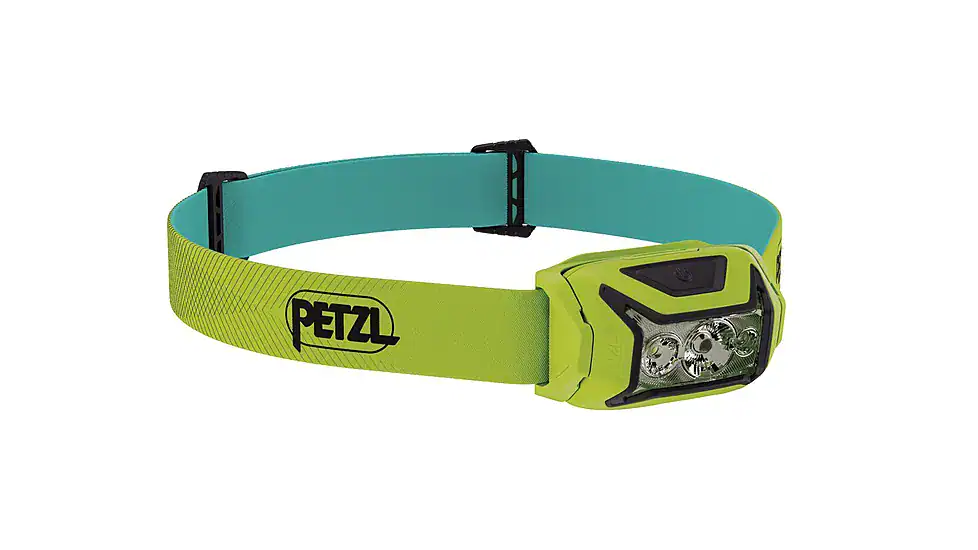
Label: Researched · Best AAA-first headlamp
The non-Core Actik is the same family at a lower price. It’s rated for 450 lumens and 100 meters of throw, weighs 98 grams with batteries, and ships with three AAAs. It’s also compatible with Petzl’s CORE rechargeable battery if you want to add one later.
Pricing
$64.95 at OpticsPlanet when checked. See the Petzl Actik.
Pros & Cons
Pros: Same Hybrid Concept, AAA by default, and an upgrade path.
Cons: At $65, it’s only $23 less than the Actik Core, and the Core includes the rechargeable battery. Unless you specifically want AAA-only, the Core is the better buy.
4. Olight Perun 3
Label: Researched · Brightest pick and best flashlight hybrid
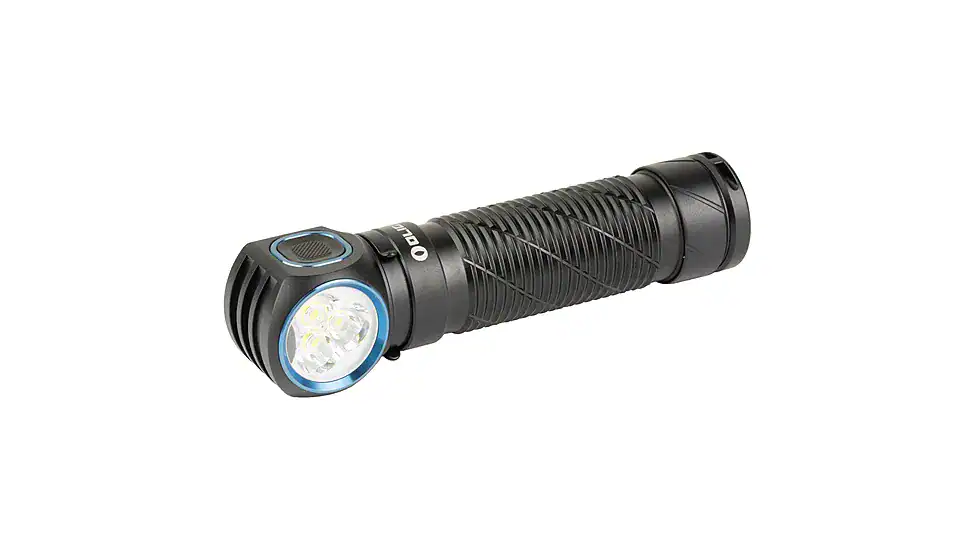
The Perun 3 is a different animal: a right-angle aluminum light that clips into a headband or works as a handheld flashlight. Olight rates it at 3,000 lumens with white and red light, and it weighs 5.29 ounces. It’s rechargeable and waterproof.
Pricing
$89.99 at OpticsPlanet when checked. See the Olight Perun 3.
Pros & Cons
Pros: Far brighter than anything else here. One light for two jobs. Good for searching a yard or checking a roofline.
Cons: Heaviest pick by a lot. No AAA backup, so during a long outage you need a power bank or solar generator to keep it running. You’ll rarely need 3,000 lumens inside a house.
What Is a Power Outage Headlamp?
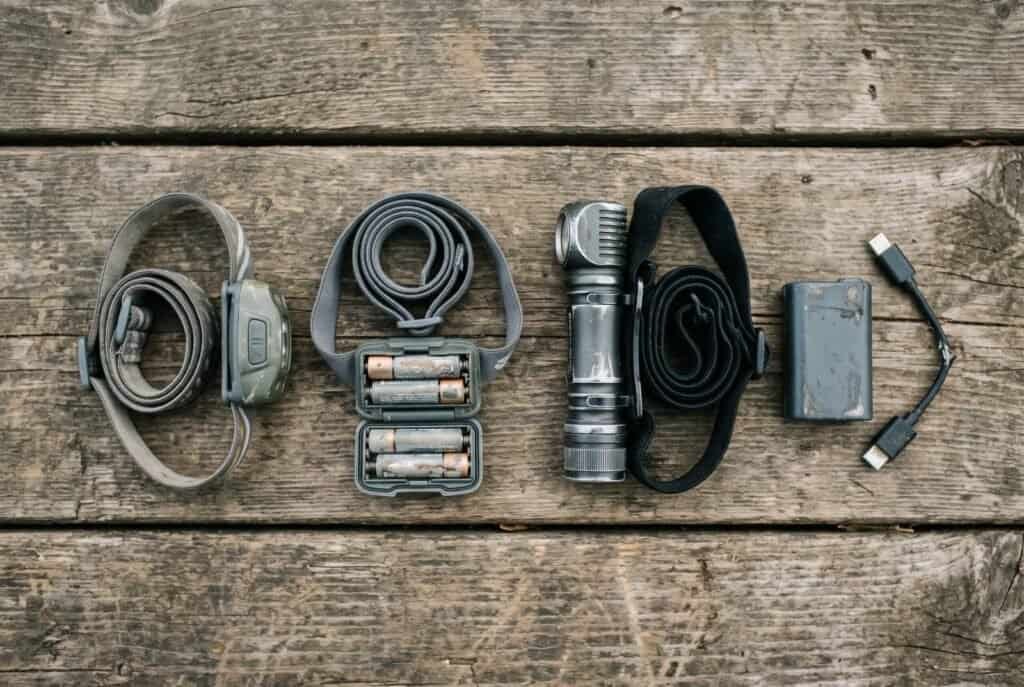
Any headlamp works in a power outage. A power outage headlamp is one chosen for the specific conditions of an outage: it may be days before you can recharge, you’ll mostly use it indoors at close range, and you’ll use it for long stretches rather than short bursts.
That shifts priorities. Peak lumens matter less. Low-mode runtime, battery flexibility and a red mode matter more. A 400-lumen headlamp that runs 200 hours on AAAs is more useful in a three-day ice storm than a 1,000-lumen light that dies in four hours and needs a USB port.
How Can a Headlamp Benefit You During an Outage?
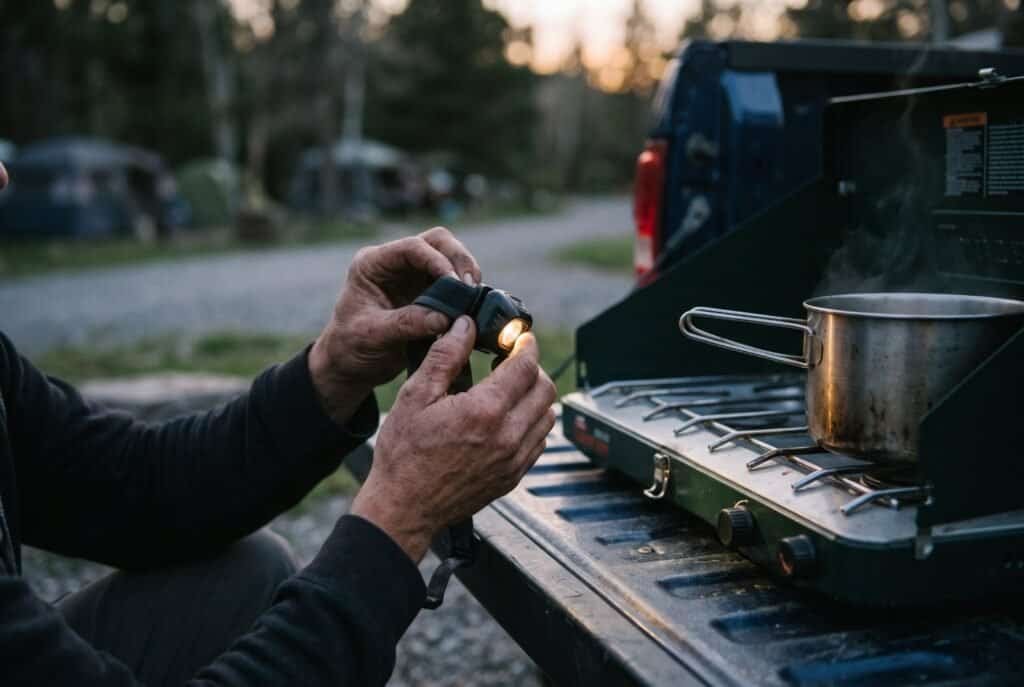
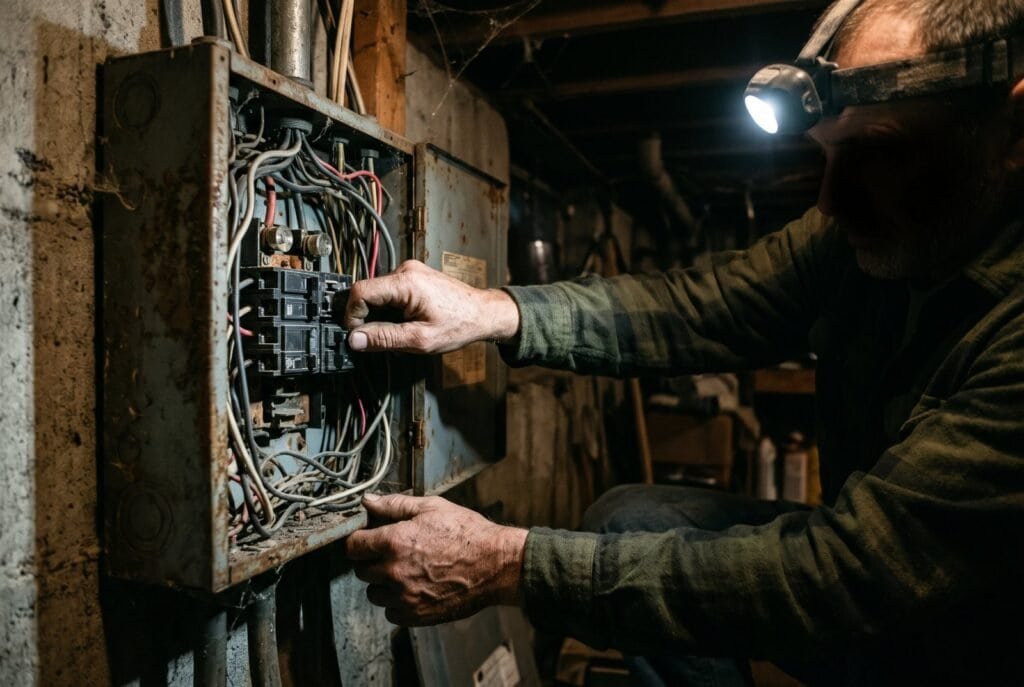
- Hands-free work. Resetting breakers, starting a generator, cooking on a camp stove, carrying a child. All of it needs both hands.
- Safer than candles. Open flames in a dark house are a real fire risk, especially with kids and pets.
- Saves your phone battery for calls, alerts and updates, which matter more than light.
- Light where you look. A headlamp points where your eyes go, which a lantern can’t do.
- It’s also your camp light. The same headlamp lives in your pack the rest of the year.
For a full outage plan, see our power outage preparedness guide and the Blackout Blueprint. FEMA’s Ready.gov power outage page also recommends flashlights over candles for emergency lighting.
Headlamp Features That Don’t Matter in a Blackout
Headlamp marketing is built for trail runners and climbers. Some of those features are wasted on a dark kitchen.
- Peak lumens. A 1,000-lumen headlamp pointed at a white kitchen wall is blinding. Most indoor tasks need 50 to 200 lumens. Peak output mostly matters outdoors at distance.
- Beam distance. 100 meters of throw is great for spotting a trail marker. In a house, nothing is more than a few meters away.
- Strobe and SOS modes. Useful for signaling in the backcountry. In an outage you’ll cycle past them every time you turn the light on.
- Reactive or motion-sensing lighting. Clever on a trail, but in a dark house simple and predictable beats smart.
What does matter: runtime on low, a dimmable output, red light, a lock mode, and the ability to run on batteries you can buy at any gas station. Those five things decide whether a headlamp is still working on night three.
How to Build an Outage Lighting Kit Around the Best Headlamp for Power Outages
One headlamp is a start. A household needs a little more, and it doesn’t cost much.
One headlamp per person. Sharing a light means someone is always standing in the dark. A $48 Spot 400 for each family member is cheaper than one fancy flashlight and far more useful.
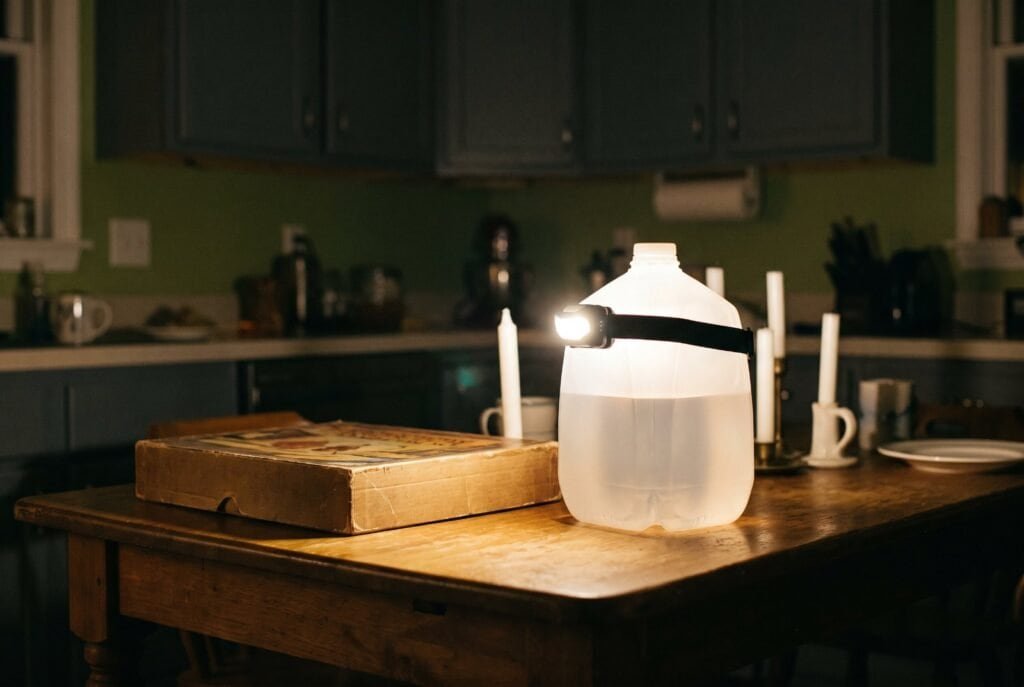
One room light. A lantern, or a headlamp strapped to a water jug, lights a whole table so the family can eat, play cards or do homework. Headlamps are terrible for conversation: everyone blinds everyone else.
A battery plan. Keep a pack of AAA lithiums per headlamp in the same drawer. If your headlamps are rechargeable, keep a charged power bank too, and know how you’ll recharge it if the outage runs long. A small portable solar power station covers that for days.
A car light. Your vehicle is part of the plan. Keep a headlamp in the glove box for changing a tire or checking under the hood.
Kid lights. Kids handle outages better when they have their own light. A simple headlamp turns “scary dark house” into an adventure, and it keeps them away from candles.
Put all of it in the same drawer, tell everyone in the house where that drawer is, and check it twice a year when you change your smoke detector batteries.
Buyers Guide: How We Chose the Best Headlamp for Power Outages
Here’s what I weighed for outages and camping, in order.
- Battery flexibility. Rechargeable-only lights are great until you can’t recharge. Dual power (rechargeable plus AAA) beat everything else on this list for outage use.
- Low-mode runtime. You’ll spend most outage hours on low. 100-plus hours on low is the target.
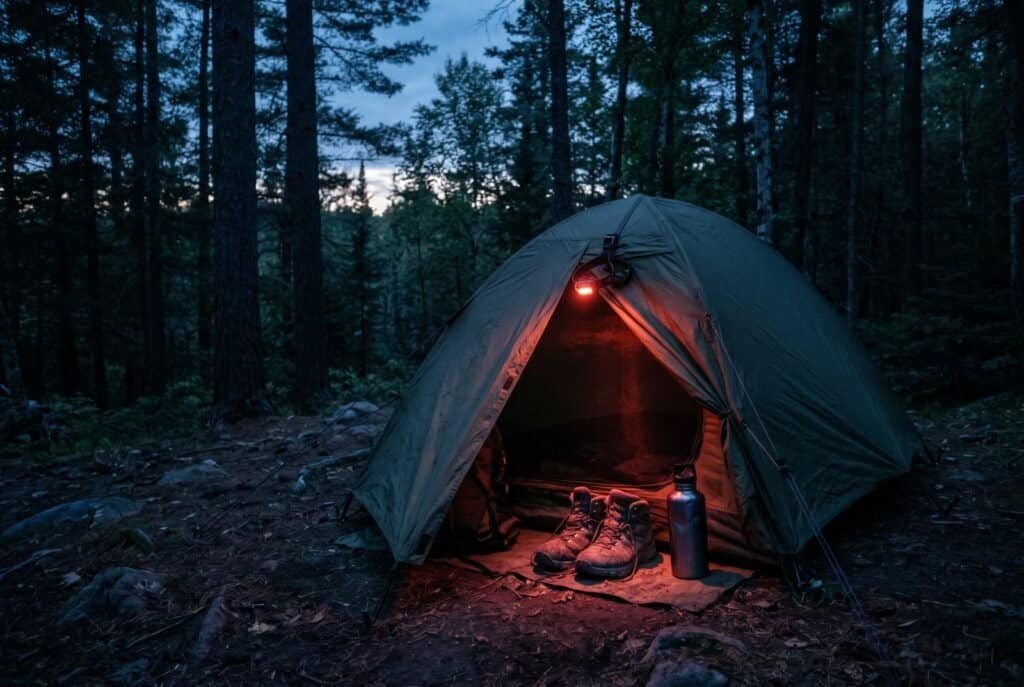
- Red light. Preserves night vision and doesn’t blind your family across the room.
- Water resistance. IPX4 handles rain and splashes. IPX8 survives a dunk. Know which you’re buying.
- Lock mode. A headlamp that turns on in a drawer is a dead headlamp when you need it.
- Comfort. You may wear it for hours. Weight and band quality matter.
- Price. A good headlamp costs $50 to $90. Buy two: one for the house, one for the vehicle.
Key Considerations for Outage Lighting
- Store AAA lithiums with the headlamp. Lithium AAAs hold their charge for years in storage and work better in the cold than alkalines.
- Take the batteries out of lights in long storage or use the lock mode, so a slow drain doesn’t leave you with a dead light.
- Make a lantern. Strap a headlamp to a clear water jug, light facing in, and it lights a whole room.
- Know where it lives. Keep one headlamp in the same drawer, always. Finding a flashlight in the dark is the oldest outage joke there is.
- Pair it with a lantern and a radio. A headlamp is personal light. A lantern is room light. Our best prepper flashlights and emergency radios guides cover the rest.
Frequently Asked Questions
What is the best headlamp for power outages?
The Petzl Actik Core. It’s rechargeable and also runs on three AAA batteries, so you can keep it going even when you can’t recharge. The Black Diamond Spot 400 is the best budget pick.
Is a rechargeable or battery headlamp better for emergencies?
Dual power is best. A rechargeable headlamp is cheap to run day to day, and AAA backup keeps it working in a long outage when USB charging isn’t available.
How many lumens do I need in a headlamp for a power outage?
Less than you think. 200 to 400 lumens covers almost every indoor task, and you’ll use the low setting most of the time. Runtime matters more than peak brightness.
How long will a headlamp last in a power outage?
It depends on the brightness setting. The Black Diamond Spot 400 is rated for about 200 hours on low with AAA batteries but only about 2.5 hours on high.
Why use red light on a headlamp?
Red light preserves your night vision and is less likely to blind people nearby. It’s ideal for moving around a dark house or campsite.
Should I keep spare batteries for my headlamp?
Yes. Keep a pack of AAA lithium batteries with each headlamp. They store for years and work better in cold weather.
Wrapping Up: The Best Headlamp for Power Outages Has a Backup Plan
The best headlamp for power outages is the Petzl Actik Core, because it charges over USB-C and still runs on AAAs when the grid is down. The best budget headlamp for power outages is the Black Diamond Spot 400, which runs about 200 hours on low.
Tonight, do this: pick one drawer near your kitchen and make it the light drawer. Put a headlamp in it, a pack of AAA lithiums, and nothing else. Then flip off your main breaker for ten minutes and walk the house with only that headlamp. You’ll find out what’s missing while the lights still come back on.
Gear on Adventure Wiser is labeled for what it is — Tested, Owned, or Researched. Here’s how that works.
