

Your cooler rides in a metal box that cooks in the sun. Pick for that, not for the brochure.
Finding the best cooler for truck camping usually starts the same way: day two of a three-day trip, you open the lid, and your bacon is floating. The ice you bought Friday is a gray slush puddle, the cheese is sweating through its bag, and the nearest gas station with ice is 40 minutes of washboard away.
I’ve been there with the coolers I actually own, which are plain Igloo and Coleman boxes, the kind that live in every garage in Arkansas. They work. They also have limits, and a truck bed finds those limits fast.
This guide is for the moment you’re deciding whether to keep doing the daily ice run, spend real money on a rotomolded cooler, or skip ice altogether with a powered fridge. I’ll give you six picks across four brands, tell you which one I’d buy, and tell you when the cheap cooler you already have is still the right answer.
METHOD: Every cooler on this list is labeled Researched. I haven’t run any of them on a trip. I own basic Igloo and Coleman coolers and use them as the honest baseline, and I camp with an EcoFlow DELTA 3 Plus, so I know that power ecosystem, but not the Glacier fridge itself. Specs and prices come from the makers’ and retailers’ own product pages, checked November 2026. Where an independent lab measured something, I say so.
This post contains affiliate links. If you buy through them, Adventure Wiser may earn a commission at no extra cost to you. As an Amazon Associate, Adventure Wiser earns from qualifying purchases.
What Are the Best Coolers for Truck Camping?
Short version: for most truck campers doing weekend to week-long trips, the Blue Coolers 60 Quart Ice Vault is the pick. It’s rated for up to 10 days of ice, holds a true 60 quarts, weighs 31 pounds empty, and costs about $125 to $145 less than the YETI it competes with.
Here’s the whole field.
| Cooler | Best for | Price (Nov 2026) | The spec that decides it |
|---|---|---|---|
| Blue 60qt Ice Vault | Most truck campers | $249.99 | Up to 10-day ice rating, 31 lb empty |
| YETI Tundra 65 | Buy-it-once premium | $375–$395 | Molded tie-down slots, IGBC certified |
| Cabela’s Polar Cap Equalizer 60 | Seeing it before you buy | In-store price | Up to 7-day claim, 30 lb empty |
| YETI Roadie 48 Wheeled | Solo campers, bad backs | $425 | Wheels, 28.3 lb, top lab insulation score |
| Blue Companion 30 | Small trucks, cab storage | $199.99 | 21.2 lb, fits behind a seat |
| EcoFlow GLACIER Classic 45L | Done buying ice | $899 list | Compressor fridge-freezer, dual zone |
The prices run from $200 to $900, and that spread is the real decision. Under $450 you’re buying insulation, meaning thicker walls and a better lid seal. At $900 you’re buying a fridge with a compressor and a power cord, which is a different tool, not just a better cooler.
1. Blue Coolers 60 Quart Ice Vault
Label: Researched · Best value for most truck campers
The 60 Quart Ice Vault is Blue’s most popular model, and it’s the one I’d put in a full-size bed for a long weekend or a week. It’s a rotomolded cooler with a true 60-quart interior, a rapid drain, removable tether handles, and a 10-day ice rating. Blue says it holds 50 to 55 cans at a 2:1 ice ratio.
Key Benefits
- Rated for up to 10 days of ice. That’s the top rating in Blue’s lineup.
- 31 pounds empty. Heavy, but one adult can still lift it before it’s loaded.
- IGBC certified bear resistant when you add padlocks, per Blue. The Interagency Grizzly Bear Committee runs that certification. Useful in bear country, irrelevant if you don’t camp there.
- 5-year parts and construction warranty and a 90-day money-back guarantee.
- A wheeled version exists. Same box plus wheels and a pull handle, 36.5 lb empty, $319.99 when checked. See the wheeled Ice Vault.
Pricing
$249.99 on Blue’s site when I checked in November 2026, marked down from a $299.99 list price. Check the current price at Blue Coolers, or grab the 60 Quart Ice Vault on Amazon if you’d rather have Prime shipping. Amazon’s price can differ from Blue’s, so compare before you click buy.
Pros & Cons
Pros: Longest ice rating among the passive coolers here, real bear-resistance certification, strong warranty, and a lot of cooler for the money next to YETI.
Cons: Loaded with ice and food it will push past 70 pounds, which makes it a two-person lift onto a tailgate. The dry basket and divider are sold separately. Blue’s 10-day number is its own rating, not an independent lab result.
2. YETI Tundra 65
Label: Researched · Best premium hard cooler
The Tundra 65 is the cooler every other rotomolded cooler gets compared to, and REI carries it. The truck-specific detail is the tie-down slots molded right into the body, so you can ratchet-strap it to the bed and still open the lid. It’s also IGBC certified as bear resistant with two padlocks.
There’s a catch on capacity, and it’s worth knowing before you pay for it. OutdoorGearLab measured about 56 usable quarts against the advertised 65. That’s because the thick walls eat interior space. In their testing it kept food under 40°F for about 4.8 days, which is a useful real-world anchor when you’re reading anyone’s “up to 10 days” claim.
Key Benefits
- Molded tie-down slots for strapping into a truck bed
- IGBC bear-resistant certification with padlocks
- Includes a dry goods basket, which Blue sells separately
- About 30.8 lb empty as measured, close to the Blue 60
Pricing
$375 to $395 depending on color, at YETI and REI in November 2026. REI members get their annual dividend back on it. See the Tundra 65 on Amazon. On Amazon, check that it’s shipped and sold by Amazon or YETI so the 5-year warranty is clean.
Pros & Cons
Pros: Proven design, molded tie-downs, wide accessory ecosystem, holds resale value.
Cons: You’re paying for the name. It costs about $125 to $145 more than the Blue 60 and has less real interior space than the “65” suggests.
3. Cabela’s Polar Cap Equalizer 60
Label: Researched · Best if you want to see it before you buy
The Polar Cap Equalizer is Cabela’s own rotomolded line. The reason it’s on this list is simple: you can walk into a Cabela’s or Bass Pro, put your hands on it, and open the latches before you spend a dime. Cabela’s lists the 60-quart at about 30 pounds empty, 37 x 19.5 x 18.75 inches, with a freezer-grade gasket it says holds cold for up to 7 days.
It’s built for real use: rubberized T-latches, a pressure-release valve so the lid doesn’t vacuum-seal shut, a leakproof spigot on a steel lanyard, and raised non-skid feet that keep it off a hot bed floor. Independent reviewers rate it highly. Field & Stream put it in the same class as YETI and RTIC after testing the 60-quart.
Key Benefits
- Lighter than the Blue 60 and YETI Tundra 65 at about 30 lb
- Raised feet reduce heat transfer from a sun-baked bed floor
- Pressure-release valve and lanyard spigot are easy to use with cold hands on a tailgate
- Sold in-store, so you can check the fit against your bed measurements in person
Pricing
When I checked in November 2026, Cabela’s website listed the 60-quart as not available for online purchase, with no price shown. Check your nearest Cabela’s or Bass Pro store, and expect the price to vary. It’s a Cabela’s house brand, so you won’t find it on Amazon.
Pros & Cons
Pros: You can handle it before buying, it’s lighter than the big names, and it has good features at the tailgate.
Cons: Hard to buy online right now. The 60-quart product page describes a bear-resistant design with padlock tabs but doesn’t cite an IGBC certification, so don’t assume one. No wheels.
4. YETI Roadie 48 Wheeled Cooler
Label: Researched · Best for solo campers
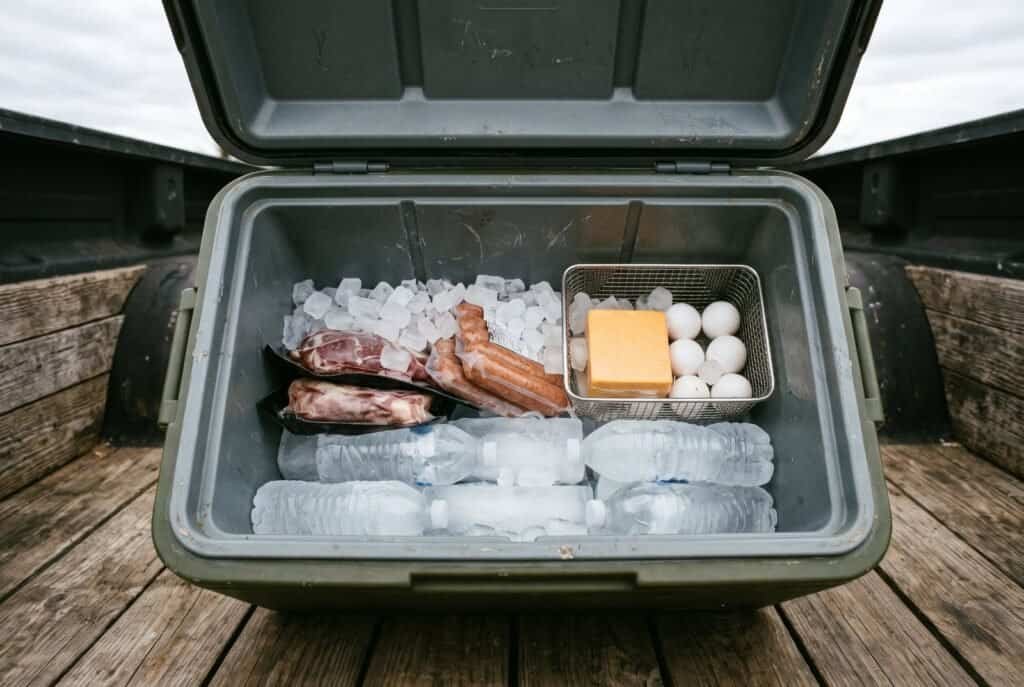
If you camp alone, the problem isn’t ice, it’s moving 60-plus pounds from the bed to the fire ring by yourself. The Roadie 48 is a tall, narrow rotomolded box on wheels with a telescoping handle. It weighs 28.3 pounds empty, and YETI says it holds 76 cans with no ice.
The surprise is insulation. In OutdoorGearLab’s testing, the Roadie 48 scored best of every cooler they tested for insulation, beating the bigger Tundra 65. A tall, narrow shape has less lid area for cold to escape through.
Key Benefits
- Wheels and a periscope handle for moving a full load solo
- Tall interior fits wine bottles and 2-liter jugs standing up
- Narrow footprint leaves bed space beside it
- Includes one dry goods basket
Pricing
$425 list at REI and YETI in November 2026, with some seasonal colors marked down. Check the Roadie 48’s Amazon price, where color markdowns sometimes show up first.
Pros & Cons
Pros: Best lab insulation result in this field, genuinely easy to move alone, small footprint.
Cons: Most expensive passive cooler here. 48 quarts is a weekend for two, not a week. The tall shape is less stable strapped in a bed than a low chest cooler, so tie it down well.
5. Blue Coolers 30 Quart Companion
Label: Researched · Best for small trucks and cab storage
Not every truck camper runs a full-size bed. If you’re in a Tacoma, a Ranger or a Maverick with a topper and a sleeping platform, floor space is gold. The Companion 30 is 21.2 pounds empty, holds 24 to 26 cans, and still carries Blue’s 10-day ice rating on its product page.
Key Benefits
- Small enough to ride in the cab or wedge beside a platform
- Same warranty and money-back guarantee as Blue’s larger models
- Makes a good drinks cooler next to a bigger food cooler
Pricing
$199.99 when checked, list $249.99. See the Companion 30, or find the Companion on Amazon. The Amazon listing covers more than one size, so pick the 30-quart before you add it to the cart.
Pros & Cons
Pros: Fits places a 60-quart can’t. As a second cooler for drinks, it keeps the food cooler closed.
Cons: A small chest cooler has less thermal mass, so treat that 10-day rating with extra skepticism. And it’s only $50 less than the 60-quart Ice Vault.
6. EcoFlow GLACIER Classic 45L
Label: Researched · Best if you’re done buying ice
This isn’t a cooler. It’s a compressor fridge-freezer, and for some truck campers that’s the real answer. No ice means no meltwater, no floating bacon, and none of the cooler’s space taken up by frozen water. The 45L version has a divider that splits it into two zones, so one side can be a fridge and the other a freezer.
It runs on 12V from your truck, AC at home, solar, or an optional plug-in battery that EcoFlow says holds 39°F for up to 39 hours. It also has battery protection settings that shut it off before it drains your truck’s starting battery. If you already run an EcoFlow power station like I do, it fits into the same ecosystem.
Key Benefits
- No ice, ever, so you get the full 45 liters for food
- Dual-zone fridge and freezer with the included divider
- Powers from 12V, AC, solar or the plug-in battery
- App control and a USB-C port
Pricing
$899 list for the 45L in November 2026, with authorized dealers selling it for roughly $750 to $850. The plug-in battery bundle costs more. EcoFlow also makes 35L and 55L sizes. Check the GLACIER Classic at EcoFlow, or compare the GLACIER Classic 45L on Amazon. That Amazon listing is the version without the plug-in battery.
Pros & Cons
Pros: Solves the ice problem completely. Doubles as a fridge in a power outage. Freezer zone for real frozen food on a long trip.
Cons: 51 pounds empty, more than double the Companion 30. It needs power, so plan for multi-day camping without driving: the plug-in battery is rated for about a day and a half, then you need solar or a power station. It has a 2-year warranty against the coolers’ 5 years, and electronics can fail where a plastic box can’t.
What Is a Truck Camping Cooler?
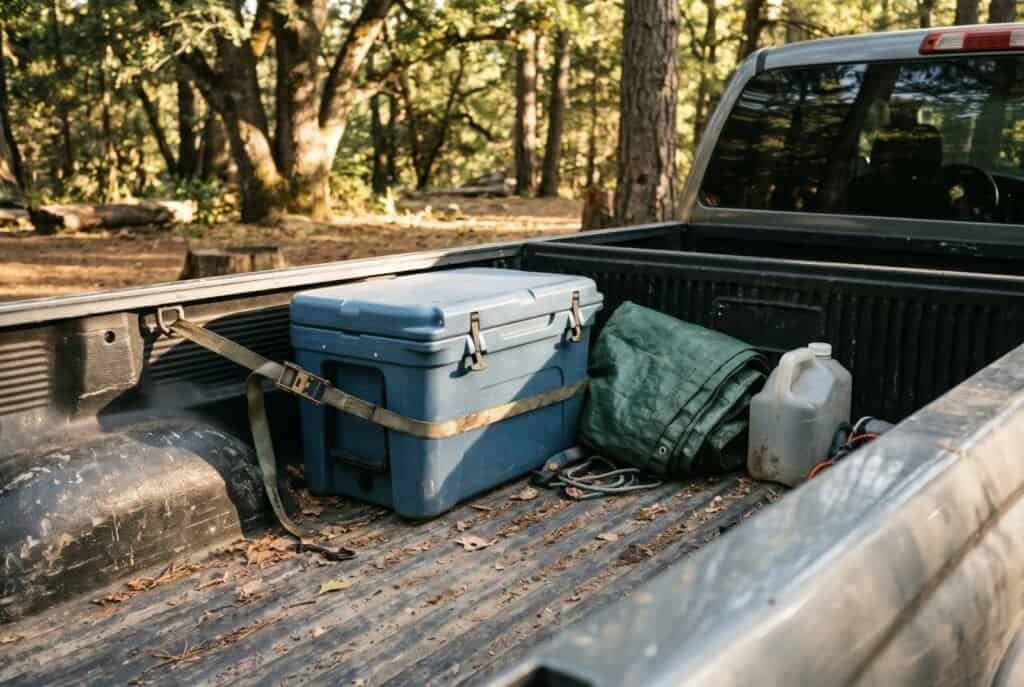
Any cooler can ride in a truck. A truck camping cooler is one that survives the specific abuse of a pickup bed: hours of direct sun on a dark surface, vibration on gravel roads, getting slid and dropped on a tailgate, and staying closed for days because the next ice is far away.
That’s why rotomolded coolers dominate this category. A rotomolded cooler is molded as one thick seamless shell, filled with dense foam, with a gasketed lid that latches tight. A typical blow-molded cooler, the Igloo or Coleman most of us own, has thinner walls, less insulation and a lid that relies on gravity to stay shut. A powered fridge like the GLACIER sidesteps the whole question by making its own cold.
How Can the Right Cooler Benefit You?
The obvious benefit is fewer ice runs. The less obvious ones matter more:
- Food safety. USDA guidance is to keep cold food at 40°F or below. Meltwater sitting at 50°F is a slow problem you won’t notice until it’s a fast one.
- Range. A cooler that holds ice for five-plus days opens up trips where you aren’t planning around a gas station. If you’re into overlanding or dispersed camping, that’s the whole point.
- Double duty at home. A good cooler, or a powered fridge, is your backup fridge during an outage. That’s covered in our winter power outage guide, and it’s one reason the money isn’t only a camping expense.
What About the Cooler You Already Own?
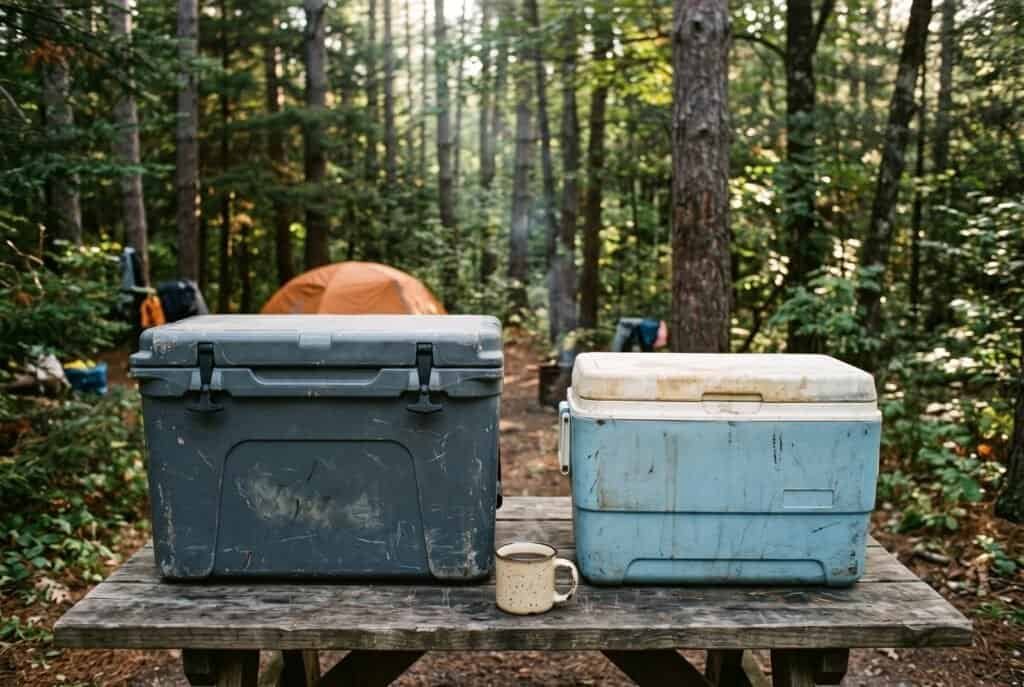
Here’s the honest part. My own coolers are basic Igloo and Coleman models. For overnight trips and day trips, they do the job. If you’re doing one or two nights, packing smart (below) matters more than the brand on the lid.
Where the cheap cooler falls behind is time and heat. Thin walls and a loose lid let cold out faster, and a truck bed in summer is the worst place to test that. If you’re doing three-plus nights in warm weather, or you hate the daily ice run, that’s when a rotomolded cooler starts paying for itself.
If you’re trying to decide whether a pricier cooler is worth it, the principle is the same one we use in our buy once, cry once guide: spend where failure is expensive. A ruined cooler of food on a week-long trip is expensive.
Buyers Guide: How We Chose the Best Cooler for Truck Camping
These picks are researched, not tested. Here’s what I weighed, in order of how much it matters in a truck.
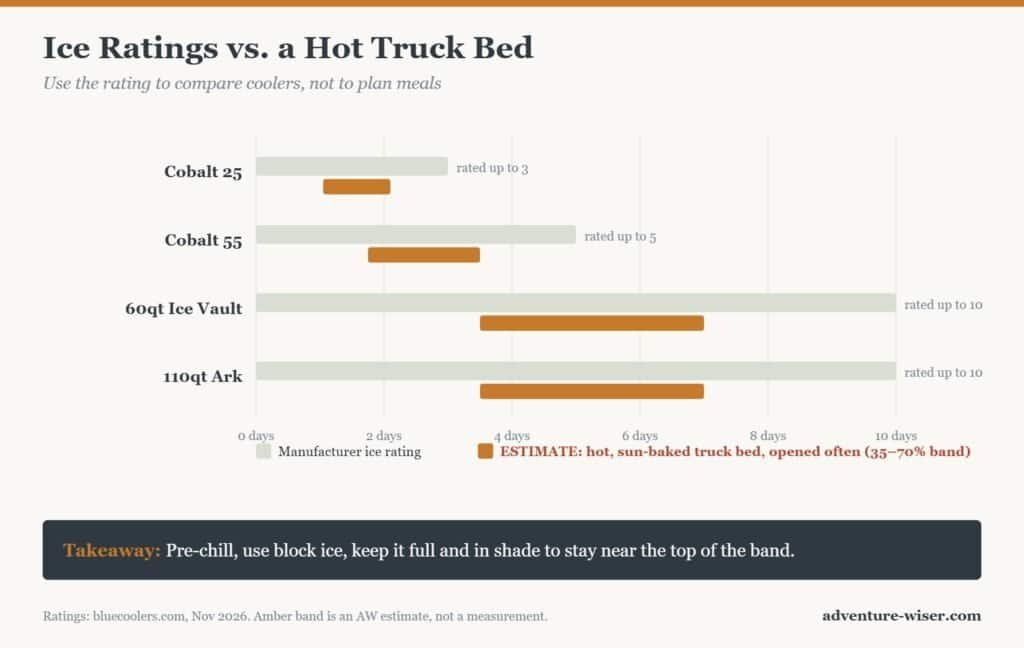
- Ice rating, treated as a ceiling. Manufacturer ratings come from the manufacturer’s own tests. Where an independent lab measured real hold time, I used that instead. A truck bed in July is harsher than either.
- Real interior volume. “65 quart” on a YETI measured about 56 quarts usable. Blue lists true interior quarts. Compare what fits inside, not the number on the side.
- Empty weight. Add roughly a pound per quart for ice, food and drinks and you’ll see why a 30-pound empty cooler becomes a two-person job.
- Tie-down points. A loose 70-pound cooler is a projectile on a washboard road. Molded slots, like the Tundra’s, or handles you can run a ratchet strap through are a must.
- Drain and latches. You will drain meltwater on a tailgate. A good drain and latches you can work with cold hands are daily-use features.
- Where you can buy it. Online-only, on Amazon, in-store at Cabela’s and Bass Pro, or at REI with member dividends. Being able to see it in person matters with a cooler this size.
- Warranty and returns. Blue offers a 90-day money-back guarantee and a 5-year warranty. YETI’s hard coolers carry a 5-year warranty. The GLACIER has 2 years, which is normal for electronics but shorter.
How to Pack the Best Cooler for Truck Camping
Whatever you buy, packing does more for ice life than any spec sheet:
- Pre-chill it. Put a sacrificial bag of ice in the night before. A warm cooler spends its first day cooling itself. (With a powered fridge, plug it in at home the night before.)
- Block ice on the bottom. Blocks melt far slower than cubes. Frozen water jugs work and become drinking water later.
- Freeze what you can. Meat for day three goes in frozen.
- Keep it full. Air space melts ice. Fill gaps with more ice or a towel.
- Two coolers if you can. Drinks get opened all day. Food doesn’t need to.
- Shade it. A reflective cover, a tarp, or just parking with the bed in shade helps more than people expect.
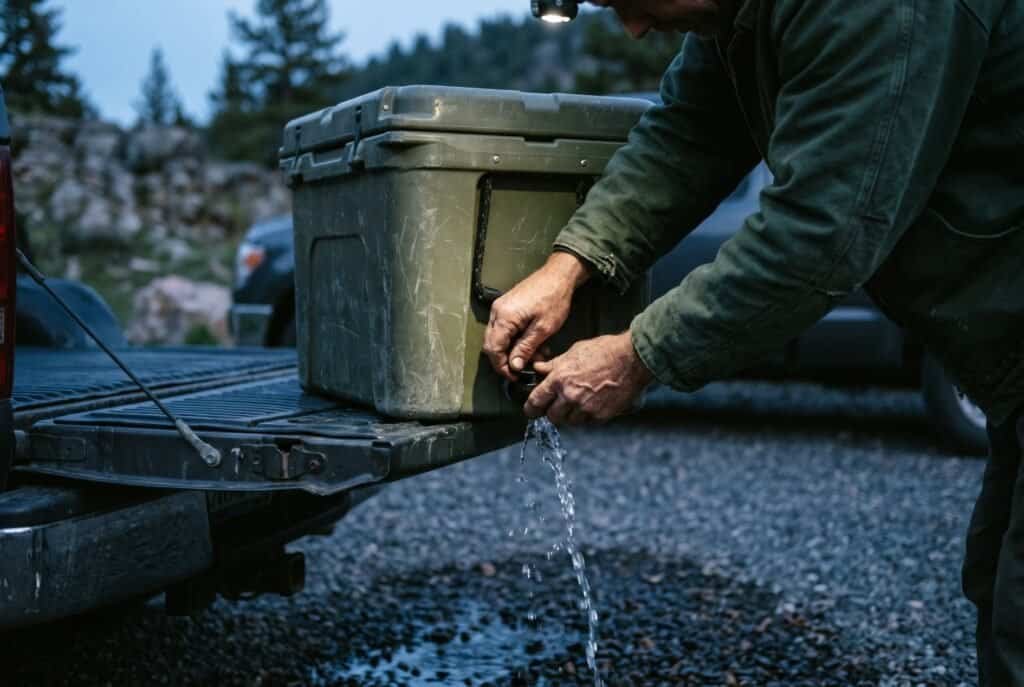
- Drain smart. Cold meltwater still insulates. Drain it when it’s warm or when food is sitting in it.
What Didn’t Make the Cut
RTIC makes good, cheaper rotomolded coolers, but they sell mostly direct and I can’t link them as cleanly as the stores above. If you find one on sale, it’s a fair alternative to the Blue 60.
Giant coolers (100+ quarts) were left off on purpose. Loaded, they top 100 pounds and live in the truck until you get home. For most people, two medium coolers are the better setup.
Thermoelectric “plug-in coolers” are cheap, but they only cool to a set amount below the outside temperature. In a truck bed in July, that isn’t cold enough to keep food safe. If you want powered cooling, buy a compressor fridge like the GLACIER.
Frequently Asked Questions
What is the best cooler for truck camping?
For most people, the Blue Coolers 60 Quart Ice Vault. It has a 10-day ice rating, true 60-quart capacity and a 31-pound empty weight that one person can still manage. Solo campers should look at the YETI Roadie 48 Wheeled, and anyone done with ice should look at the EcoFlow GLACIER Classic.
What size cooler do I need for truck camping?
For two people on a weekend, 45 to 60 quarts is the sweet spot. For a week or a family of four, split into two coolers, one for food and one for drinks. Solo day trips need 25 to 30.
How long does ice last in a cooler in a truck bed?
Less than the rating. In independent lab testing, a YETI Tundra 65 kept food under 40°F for about 4.8 days, in a controlled setting. A hot truck bed is harsher. Pre-chilling, block ice, a full cooler and shade make the biggest difference.
Is a powered fridge better than a cooler for truck camping?
For trips longer than four or five days, or when you want frozen food, often yes. It costs two to four times as much, weighs more, and needs a power plan. For weekends, a good rotomolded cooler is simpler and cheaper.
Is a rotomolded cooler worth it for camping?
If your trips run three nights or longer in warm weather, usually yes. For overnights, a basic cooler packed well does fine.
Should I strap my cooler down in the truck bed?
Yes. A loaded cooler can weigh 70 to 100-plus pounds. Run a ratchet strap through the handles, molded tie-down slots, or to bed tie-downs so it can’t slide or launch on rough roads.
Wrapping Up: The Best Cooler for Truck Camping Is the One Sized to Your Trip
My pick for the best cooler for truck camping is the Blue 60 Quart Ice Vault. It’s the right size for most trips and the best value of the passive coolers here. If you want the proven name and molded tie-downs, get the YETI Tundra 65. If you camp alone, get the Roadie 48. And if you’re done with ice for good, the EcoFlow GLACIER Classic is the upgrade.
Before you buy anything, do this: measure the space in your bed between the wheel wells and any platform or drawer system, and write down how many nights your last three trips actually lasted. Buy the cooler that fits both numbers. Then pre-chill it the night before your next trip and see what you’ve been missing.
Building out the rest of your rig? Start with our guide to off-grid truck campers and the camping gear guide.
Gear on Adventure Wiser is labeled for what it is — Tested, Owned, or Researched. Here’s how that works.
