

Most lists of what to stock up on start with the scariest headline they can find. This one starts with your kitchen, your closet and the water you drink, sorted by how far along you already are.
The forecast says ice by Thursday. By Wednesday afternoon the bread aisle is bare, the bottled water is down to the weird flavored stuff, and there’s a line at the gas pump that wraps around the building. Everybody in that store had the same idea at the same time.
The people who aren’t in that line aren’t smarter or richer. They just did their shopping on a boring Tuesday a few months earlier, a little at a time, when the shelves were full.
With the news the way it’s been, a lot of people are asking what to stock up on right now. Fair question. The honest answer is that it doesn’t change with the headline. An ice storm, a tornado, a lost paycheck, a supply hiccup, or something bigger all ask your house the same three questions: do you have water, can you eat without a store, and can you see and stay warm when the power quits.
So here’s the short version. Water first. Then food you already eat. Then light, medicine and a little cash. Stock to your level, not your fear, and buy it over months, not in one panicked weekend.
What Does Stocking Up Actually Mean?
Stocking up means keeping enough supplies in the house to ride out a disruption without a trip to the store. Not a bunker. Not a year of rations. A buffer.
The two numbers worth knowing come from the people who run disaster shelters. The American Red Cross survival kit list sets the bar at a 3-day supply of water and food if you have to leave, and a 2-week supply if you stay home. Those two targets line up with Levels 2 and 3 of the five levels of preparedness, and they’re the backbone of everything below.
Reasons You Need to Know What to Stock Up On
None of these require a collapse. They happen to ordinary households every year:
- Ice and snow. Roads close, the power goes, and the plumber and the grocery store are both on the far side of a downed tree.
- Tornadoes and floods. Even a near miss can knock out power and water for days.
- Empty shelves. Stores restock on a schedule, not on demand. When everyone shops at once, the shelves empty first.
- A rough month. A layoff, an injury or a sick household is easier when the pantry can carry a couple of weeks.
- Prescriptions. Ready.gov notes that about half of all Americans take a prescription every day, and a disaster can close the pharmacy you count on.
Every one of those is solved by the same short list. That’s good news. It means you don’t need a different kit for every fear.
What to Stock Up On, Level by Level
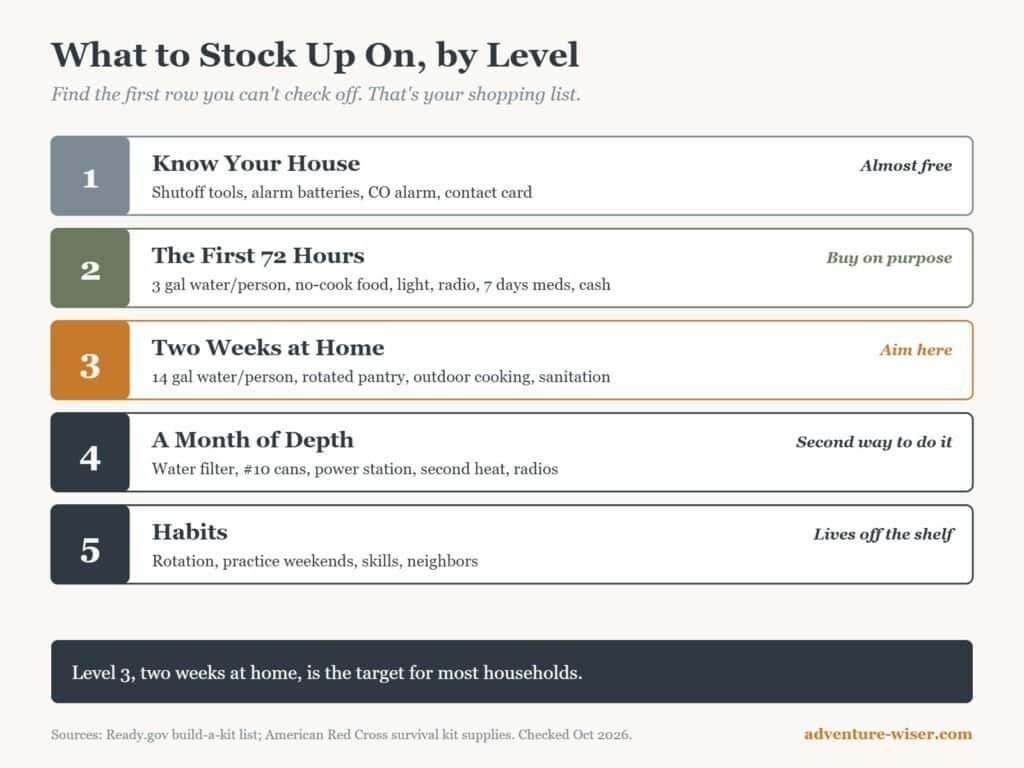
The list below is sorted so you can stop reading at your level. Find the first item you don’t have, and that’s where your shopping starts.
- Level 1: Know your house. Tools and batteries, mostly free.
- Level 2: The first 72 hours. Water, no-cook food, light, radio, meds, cash.
- Level 3: Two weeks at home. The Red Cross home benchmark. Aim here.
- Level 4: A month of depth. A second way to do every critical thing.
- Level 5: Habits. Rotation, skills and neighbors.
Most households should be shooting for Level 3. That’s where the real protection is, and it’s where the spending should stop until you’ve lived with it for a while.
Level 1: Start With What’s Free
Before you buy a single can, make sure you can control your own house. That means knowing where your water main, main breaker and gas or propane valve are, and staging the tool that turns each one. The full walk-through is in the guide to shutting off your utilities before the storm.
Then knock out the cheap stuff:
- Fresh batteries in every smoke and carbon monoxide alarm
- A battery-powered or battery-backup CO alarm near the bedrooms, which the CDC recommends for power outages because a plug-in alarm goes dark with the grid
- A paper card with phone numbers for family, your utilities and your doctor
- A flashlight in a known spot on every floor
Level 2: The 72-Hour Stock-Up
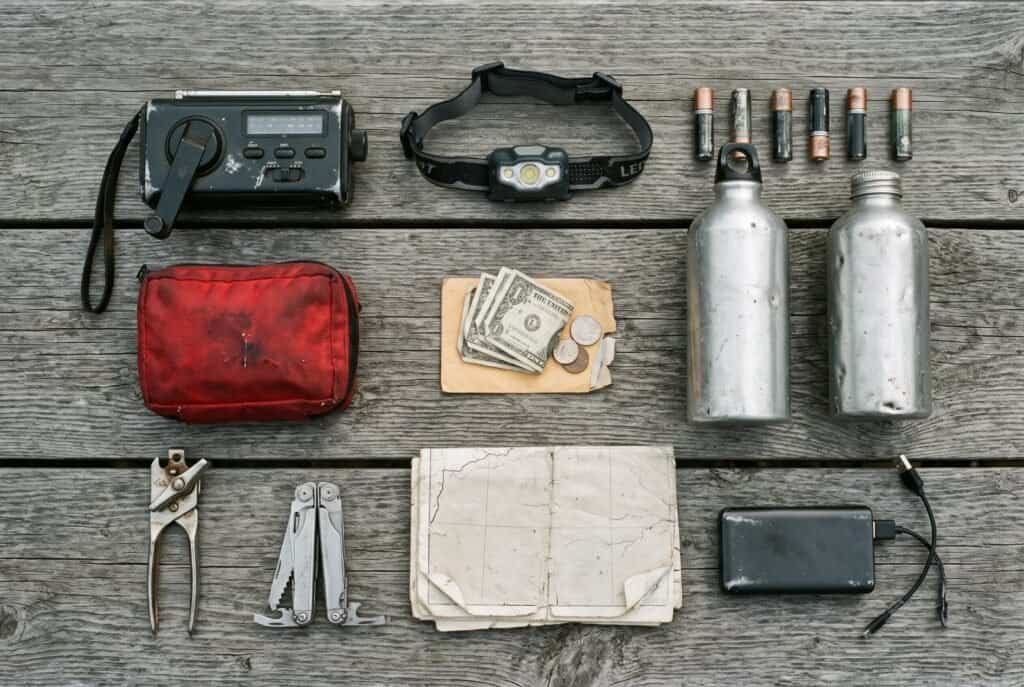
This is the classic emergency kit, and it’s worth buying on purpose. The core of the Ready.gov basic supply list and the Red Cross list overlap almost perfectly:
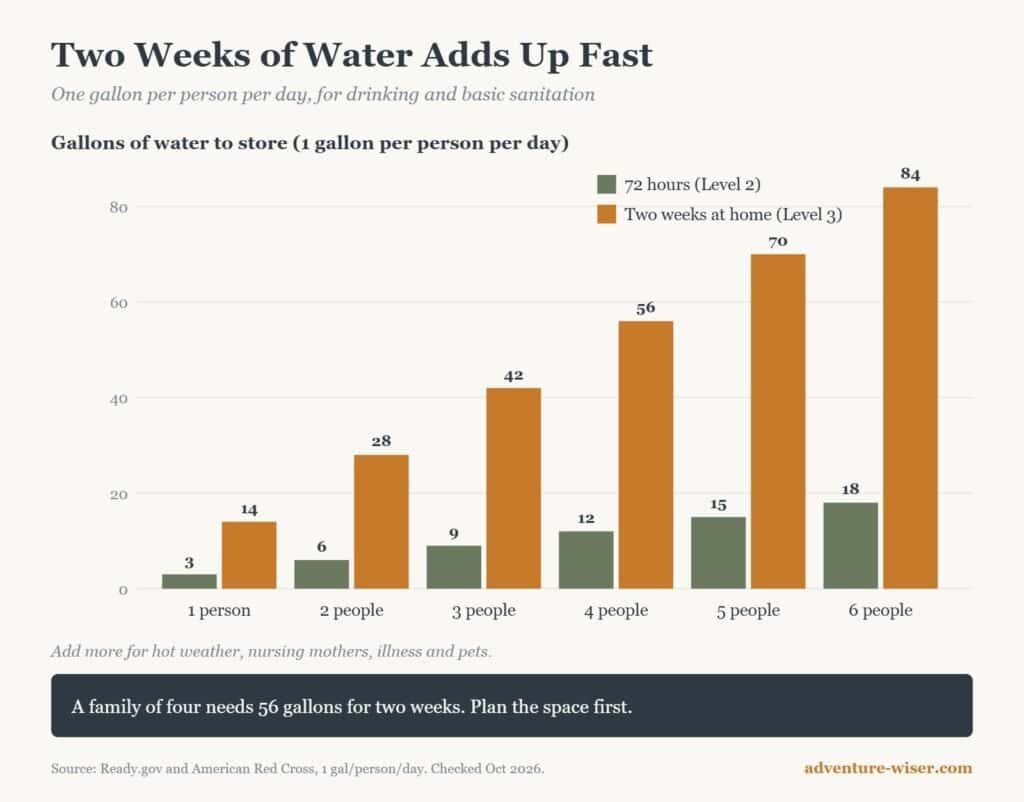
- Water: one gallon per person per day, so 3 gallons each for three days. That covers drinking and basic sanitation.
- Food you don’t have to cook: peanut butter, crackers, canned meat and fruit, granola, cereal. Plus a manual can opener.
- Light: flashlights or headlamps and extra batteries. More than you think. Candles are a fire you have to babysit.
- A radio: battery or hand-crank, ideally with NOAA Weather Radio alerts. Our roundup of hand-crank emergency radios covers what to look for.
- Medications: the Red Cross list calls for a 7-day supply, plus a first aid kit.
- Cash: small bills. When the power is out, card readers are too.
- Power for the phone: a charged power bank and the cable that fits.
- Sanitation basics: wet wipes, trash bags and ties.
That’s it. Three days, everyone in the house, plus pets. It fits in two plastic bins.
Level 3: Two Weeks at Home
Here’s where stocking up actually earns its keep. Two weeks covers almost every outage, ice storm and supply hiccup most families will ever see, and it’s the target the Red Cross sets for staying home.
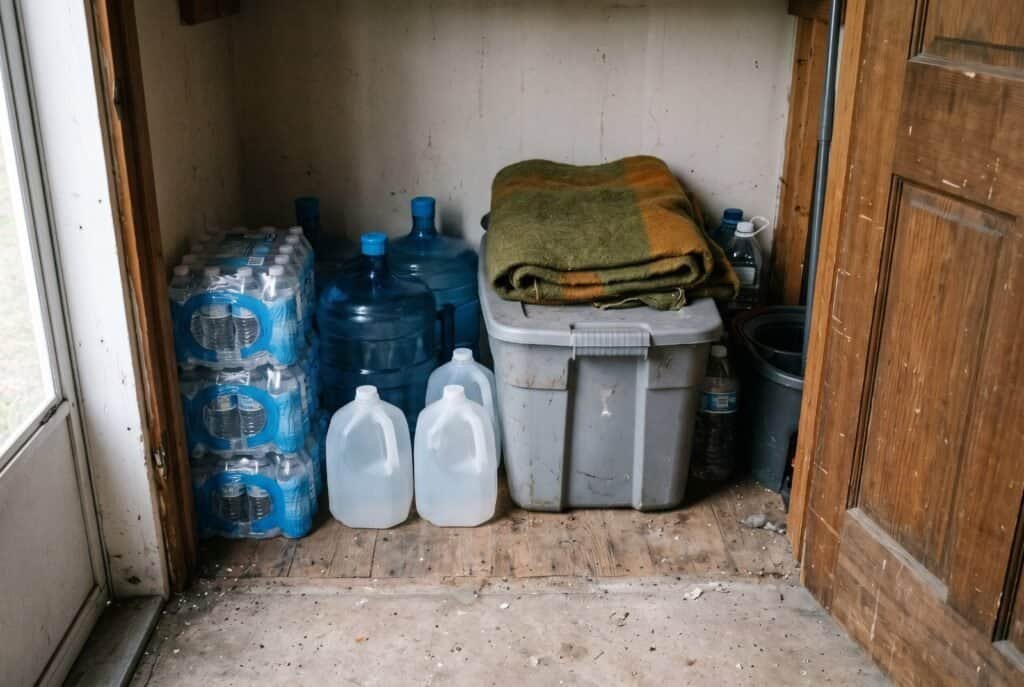
Water comes first, and it adds up fast. At a gallon per person per day, two weeks is 14 gallons for one person and 56 gallons for a family of four. That’s a real pile of water, so plan where it lives before you buy it. Our guide to storing water at home covers containers, rotation and treatment.
Food should be food you already eat. The cheapest two-week pantry is just your normal groceries, bought a little deeper and rotated by eating the oldest first. The smart prepper’s pantry lays out the rotation habit, and the food and water storage blueprint covers quantities.
Lean hard on no-cook meals. This is the lesson most people learn the hard way. When the power goes, the fridge and freezer become a countdown. The CDC’s food safety guidance gives a closed fridge about 4 hours, a full freezer about 48 and a half-full one about 24. After that you’re eating out of the pantry, so stock things that don’t need a stove.
Then fill in the rest of the two weeks:
- A way to cook outdoors: a grill, a camp stove and fuel to run it. Never indoors, never in the garage.
- Sanitation for when the toilets won’t flush. That’s its own subject, covered in sanitation without running water.
- Warm bedding and layers for every person, if you live anywhere it freezes.
- More batteries. Two weeks of evenings is a lot of flashlight time.
- Prescriptions as far ahead as your pharmacy and insurance allow. Ask your doctor about a refill buffer.
Level 4: A Month of Depth
Level 4 isn’t about more stuff. It’s about a second way to do each critical thing, so one failure doesn’t end the plan.
- Water: a way to treat water you didn’t store. A gravity filter or a squeeze filter plus a backup chemical method. The water filter comparison covers the options.
- Food: long-shelf-life staples in sealed steel. Why #10 cans matter explains what lasts for decades and what doesn’t.
- Power: a portable power station or a properly installed generator setup. Notes on the unit I run are in the EcoFlow review.
- Heat: a safe second heat source and the fuel to feed it.
- Communication: something that works when the cell towers don’t. Which radio actually reaches anyone sorts out GMRS, ham and mesh.
Level 5: Skills, Not Stuff
The last level doesn’t live on a shelf. It’s rotating your supplies without thinking about it, knowing how to use everything you bought, and knowing your neighbors well enough to trade a gallon of water for a bag of ice. A month of supplies with no habits behind it slowly turns into a month of expired supplies.
Key Considerations Before You Buy
Don’t panic-buy. Buying a year of anything the week before a storm costs more, empties the shelves your neighbors need, and usually ends with food nobody wants. Add a little to every grocery trip instead. A two-week pantry built over three months barely shows up on the receipt.
Buy what you eat. If your family won’t touch canned chili on a normal Tuesday, they won’t like it more by candlelight.
Store it cool and dry. Heat is what quietly shortens shelf life. An interior closet beats a hot garage every time.
Count everyone. Babies need formula and diapers. Older family members may need medical supplies. And the dog still has to eat. The pet emergency kit guide covers food, water and records for animals.
Taking It to the Next Level: Run a 48-Hour Test
Pick a weekend. Flip the main breaker Friday night, or just pretend you did, and live off what you’ve stocked until Sunday. You’ll find the gaps fast: the can opener that’s in the camper, the batteries that are the wrong size, the meal nobody will eat. Every gap you find on a quiet weekend is one you won’t find during an ice storm. The first 24 hours of an outage is a good script to follow.
Alternatives to Stocking Up Yourself
- Pre-built kits. Fast, and better than nothing. The trade-off is that you’re paying for someone else’s guess at what you need, and the food is often the cheapest part. Treat a kit as a starting point, then add water and your own pantry.
- Bulk freeze-dried buckets. Good for Level 4 depth. Taste-test before you buy a stack of them.
- Your neighbors. A street where three households each have two weeks of supplies is stronger than one house with a year of it.
- A place to go. Sometimes the right move is leaving. A 72-hour kit by the door and a plan for where you’d go cover that case.
Frequently Asked Questions About What to Stock Up On
What should I stock up on first?
Water. One gallon per person per day, with at least three days on hand. Then no-cook food, a flashlight with spare batteries, a radio, a week of medications and some cash.
How much water should I store for an emergency?
Ready.gov and the Red Cross both use one gallon per person per day. That’s 3 gallons per person for 72 hours and 14 gallons per person for two weeks at home.
How much food should I keep on hand?
The Red Cross recommends a 3-day supply for evacuation and a 2-week supply for home. Build it from food you already eat, and rotate it.
What food should I stock up on for a power outage?
Things that don’t need cooking or refrigeration: canned meat, fish and fruit, peanut butter, crackers, cereal, granola and shelf-stable milk.
Is it smart to stock up because of the news?
It’s smart to stock up, period. The same list covers storms, outages and supply problems, so build it steadily instead of rushing it when a headline hits.
Where should I store emergency supplies?
Somewhere cool, dry and easy to reach in the dark, like an interior closet. Keep a smaller 72-hour kit near the door in case you need to leave.
Wrapping Up: What to Stock Up On, From My Own House
Our household sits at about two weeks. The longest outage we’ve had here ran three to five days, and the ice storm was its own separate mess. During the ice storm our drinking water came straight out of stored jugs and cases. During the outage we ate mostly no-cook food and cooked on the grill outside.
Two things surprised me. First, the real problem wasn’t the pantry. It was the fridge and freezer, and I wished I’d had more easy no-cook meals ready to go. Second, I caught myself rationing flashlight time because I didn’t know when the power was coming back. That’s the point of stocking up. It isn’t about the gear. It’s about not having to ration when you don’t know the end date.
During the ice storm we kept to one room with the wood stove, wore layers, and ran a power station for the essentials. Our water is a mix of store-bought jugs and cases plus refilled containers, and the food is just our normal pantry rotated by eating it, with some freeze-dried and canned food behind it.
So here’s what to stock up on first, starting this weekend. Count the gallons of water in your house and divide by the number of people. If the answer is under three, buy water before you buy anything else. Then add one bag of no-cook food to every grocery trip until you hit two weeks. Grab the free 72-hour checklist to keep track.
Gear on Adventure Wiser is labeled for what it is: Tested, Owned, or Researched. Here’s how that works.
