


Most people buy off-grid power the way they buy a truck: they get more than they need, pay for it, and then find out it still can’t do the one job they bought it for.
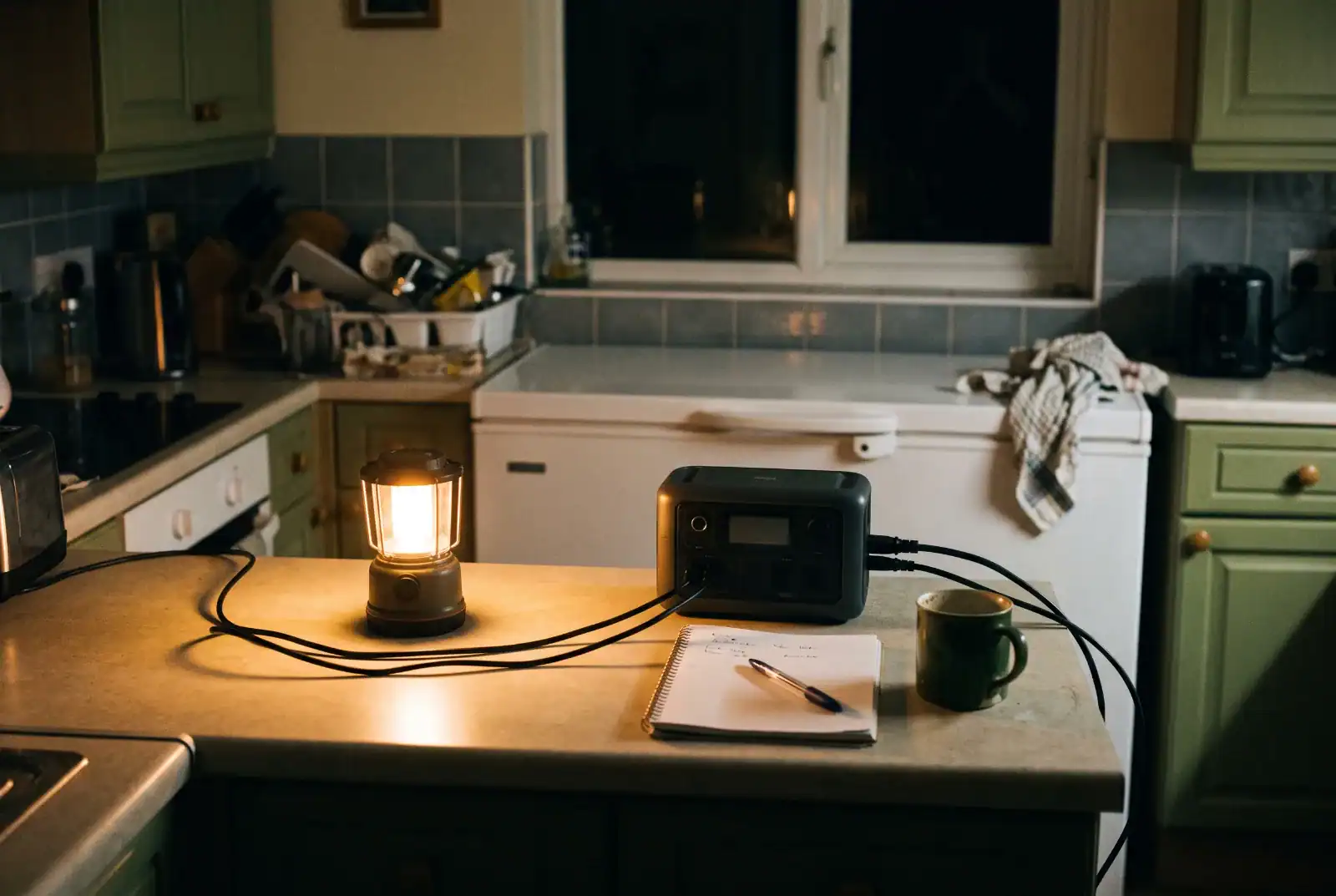
The ice in the freezer is starting to slump. It’s hour nine of the outage, the lineman crews are two counties over, and you’re standing in the kitchen doing arithmetic you should have done in April.
You own a power station. You bought it after the last storm. And you’re now discovering that the number printed on the front of it — the one that sounded enormous in the store — doesn’t tell you whether it can run your refrigerator, or for how long, or whether plugging it in will simply trip the inverter the second the compressor kicks on.
That’s not a gear problem. It’s a sizing problem, and you can solve it on a Saturday afternoon for free.
What Off-Grid Power Actually Means
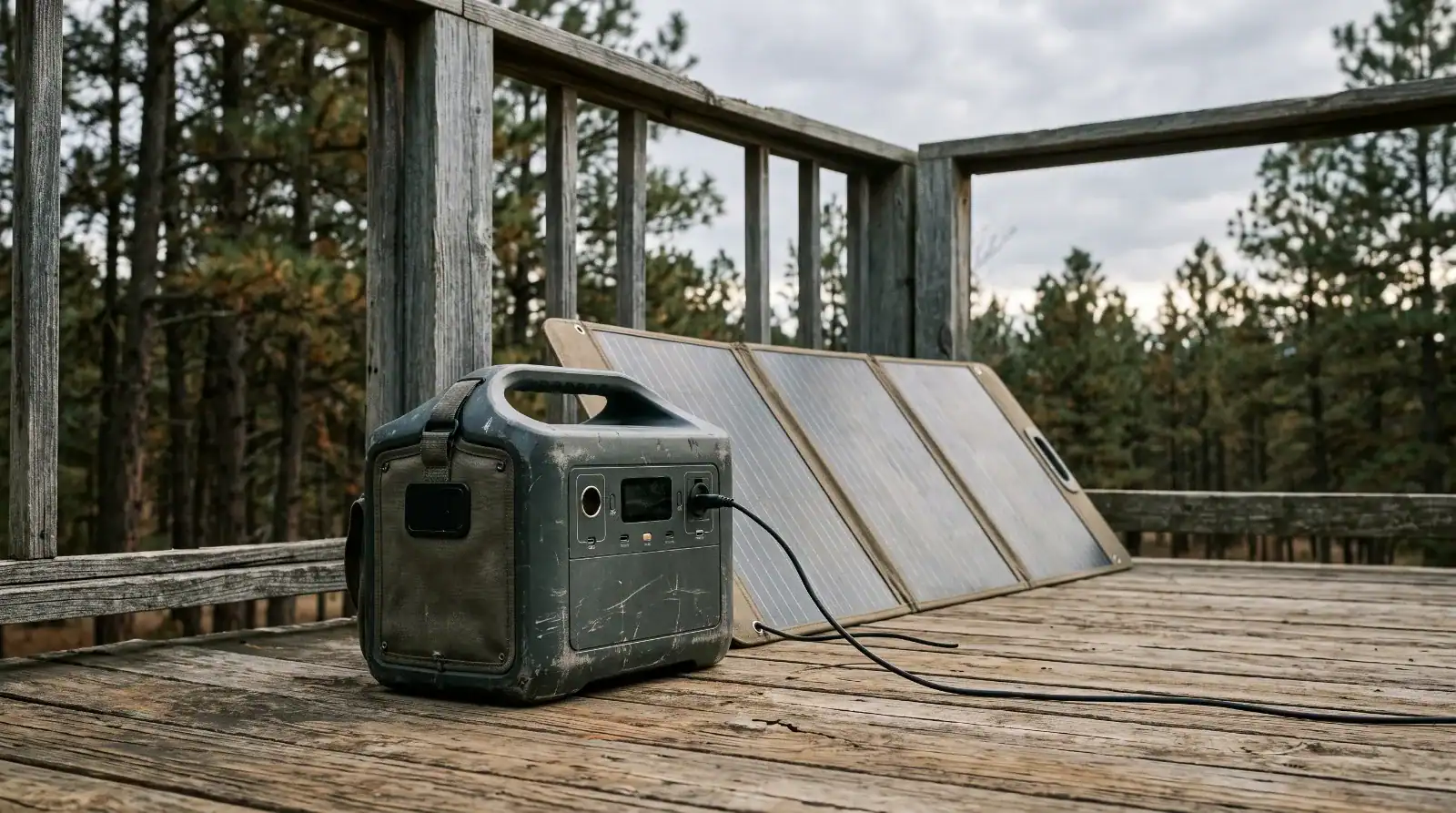
Off-grid power is any setup that keeps your essential loads running when the utility doesn’t: a portable power station, a solar generator with panels, a fuel generator, or some combination.
The category is easy to shop for and hard to size. Every product page leads with a big capacity number, because a big number sells. Almost none of them start where you have to start, which is with a list of what actually has to stay on.
There are three numbers that matter, and confusing them is the single most expensive mistake in this category.
Watts tell you whether a device can run at all. Surge watts tell you whether it can start — motors and compressors briefly pull several times their running draw. Watt-hours tell you how long. A station rated 1,000 Wh delivers 1,000 watts for an hour, or 100 watts for ten. Roughly. We’ll get to why “roughly” is doing work in that sentence.
Reasons You Need to Know This
- Buying too small is the obvious failure, and the one people fear. It’s also the less common one.
- Buying too big is the expensive failure. Capacity costs money and weight, and most people size for a fantasy load list that includes a coffee maker.
- Buying the wrong shape is the invisible failure. Plenty of stations have the watt-hours to run a fridge for a day and not the surge headroom to start it once.
- You cannot fix any of this during the outage. The store is closed and so is the internet.
Step-by-Step Instructions to Size Your Off-Grid Power
Six steps. The first four are arithmetic and take about an hour. The last two are where most setups actually fail.
- List what must stay on — not what you’d like on
- Do the watt-hour math — daily energy, not peak draw
- Check the surge — the number that trips inverters
- Add the losses — you don’t get what’s on the label
- Size the panel for your real sun — not the sticker
- Run it for a weekend — before you need it
Step 1: List What Must Stay On
Write it down. Actual pen, actual paper, because this list becomes the reference you use for everything after.

The discipline here is brutal honesty about the difference between essential and nice. Refrigeration, medical equipment, phone charging, some light, and in cold country a way to run the furnace blower — that’s a real list. Coffee makers, microwaves, space heaters and hair dryers are resistive loads that draw close to their full rated wattage the entire time they’re on, and they will end this exercise fast. A 1,500 W space heater run for four hours is 6,000 Wh, which is more than most portable stations hold at all.
If you have a medical device, it goes at the top and it is non-negotiable. If it’s a CPAP, note whether you use heated humidification, because it roughly doubles the draw.
Step 2: Do the Watt-Hour Math
For each item: running watts × hours per day = watt-hours per day. Add them up.
The one that trips everybody is the refrigerator. It does not draw its running wattage for 24 hours — the compressor cycles, typically running somewhere around a third of the time. Size it as if it runs continuously and you’ll triple your answer and your budget.
A worked example for a 24-hour outage lands around 2,300 Wh for a genuinely essential list. That number is your anchor for everything that follows.
If you want the real figure rather than a planning estimate, a plug-in energy meter costs about fifteen dollars and will tell you exactly what your fridge uses over 48 hours, defrost cycle included. That is the single best fifteen dollars in this entire post.
Step 3: Check the Surge, Not Just the Running Watts
This is the step that turns a working setup into a useless one, and it’s the step nobody does.
Anything with a compressor or a motor — refrigerator, freezer, well pump, sump pump, furnace blower — pulls a brief startup surge far above its running draw. A fridge running at 150 W can demand somewhere between 600 and 1,800 W for a second or two when the compressor starts. If your station’s inverter can’t supply that, it shuts off, and it doesn’t matter that the capacity was plenty.
Two things to check on the spec sheet: continuous AC output must exceed the combined running watts of everything on at once, and surge rating must cover your largest motor load’s startup. If a spec sheet doesn’t publish a surge figure, that tells you something about the manufacturer.
One more: use a pure sine wave inverter. Medical equipment, anything with a motor, and most modern electronics want clean power. Modified sine wave is cheaper and is a bad idea for a CPAP.
Step 4: Add the Losses You Don’t Get on the Label
A station rated 1,000 Wh does not give you 1,000 Wh. Between inverter conversion and usable depth of discharge, plan on roughly 85% — and less in the cold.
So take your daily total and divide by 0.85. Our 2,300 Wh example needs about 2,700 Wh of rated capacity to genuinely cover 24 hours. Round up to the next real product size rather than shaving it, because the day you need this will not be a mild day.
Cold matters more than people expect. Lithium batteries lose usable capacity in the cold and many refuse to charge below freezing. If your plan is a power station in an unheated garage in January, that’s a real derating on top of everything else, and it’s covered in the winter power outage guide.
Step 5: Size the Panel for Your Actual Sun
Here’s where the marketing gets furthest from reality.
A 200 W panel does not deliver 200 W. That number comes from a lab at a perfect angle and 25°C. Outdoors you lose output to heat, angle, haze, cable runs and conversion — real delivery lands somewhere around 50–75% of rated in good conditions, and far less under cloud.
Then there’s time. A full day of daylight only delivers the equivalent of about 4–6 peak sun hours, concentrated around midday. So a 200 W panel realistically harvests something like 600–900 Wh across a good day.
Put those together and the uncomfortable conclusion is this: solar rarely keeps up with a real load list on its own. Our 2,300 Wh/day example would need something like 600–800 W of panel, aimed and clean, to break even in decent weather. Solar extends your runway. It does not usually replace the grid.
One specification people miss entirely: your station has a maximum solar input. If it caps at 100 W, buying a second panel does nothing at all. Check that number before you buy panels, not after. The portable solar power station comparison covers where those caps sit across the common units, and if you’re deciding between the two biggest brands, the EcoFlow versus Jackery breakdown is the head-to-head.
Step 6: Run It for a Weekend
Everything above is arithmetic until you test it.
Pick a Saturday. Unplug the refrigerator from the wall and run it off the station. Note what time you started and what time the station hits 20%. That single number is worth more than every spec sheet you’ve read, because it accounts for your fridge, your climate, your kit, and your habits.
While you’re at it: start the fridge on the station at least once and confirm the inverter doesn’t trip. Confirm your solar setup actually charges at the rate you expected. And confirm you know where the cables are without a flashlight, which sounds trivial until it’s dark.
Most people find one problem in this test. Finding it on a Saturday costs you an afternoon. Finding it in hour nine of an outage costs considerably more.
Key Considerations For Off-Grid Power That Actually Works
Fuel generators and battery stations solve different problems. A fuel generator makes big power for motor loads — well pumps, window units, furnace blowers — and runs as long as you have fuel. A battery station is silent, safe indoors, and finite. Plenty of households want both: the generator for the heavy stuff a few hours a day, the station for the quiet overnight loads. The home power redundancy guide works through layering them.
Never run a fuel generator indoors, in a garage, or near a window. Carbon monoxide kills people every single storm season, and it kills them in attached garages with the door open. This is the one item on this page that is genuinely about survival rather than convenience.
Batteries self-discharge and firmware needs updating. A station left in a closet for two years may not be at the charge level you assume. Top it up quarterly and put it on the same calendar reminder as your smoke detector batteries.
Your fridge is the whole game. For most households, refrigeration is more than half the daily load. If you solve the fridge, you’ve solved off-grid power. Everything else is phones and lights.
Taking It to the Next Level: Loads You Can Shed
The cheapest capacity is the capacity you don’t need.
A chest freezer holds temperature for a day or more if you leave the lid shut, so it may not need power at all in a 24-hour outage. Moving fridge contents into a cooler with ice for the first day can take your biggest load off the list entirely. Running lights on their own rechargeable batteries rather than off the station keeps the inverter idle — worth pairing with dedicated flashlights and lanterns instead of charging phones for light.
Shedding loads is unglamorous and it’s the highest-return move available. Every watt-hour you don’t need is a watt-hour you don’t have to buy, carry, or recharge.
Alternatives to a Portable Power Station
A fuel generator if your loads include a well pump, sump pump, or anything that has to move water. Batteries struggle with those surges; a 3,500 W or larger generator doesn’t.
A vehicle as a bridge. A truck with an inverter will keep phones and a CPAP going, and it recharges itself. It won’t run a fridge for long, and idling burns fuel you may want later — but it’s already in your driveway.
Doing nothing, deliberately. If you live somewhere with reliable power and your longest outage in a decade was four hours, a cooler of ice and a good flashlight may genuinely be the right answer. Not every household needs a battery. I’d rather say that than sell you one.
Frequently Asked Questions
What size power station do I need for a refrigerator?
For 24 hours of refrigeration alone, plan on roughly 1,200 Wh of consumption, which means about 1,500 Wh of rated capacity after losses — and a surge rating that covers your compressor’s startup, commonly 600–1,800 W. Check your fridge’s nameplate rather than trusting a general figure.
How long will a 1,000 Wh power station run my fridge?
Somewhere between 10 and 15 hours for a typical modern fridge, depending on ambient temperature, how full it is, and how often the door opens. Less in a hot kitchen, more in a cold one.
Can I run a CPAP off a power station all night?
Yes, easily. Without heated humidification a CPAP draws roughly 30–60 W, so a night runs about 240–480 Wh. Heated humidification and heated tubing can roughly double that. A 1,000 Wh station covers one to two nights; use a pure sine wave inverter.
Do I need solar panels or just a battery?
A battery alone is fine for outages measured in hours. Panels matter when the outage runs multiple days, or when you’re genuinely off-grid. Given real-world derating, budget considerably more panel wattage than intuition suggests.
Is a solar generator better than a gas generator?
They solve different problems. Battery stations are silent, indoor-safe and maintenance-free but finite. Fuel generators make far more power for motor loads and run as long as you have fuel, but they’re loud, need maintenance, and produce carbon monoxide. Many households benefit from both.
How often should I test my setup?
Twice a year, and always before storm season. A station you’ve never run under load is an assumption, not a plan.
Wrapping Up: What I’d Actually Do First
The temptation with off-grid power is to start by shopping. Don’t. Start with the fifteen-dollar energy meter and a sheet of paper.
Plug the meter into your refrigerator and leave it for 48 hours. That one measurement — your fridge, your kitchen, your climate — replaces every planning estimate on this page and most of the ones you’ll find anywhere else. Then write your list, do the arithmetic, and only then look at products.
You’ll almost certainly end up buying something different from what you would have bought first. Usually smaller, occasionally larger, but nearly always a different shape — because the surge rating and the solar input cap turn out to matter more than the headline capacity that was going to make the decision for you.
Then run it for a weekend, before the weather makes the decision for you.
If you want the rest of the kit squared away on the same schedule, the free 30-Day Preparedness Plan walks it one day at a time.
Adventure Wiser tests gear in the field before it goes on the site. If it doesn’t hold up on the trail, it doesn’t make the cut.