


Investing in power shouldn’t be a gamble. But let’s look at the current state of the electrical grid: it’s aging, it’s overloaded, and it’s increasingly prone to “public safety power shutoffs” that leave you in the dark while the utility company manages its liability. Most people treat backup power like a cheap insurance policy they hope they never have to use. They buy a loud, gas-guzzling generator, shove it in the garage, and assume they’re “safe.”
But hope is not a strategy. If your grid goes down during a five-day blizzard, a single point of failure can liquidate your entire “asset” (your home comfort). That’s why we advocate for home power redundancy systems. True redundancy isn’t just about having a backup; it’s about having multiple, overlapping paths to keep your lights on when the primary source fails. Whether you’re protecting a home office or a freezer full of expensive wagyu, you need a tiered defense strategy. In this guide, we’ll show you how to layer your energy assets into a system that actually works when the world stops.
What is home power redundancy?
At its heart, home power redundancy systems represent a shift from “standby backup” to a “multi-layered energy architecture.” In the financial world, you wouldn’t put 100% of your net worth into a single speculative stock. You diversify. You have core holdings, growth assets, and hedges. Home power redundancy systems follow the same logic.
Instead of relying on one big engine to save you, home power redundancy systems use a combination of battery storage, renewable generation, and mechanical backup. This ensures that even if one component fails (like your solar panels being covered in three feet of snow), another kicks in.
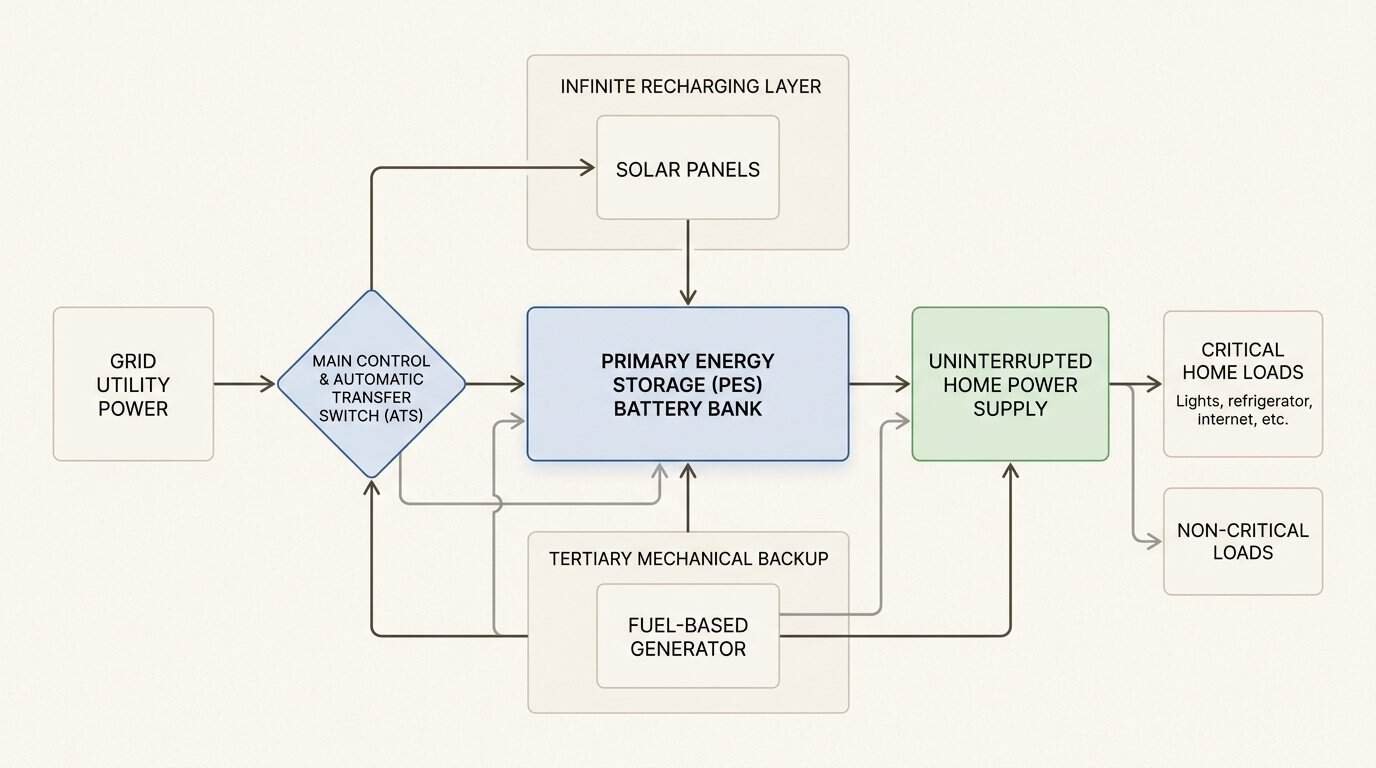
We generally categorize these systems into three main layers:
- Primary Energy Storage (PES): This is your core holding. It’s a high-capacity battery bank that provides instant, clean power the second the grid drops.
- Infinite Recharging Layer: This is your growth asset. Usually solar, this layer allows you to “earn” power from the sun, making your redundancy truly sustainable for multi-day outages.
- Tertiary Mechanical Backup: This is your hedge. A fuel-based generator that acts as a “break glass in case of emergency” source when the batteries are low and the sun isn’t shining.
By integrating these into cohesive home power redundancy systems, you move from “hoping the lights stay on” to “knowing they will.”
Reasons you need to know home power redundancy systems
Grid instability is no longer a “prepper” fantasy; it’s the new normal. Aging infrastructure and extreme weather events are causing interruptions that happen multiple times per year (or even per month in some regions). If you value your productivity and property, you need to understand how home power redundancy systems protect your interests.
Here are a few specific reasons why this matters:
- Food preservation: Preventing “liquidated” groceries and the health hazards of a warm refrigerator.
- Remote work connectivity: The cost of being offline for 48 hours often exceeds the cost of the redundancy system itself.
- Medical equipment safety: Ensuring CPAPs, nebulizers, and mobility equipment remain operational without interruption.
- Property protection: Keeping sump pumps running during a storm to prevent catastrophic basement flooding.
Setting up a tiered defense strategy is the only way to ensure you’re never “liquidated” by a grid failure. Let’s break down the process.
Step-by-step instructions to build home power redundancy systems
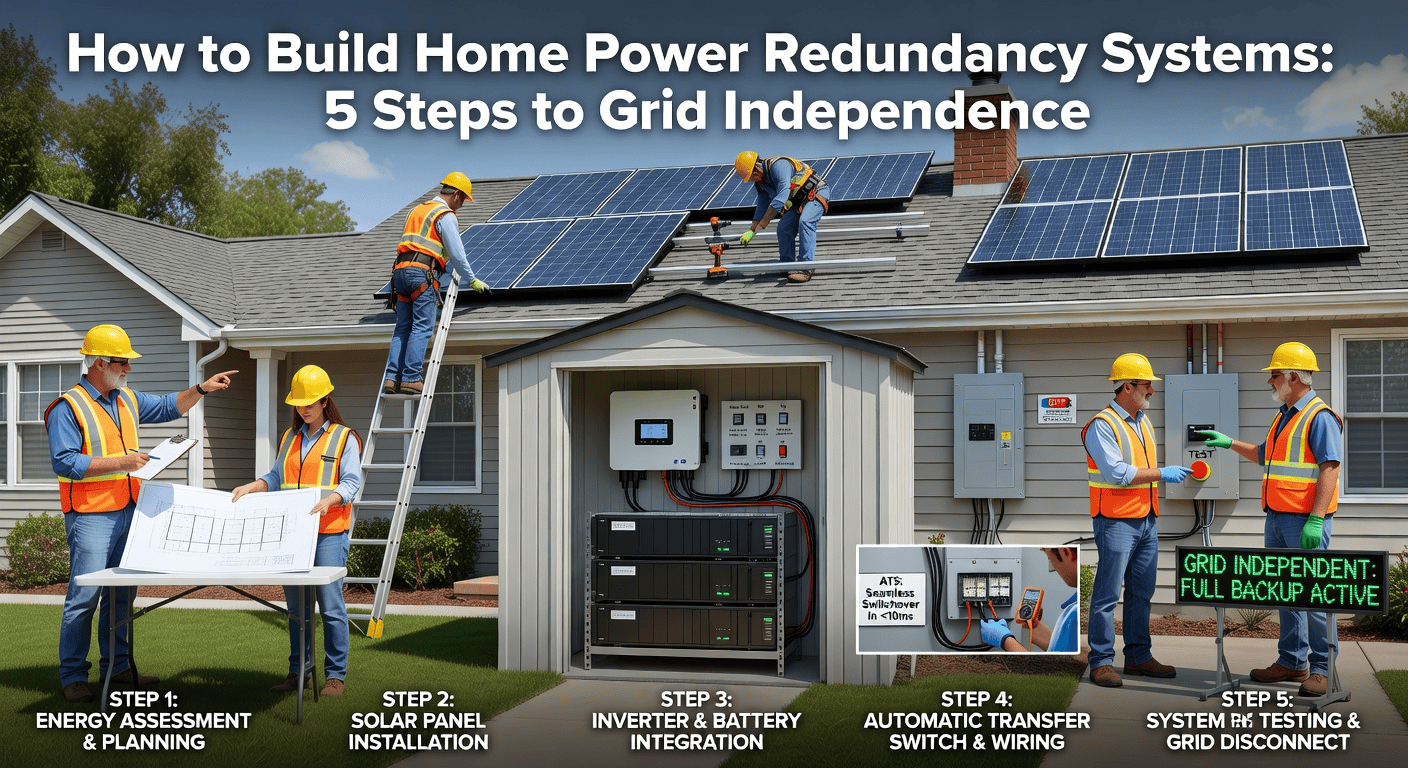
Building home power redundancy systems requires a disciplined approach. You aren’t just buying gear; you’re designing a private utility. The goal is to minimize “points of failure” while maximizing uptime. As one experienced off-grid user on the DIY Solar Forum noted, “the more points of failure you have, the more points of failure you have the potential to encounter.” We build our home power redundancy systems to route around those failures.
Here is our unique 5-tier process for protecting your domestic energy assets.
Step 1: Audit your critical electrical loads
Before you spend a single dollar on home power redundancy systems, you must know what you are actually trying to power. Most people overestimate their “needs” and underestimate their “wants.” In an emergency, your hot tub is a liability; your refrigerator is a necessity.
To start, identify your “Critical Loads.” This usually includes:
- Refrigerator and freezer (approx. 2-3 kWh per day)
- Internet router and home office setup (approx. 1-2 kWh per day)
- Sump pump or well pump
- A few LED lighting circuits
- Medical devices
Use a load sizing tool to calculate the total watt-hours required for 24 hours of survival. This number is your “Daily Burn Rate.” If your daily burn rate is 10 kWh, your home power redundancy systems should ideally have at least 20-30 kWh of storage to handle multi-day blizzards without stress.
Step 2: Establish the battery core (PES)
Your battery bank is the “Blue Chip” asset of your home power redundancy systems. For modern systems, Lithium Iron Phosphate (LiFePO4 or LFP) is the only technology worth considering. Unlike old lead-acid batteries, LFP batteries can cycle thousands of times and last for over a decade.
We recommend starting with a core like the EcoFlow DELTA 3 Max Plus. At $1,099.00 (MSRP $1,899.00), it provides 2048Wh of capacity and a 3000W output. It’s scalable up to 10kWh, which is essential for growing your home power redundancy systems as your needs change.
Alternatively, for a more “industrial” fixed installation, you might look at the Fortress Power eFlex 5.4kWh. These batteries are rated for 8,000 cycles at 80% Depth of Discharge, meaning they will likely outlast the house they are installed in.
Step 3: Configure your automatic transfer logic (ATS)
A battery is useless if you have to fumble in the dark to plug your fridge into it. True home power redundancy systems require an Automatic Transfer Switch (ATS). This device monitors the grid and automatically flips your critical circuits over to battery power the millisecond the grid fails.
For the fastest transition, we look at systems like the EcoFlow Smart Home Panel 2, which offers a 20ms auto-switchover. If you have sensitive electronics like a desktop PC or a NAS, you should supplement this with local UPS (Uninterruptible Power Supply) units at the “Last Mile.” This “redundancy within redundancy” ensures your data isn’t corrupted during the brief gap when the ATS is switching.
Step 4: Layer in your recovery asset (Solar)
Stored energy is a finite resource. To make your home power redundancy systems truly resilient, you need a way to recharge when the grid stays down for days. Solar is the only way to “earn” your way out of a power deficit.
When designing the solar layer of your home power redundancy systems, don’t just think about summer peak performance. You must design for the “worst-case scenario” (winter). This means over-provisioning your panels. If you need 5 kWh per day, install enough panels to generate 10 kWh on a cloudy day.
The Oupes Mega 2 Pro 4096Wh Ultimate Home Backup Kit is a strong contender for the solar layer. It bundles 4096Wh of LFP capacity, 2500W of output, two 240W solar panels, and a 1000W Anderson hub for https://oupes.com/products/oupes-2400w-portable-power-station,129.00, giving you an expandable, ready-to-deploy setup for your home power redundancy systems.
Step 5: Secure your mechanical backup (Generator)
The final layer of sophisticated home power redundancy systems is the “hedge.” This is a fuel-based generator. We don’t like them as primary sources because they are loud, dirty, and require maintenance. But as a tertiary source, they are invaluable.
If a blizzard lasts for five days and covers your solar panels, your home power redundancy systems will eventually run dry. A small propane or dual-fuel generator can be used to “top off” your battery core during the few hours a day you actually run it.
To integrate this properly, we use components like the Victron Orion-Tr DC-DC. These isolated converters allow you to safely charge your high-end lithium bank from a different voltage source or even an old lead-acid system you have lying around. It’s the “Lego” of home power redundancy systems, allowing you to bridge different technical eras for maximum uptime.
Key considerations for successfully building home power redundancy systems
Let’s break down the reality of these investments. Building high-end home power redundancy systems is not a weekend DIY project you can finish for fifty bucks. It’s a capital investment.
The “Sticker Shock” Reality
True redundancy isn’t cheap. If you want a system that can power your fridge, lights, and internet for three days without sun, you’re looking at a $10,000 to $20,000 investment. Treat this like an insurance premium for your lifestyle. The ROI isn’t found in your monthly utility bill; it’s found in the lack of stress when the neighborhood goes dark and your home stays bright.
Maintenance Matters
Redundancy systems often rot from the inside if they aren’t used. We recommend performing “shakedown runs” every six months. Shut off your main breaker and let your home power redundancy systems take over for 24 hours. Does the ATS flip correctly? Do the batteries balance properly? Does the generator start? If you don’t test it, you don’t have it.
Temperature Resilience
Lithium Iron Phosphate batteries are excellent, but they hate the cold. If you live in a climate where blizzards are common, your home power redundancy systems must include heaters or be installed in a climate-controlled space. Batteries like the Fortress Power Envy 12kW system often pair with heated battery options (like the eForce) specifically for this reason.
Taking it to the next level: Whole-home automation
If you really want to optimize your home power redundancy systems, move from manual circuit management to smart panels. A smart panel, like the EcoFlow Smart Home Panel 2, allows you to set “Smart Power Reserves.” If an outage hits, the panel can automatically “shed” non-essential loads like your dishwasher while prioritizing your fridge.
Furthermore, these home power redundancy systems can often participate in Virtual Power Plants (VPPs). This means you can actually get paid by the utility company to discharge your batteries during peak demand. Your “insurance policy” could actually start paying you dividends.
Alternatives to home power redundancy systems
Not everyone needs a five-tier defense. Here are the “lite” versions:
- Standby Generators (Generac/Kohler): These are the traditional choice. They provide massive power but are loud, maintenance-heavy, and depend entirely on a fuel supply that might be interrupted during a major disaster.
- Portable Power Stations: These are great for renters. They offer a “micro” version of home power redundancy systems that you can take with you if you move. They lack the seamless integration of a fixed system but provide immediate relief for critical devices.
Start building your home power redundancy systems today
The grid is a “leaky bucket,” and it’s not getting fixed anytime soon. Building home power redundancy systems is the only way to ensure your family’s safety and comfort when the infrastructure fails.
Let’s recap the 5 steps:
- Audit your critical loads (know your “burn rate”).
- Establish a LiFePO4 battery core for instant power.
- Configure an ATS for seamless switchover.
- Layer in solar for infinite recharging.
- Secure a generator as a tertiary hedge.
Bottom line? Investing in home power redundancy systems is about taking control of your most basic needs. While your neighbors are trading canned goods by candlelight, you’ll be finishing your work day or watching a movie. Check out our other Witty or Risky reviews of energy hardware to find the best components for your specific budget and investing guides to stay ahead of the curve.
Frequently Asked Questions
How much do true home power redundancy systems cost to install?
A comprehensive system covering critical loads for 3+ days typically costs between $10,000 and $20,000 depending on the battery capacity and inverter power.
Can I install home power redundancy systems myself?
While portable power stations are plug-and-play, any system involving an Automatic Transfer Switch or a smart home panel requires a qualified electrician to ensure safety and code compliance.
Do home power redundancy systems work in the winter?
Yes, but you must ensure your batteries are either in a climate-controlled space or have built-in heaters, as LFP batteries cannot charge below freezing temperatures.
How long will home power redundancy systems last?
Modern LiFePO4 systems like those from EcoFlow or Fortress Power are rated for 10+ years of daily use, making them a long-term capital investment.
Do I need solar panels for effective home power redundancy systems?
While batteries provide instant backup, solar panels are the only way to recharge your system during extended, multi-day grid failures when fuel might be unavailable.
Keep Your Power On (Even When the Grid Taps Out)
If this post got your gears turning about energy independence, don’t stop here. Building a resilient home isn’t a one-tool job… it’s a layered system, like a good defense plan or a well-built investment portfolio.
Here are three next steps to sharpen your setup:
- Best Solar Generators for Preppers in 2026 (Field-Tested Picks That Actually Work)
→ Because not all “solar generators” are created equal. Some are workhorses. Others are expensive paperweights with handles. - Emergency Food & Water Storage Guide (2026): Build a Supply That Won’t Betray You
→ Power is great… until your fridge is full of nothing. Pair your energy plan with a food and water strategy that survives longer than your last grocery run. - How to Build a Bug-Out Power Kit That Actually Works (Without Overthinking It)
→ For when staying put isn’t the plan. A mobile power setup keeps your gear running when your address changes unexpectedly.
Layering a generator and a battery only works once you know what each layer has to carry. Start with the load list.