

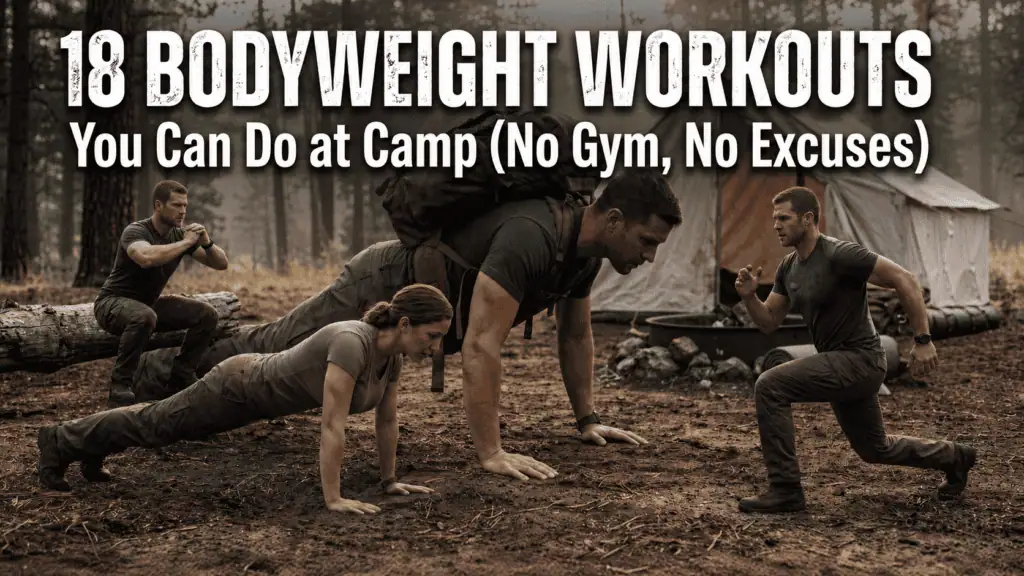
At a Glance: The 18-Move Survival Fitness Blueprint
The mission: Build trail-ready, functional strength without a commercial gym, electricity, or expensive equipment.
The method: Eighteen bodyweight workouts split into mobility, upper-body strength, lower-body strength, and conditioning.
The minimum gear: Your own skeleton, gravity, and enough stubbornness to avoid becoming a liability in the woods.
The payoff: Strength that translates directly to carrying a loaded pack, climbing rough terrain, moving firewood, setting up shelter, and handling whatever the day throws at you.
If you want to stay physically prepared for wilderness travel, emergency evacuations, or survival situations, bodyweight workouts should be part of your baseline training. You need enough functional strength to carry a heavy pack, climb over deadfall, chop wood, move quickly across uneven terrain, and get yourself off the ground without requesting assistance from a nearby pine tree.
I’ve done bodyweight workouts on a pitching boat deck during my four years in the Navy, on the side of a mountain, and once in a Motel 6 parking lot at 0500 because the local gym didn’t open until six. As a 52-year-old guy with more than 20 years of outdoorsmanship and prepping experience, my point is simple: your excuse for skipping bodyweight workouts has never required a gym. It has only required you.
If you plan meticulously for grid-down scenarios but still think fitness only happens on an elliptical with a TV bolted to it, we need to talk. The best piece of survival equipment you’ll ever own is already attached to your skeleton — and a perfectly packed bug-out bag isn’t especially useful when your legs surrender after the first uphill mile.
Safety note: Adjust these exercises to your fitness level. Stop if you experience sharp pain, dizziness, chest pain, or unusual shortness of breath. Speak with a healthcare professional before starting a new exercise program, particularly with an existing condition, injury, or long period of inactivity.
Why Bodyweight Workouts Beat a Gym Membership Off-Grid
A gym membership assumes three things a grid-down or bug-out situation may not provide: reliable electricity, a climate-controlled building, and a monthly billing cycle anyone still cares about. Bodyweight workouts assume none of that — they scale to wherever you’re standing, whether that’s a campground, a trailhead, or the dirt beside your truck.
Bodyweight resistance training builds strength, muscular endurance, coordination, and overall physical function; the American College of Sports Medicine’s updated resistance-training guidance recognizes bodyweight exercises and home-based routines as practical ways to train without conventional gym equipment. The gym building is optional. Consistent bodyweight resistance is not.
These movements also build patterns that carry over to real outdoor tasks: squatting to lift gear, lunging across uneven ground, pushing yourself off the earth, bracing beneath a loaded pack, carrying awkward objects, moving quickly while fatigued. It’s not about a trailhead selfie — it’s about moving your body weight plus a loaded pack plus whatever the day throws at you without your knees filing a complaint.
Warm-Up: 3 Moves in About 5 Minutes
Going straight from sitting by the fire into burpees is a fine way to make tomorrow unnecessarily dramatic. Mayo Clinic recommends beginning with slower, lower-intensity movement before ramping up effort. Run these three bodyweight workouts in order.
1. High Knees or Jumping Jacks — 45–60 seconds. Start slow for 15 seconds, then build pace. You should feel warmer and slightly winded, not already questioning your life choices. This gradually raises your heart rate — the human equivalent of letting an old truck warm up before dragging something uphill.
2. Bear Crawl — Hands and feet on the ground, knees an inch or two off the dirt, crawl forward 10 controlled steps, then back. Keep hips low and movements deliberate. This fires shoulders, hips, legs, and core together — useful when your first task of the day is breaking down a wet tent or hauling water.
3. World’s Greatest Stretch — Step into a deep lunge, hands inside your front foot, rotate your torso and reach one arm skyward. Hold 2–3 seconds, switch sides, five reps per side. Mayo Clinic advises warming cold muscles with 5–10 minutes of light movement before deeper stretching. It opens hips and improves upper-back mobility so you can step over obstacles, kneel, and climb without moving like a folding lawn chair in a windstorm.
Upper-Body Bodyweight Workouts
These upper-body bodyweight workouts are where functional preparedness starts separating from gear collecting. If you can’t move your own body mass, manipulating your environment gets a lot harder.
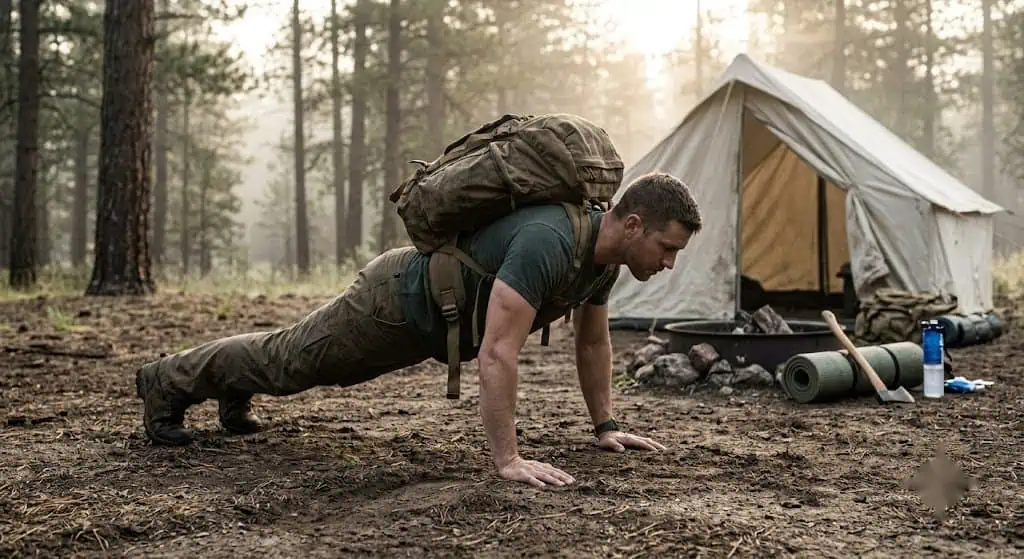
4. Push-Ups — High plank, hands slightly wider than shoulders, lower your chest, press back up. Three sets, stopping a rep or two before your form falls apart. Beginner: hands elevated on a log or tailgate. Advanced: a securely fastened loaded pack on your back. Builds chest, shoulder, tricep, and core strength for pushing off the ground and moving gear.
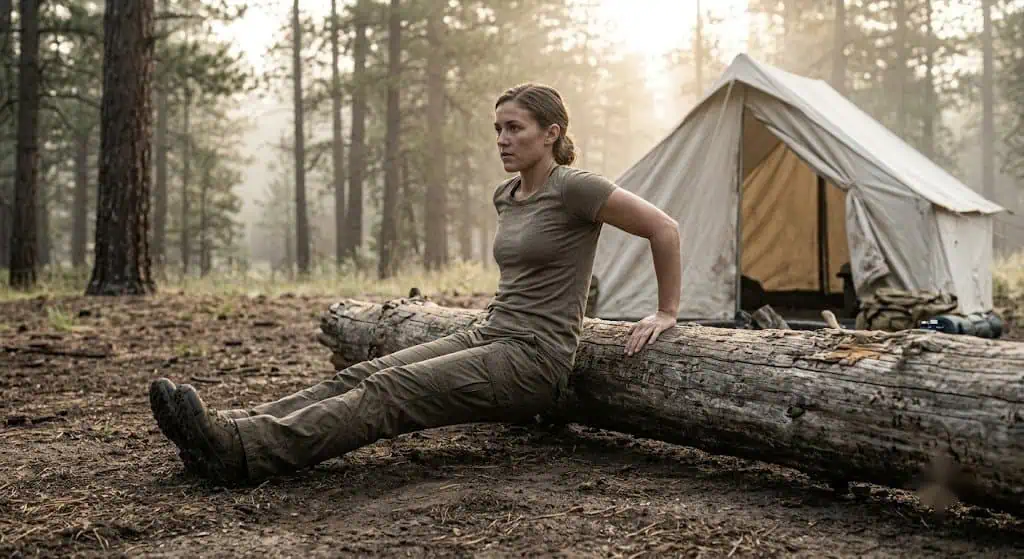
5. Log or Rock Tricep Dips — Hands on a knee-height log or tailgate, hips forward, legs extended, bend elbows to ~90 degrees, press back up. Three sets of 8–12. Beginner: bend the knees. Builds pushing strength for climbing and scrambling.
6. Forearm Plank — Forearms down, elbows under shoulders, straight line head to heels, core braced. Hold 20–60 seconds, three sets. A strong core stabilizes your spine under a pack; a weak one turns every step into an argument between your shoulders, hips, and lower back.
7. Plank Shoulder Taps — High plank, tap the opposite shoulder with each hand without rotating your hips. Three sets of 10–20 total taps. Adds anti-rotation training that helps your core resist twisting while carrying uneven loads.
8. Mountain Climbers — High plank, drive knees to chest, switching quickly while keeping hips and spine controlled. Three rounds of 20–30 seconds. Combines upper-body endurance, core stability, and conditioning — the terrain won’t care that you skipped training last week.
9. Pike Push-Ups — From plank, walk feet toward hands until hips form an inverted V, lower the top of your head toward the ground, press back up. Three sets of 6–10. Beginner: hands on an elevated surface. Builds overhead pushing strength for pitching shelter and handling gear overhead.
Lower-Body Bodyweight Workouts
Your legs are your primary transportation system when fuel runs out or roads close. These lower-body bodyweight workouts treat them accordingly — unlike a bad stock pick, time invested here keeps paying.
10. Bodyweight Squats — Feet shoulder-width, sit hips back and down, chest up, knees tracking with toes, drive back up. Three sets of 12–20. Beginner: squat to a log or camp chair. Advanced: wear a loaded pack. Foundational for hiking uphill, lifting gear, and standing up after tying your boots.
11. Walking Lunges — Step forward, lower the back knee, push through the front foot into the next rep. Three sets of 8–12 per leg. Builds unilateral strength — terrain rarely loads both legs evenly.
12. Step-Ups on a Rock or Log — Use a solid, stable surface. Drive through the planted foot to stand tall, step down under control. Three sets of 8–12 per leg. Mimics climbing steep trail and stepping over deadfall — a free StairMaster, minus the fluorescent lighting.
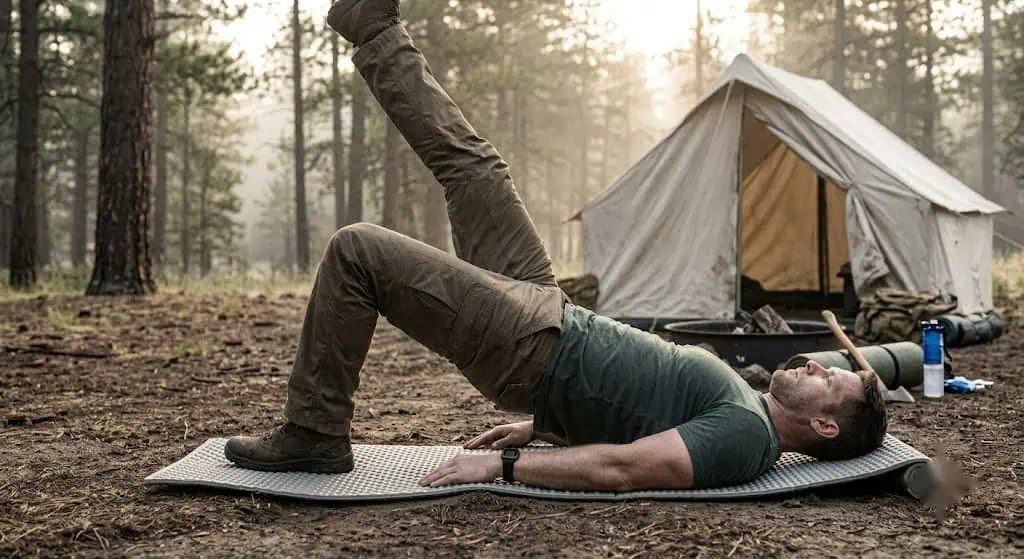
13. Single-Leg Glute Bridge — On your back, one knee bent and planted, other leg extended, drive hips up through the planted heel. Three sets of 10–15 per side. Stabilizes hips and knees for climbing and carrying loads on uneven ground.
14. Calf Raises — Balls of feet on firm ground or a step edge, raise heels, lower slowly. Three sets of 15–25. Your calves propel you uphill and control your descent — train them before the mountain does it for you.
Conditioning: Survival Fitness for the Real World
Strength without work capacity disappears once your heart rate climbs. The CDC describes moderate effort as talk-but-not-sing and vigorous effort as only a few words between breaths. Save something for the walk back to camp — these bodyweight workouts should leave you tired, not wrecked.
15. Burpees — Squat, hands down, step or jump back to plank, push-up if appropriate, feet forward, stand, small jump. Three sets of 6–10. Everybody hates burpees. I hate burpees. Do them anyway — they teach your body to repeatedly go from ground to standing.
16. Bear Crawl Sprints — Bear-crawl position, crawl forward fast for 15–20 feet, walk back to recover. Four rounds. Builds full-body coordination and short-burst conditioning.
17. Rucksack Farmer’s Carry — Load a sturdy pack lighter than you think you need, carry it one-handed by the top or side handle for 20–40 yards, switch hands. Three rounds per side. Builds grip, core stability, and the ability to move an awkward load over real distance. Weight guidance: 40–50 lbs may suit a trained person, but that’s not a universal starting point — the goal is more capability, not a lower-back emergency beacon.
18. Odd-Object Carry — Squat beside a log, rock, or water container, brace, lift through hips and legs, carry 20–40 yards, lower with control. Three rounds. Real gear doesn’t arrive with symmetrical iron handles — this trains your body to adapt (and teaches you that a rock “probably 30 pounds” often weighs one small moon).
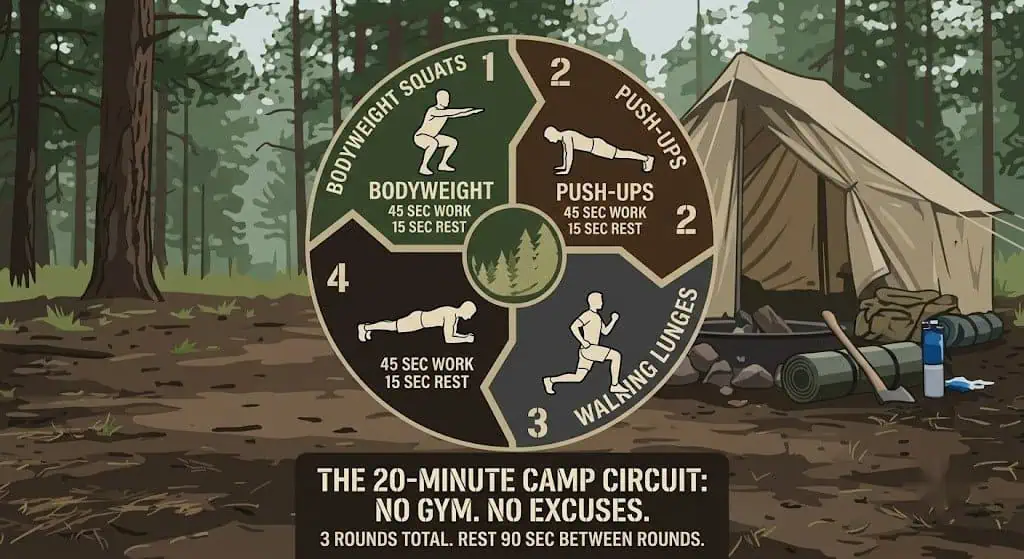
A Simple 20-Minute Bodyweight Circuit
The Camp Circuit: 45 seconds work, 15 seconds transition, through squats → push-ups → walking lunges → mountain climbers → forearm plank. Rest 90 seconds, complete three rounds (~20 minutes total).
Beginner: 30 seconds work / 30 seconds rest, one or two rounds. Advanced: wear a light pack during squats and lunges, use loaded push-ups, or stretch the work interval to 50 seconds — don’t stack every progression at once unless you enjoy regret.
Federal physical activity guidelines recommend muscle-strengthening work for all major muscle groups at least twice a week alongside regular aerobic activity. Use this bodyweight circuit as one piece of a broader weekly plan, not a way to solve your entire fitness life in one furious Tuesday.
How to Build a Weekly Survival Fitness Plan
- Day 1 — Strength: Warm-up, push-ups, pike push-ups, squats, walking lunges, planks, odd-object carries
- Day 2 — Walking or Rucking: 30–60 minutes at a sustainable pace, adding pack weight gradually
- Day 3 — Recovery: Easy walking, mobility, light stretching
- Day 4 — Camp Circuit: The 20-minute circuit above
- Day 5 — Carry and Conditioning: Bear crawls, step-ups, mountain climbers, rucksack carries, burpees
- Weekend — Field Practice: Hike, practice dead-reckoning navigation, carry your actual gear, and find out if your loadout still seems brilliant after mile four
Progressing Your Bodyweight Workouts
Bodyweight workouts stop working when you repeat the same easy session forever. Change one variable at a time: add reps, add a set, slow the lowering phase, pause at the hardest position, extend the range of motion, trim rest slightly, use a harder variation, add a light pack, carry farther, or just perform the movement more cleanly. The goal isn’t to make every session unbearable — it’s to get slightly more capable over time.
Recovery Still Counts as Training
Recovery is part of bodyweight training too — training harder than you can recover from isn’t toughness, it’s poor logistics wearing a headband. Prioritize sleep, adequate protein and food intake, hydration, easy movement on rest days, gradual load increases, proper footwear, and real time between hard full-body sessions. The ACSM’s recovery guidance for active adults likewise emphasizes nutrition, hydration, sleep, and activity. Fitness is built during training but consolidated during recovery.
Frequently Asked Questions
Do I need equipment for these bodyweight workouts? No. Every one of these bodyweight workouts uses your body weight and whatever’s around you — a log, rock, backpack, or tailgate adds options, but nothing is mandatory. Gravity is free and remarkably consistent about showing up.
How often should I do bodyweight workouts? Two or three full-body bodyweight workouts a week is a solid starting point, with recovery between demanding sessions — in line with federal guidance for muscle-strengthening work at least twice weekly.
I’m out of shape. Where do I start? One round of the 20-minute circuit using elevated push-ups, chair squats, shorter planks, stationary lunges, step-back burpees, and lighter carries. Stop each set before your technique collapses. Consistency beats one heroic workout followed by six days of walking like a damaged folding chair.
Are bodyweight workouts enough to build strength? Yes, especially for beginner and intermediate trainees — and ACSM’s 2026 guidance supports bodyweight and home-based resistance training as effective options, provided you keep making the exercises harder over time through tempo, range of motion, reps, or added resistance. Your body is the equipment, but you still have to adjust the settings.
Do these workouts help with hiking and rucking? Yes, especially combined with actual walking and gradual pack training. But the best way to get better at carrying a pack is still to carry a pack — start light, add distance gradually, and test your real gear.
Can I do these every day? Light movement and mobility work, sure. Hard full-body sessions need more recovery — alternating demanding days with lighter ones beats hammering the same muscles daily. Your body is adaptable, but it’s not a rental truck.
Does survival fitness actually matter for prepping? Absolutely. A massive 72-hour survival kit doesn’t help much if you can’t carry it. Fitness affects your ability to walk long distances, carry supplies, climb, lift awkward objects, recover from a fall, and keep making good decisions under physical stress. Tactical equipment can be purchased. Physical capacity has to be built.
Put in the work. Your future self may need the muscle.
