
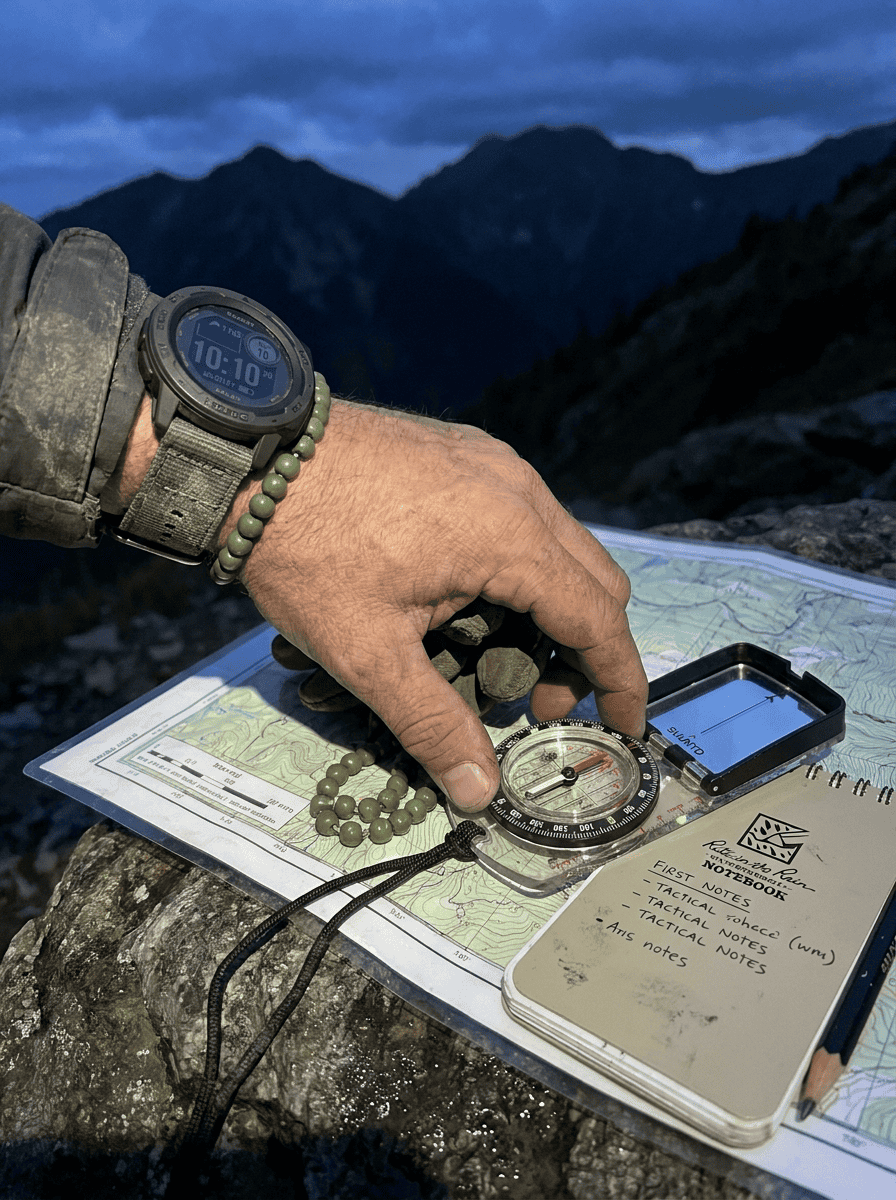

The best tactical watch for precision land navigation is a rugged ABC (Altimeter, Barometer, Compass) timepiece like the Garmin Instinct 2 Solar, but it only works if you treat it as part of a system. To achieve true precision, you must pair your watch with a high-quality mirror compass and a topographic map. In 2026, the gold standard remains a combination of solar-powered technology and analog reliability that ensures you can navigate even when the satellites or batteries fail.
When choosing a Tactical Watch, consider features that enhance navigation accuracy and durability.
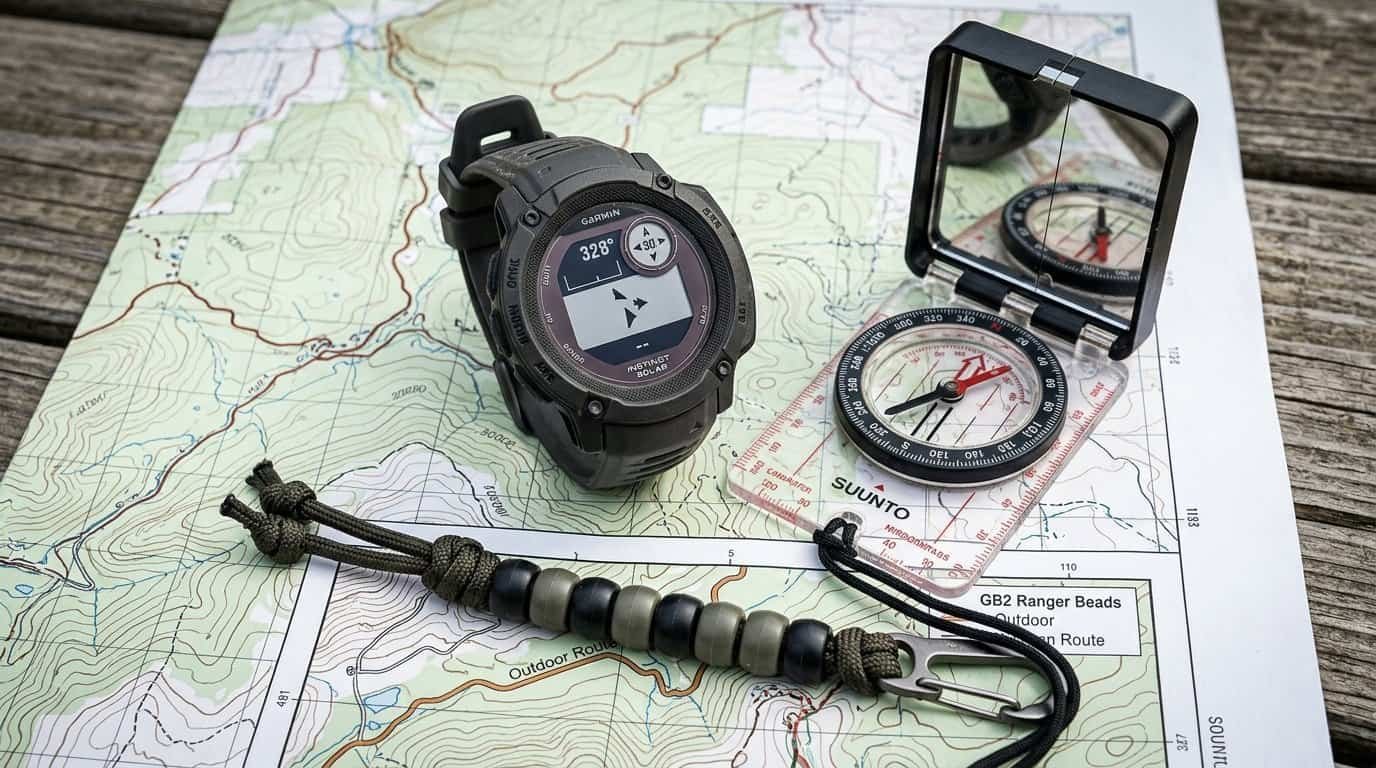
Summary Box: At-a-glance precision nav kit
The right Tactical Watch can significantly improve your survival chances in the field.
| Tool Category | Top Pick | Key Survival Feature |
|---|---|---|
| Primary ABC Watch | Garmin Instinct 2 Solar | Unlimited battery (Solar) + Multi-GNSS |
| Fail-Safe Compass | Suunto MC-2 | Adjustable declination + Sighting mirror |
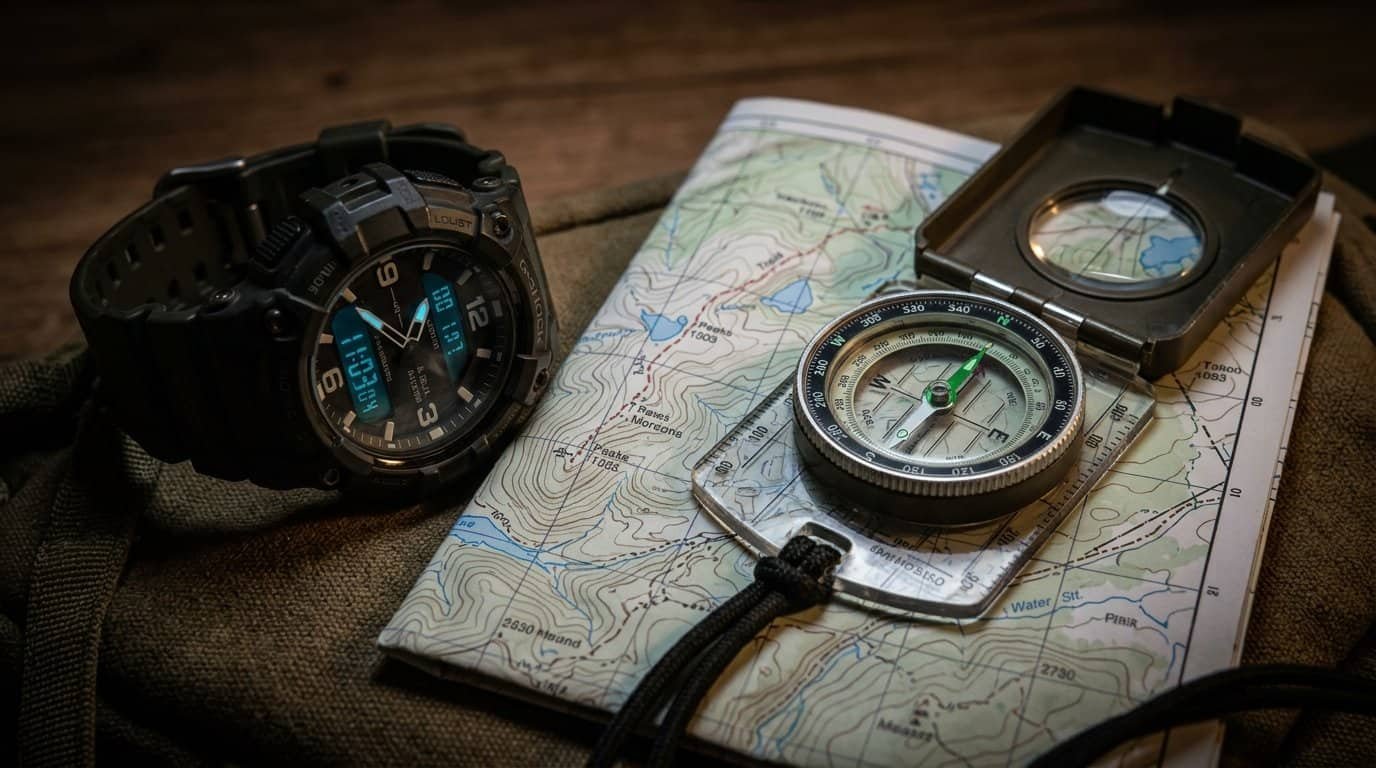
| Indestructible Beater | Casio G-Shock Mudmaster | Mud-resistant + Triple Sensor |
| Distance Tracker | GB2 Ranger Beads | Manual pace counting (No batteries) |
| Field Intelligence | Rite in the Rain Notebook | Waterproof tactical notes + Scales |
What is a Tactical Watch and why does it matter?
In the military, we lived and died by land navigation. We didn’t call it “outdoor recreation.” We called it “getting the job done without becoming a search and rescue statistic.” Most people today think a “survival watch” is just a normal watch with a tactical-looking strap and maybe a picture of a skull on the dial. That’s mall-ninja nonsense.
A real survival watch is a precision instrument. At a minimum, it requires a suite of sensors known as the ABCs: Altimeter, Barometer, and Compass. An altimeter tells you your elevation, which is critical for associating your position with contour lines on a map. A barometer tracks atmospheric pressure changes, which is your early warning system for incoming storms. And the compass? Well, if you don’t know why that matters, you’re already lost.
The difference between a survival watch and a “tacticool” gadget comes down to three things: redundancy, durability, and legibility. In the field, “cool” doesn’t matter. “Capable” does. If your watch has a fancy color screen that dies after eight hours of GPS use, it’s not a survival tool. It’s a liability. We always say that GPS and a cell phone have a place in the plan, but they are not the plan. Analog is the plan. Reliability is the plan.
My criteria for precision navigation tools
When I’m evaluating gear for the field, I don’t look at the marketing brochures. I look at how the tool performs when the chips are down. Here is my gear review criteria for a precision navigation tool:
Selecting the right Tactical Watch involves understanding its power source and durability.
- Field Synergy: How well does the tool play with others? A watch that provides MGRS (Military Grid Reference System) coordinates is only useful if you have a protractor and map to plot them on.
- Power Reliability: Does it need a wall outlet every night? Solar charging is the benchmark for 2026. If it can’t sustain itself under the sun, it’s a backup, not a primary.
- Environmental Resistance: It needs to be virtually indestructible. We’re talking 200m water resistance, shock-proof cases, and sapphire crystals that won’t scratch when you’re dragging your wrist across granite.
- Ease of Use: If you need a 200-page manual to find North while your hands are shaking from hypothermia, the tool has failed. Simple is safe.
The Garmin Instinct 2 Solar is a leading Tactical Watch for modern navigators.
A Tactical Watch like the Mudmaster GWG-B1000 can endure the toughest conditions.
Let’s break down the kit that actually works.
Comparison: The top 5 precision navigation tools
| Tool | Category | Power Source | Precision Score |
|---|---|---|---|
| Garmin Instinct 2 Solar | Smartwatch | Solar / Lithium | 9.5/10 |
| Suunto MC-2 | Mirror Compass | None (Analog) | 10/10 |
| Casio G-Shock Mudmaster | Tool Watch | Solar (Tough Solar) | 8.5/10 |
| GB2 Ranger Beads | Pace Counter | Human Power | 9.0/10 |
| Rite in the Rain | Notebook | None | 9.0/10 |
1. Garmin Instinct 2 Solar
The Garmin Instinct 2 Solar is the king of solar-powered smartwatches. It’s built to U.S. military standard 810 for thermal, shock, and water resistance. While most smartwatches are basically fragile phones for your wrist, the Instinct 2 is a ruggedized hub for the modern navigator.
What sets this apart for precision land navigation is the multi-GNSS support. It doesn’t just talk to GPS; it links with GLONASS and Galileo. This means you get a faster, more accurate lock in deep canyons or under dense tree canopies where a standard GPS might struggle. It also features TracBack® routing, which allows you to navigate the same route back to your starting point. No more “I think the truck was that way” guessing games.
- Indestructible build: The fiber-reinforced polymer case can handle more abuse than your wrist can.
- Infinite battery life: In smartwatch mode, the solar charging can theoretically keep this watch running forever.
- Precision sensors: The 3-axis compass and barometric altimeter provide the data you need to match your position to a topographic map.
The only real downside is the monochrome screen. It lacks the “wow” factor of a full-color mapping display, but that’s exactly why the battery lasts so long. It’s a tool, not a television.
Finding the right Tactical Watch can greatly enhance your navigation experience.
- Price: $350 to $450 depending on the specific model.
- Best for: The primary digital hub for any navigator who wants reliability over flashy features.
2. Suunto MC-2 Global Compass
If your watch is the brain of your navigation system, the Suunto MC-2 is the heart. This is the “gold standard” for precision bearings. In the Navy, we didn’t rely on digital compasses for anything critical; we used glass and magnets.
The MC-2 is a mirror compass, which allows you to sight an object in the distance while simultaneously reading the compass dial. This leads to sub-degree precision that a wrist compass simply cannot match. It also features adjustable declination, which is the difference between true north and magnetic north. If you don’t account for declination, you could be off by hundreds of meters over a long trek.
- Global needle: The global needle works in both the Northern and Southern hemispheres without tilting or sticking.
- Multi-use features: The sighting mirror doubles as an emergency signal mirror, and the magnifying lens helps you read tiny map details or even start a fire if you’re desperate.
- Zero failure points: It requires no batteries. It doesn’t care about EMPs or solar flares. It just works.
Learning beginner compass skills is a requirement for using this tool properly. It’s not an “auto-North” button. You have to put in the work.
- Price: $60 to $80.
- Best for: Precision map-to-ground association and as the ultimate fail-safe.
Tested — this is the compass I carry. Under two years of ownership, which is not long, but long enough to report that nothing has gone soft on it: no bubble in the capsule, no play in the mirror hinge, bezel still clicking rather than spinning free. Those are the three failure points in this price bracket, and their absence is the whole review.
One thing I would change about how this compass gets described everywhere, including above: the adjustable declination is not a set-it-once feature. I reset mine whenever I move to a different area, and so should you — declination varies by location and drifts over the years. What the MC-2 actually buys you is that adjusting it is quick and holds, not that you only ever do it once. How we label gear.
3. Casio G-Shock Mudmaster GWG-B1000
If you want a watch that will survive a nuclear blast and still tell you the altitude, you buy a G-Shock. The Mudmaster GWG-B1000 is the most indestructible ABC watch on the planet. It’s built with a Carbon Core Guard structure that shrugs off vibrations, mud, and water like they’re nothing.
What makes this a precision tool is the Triple Sensor technology. It provides highly accurate direction, altitude, and barometric pressure readings. The Location Indicator subdial at 3 o’clock is a clever feature that points to a specific waypoint saved in the “CASIO WATCHES” app via Bluetooth. It’s like having a digital scout pointing the way.
Each Tactical Watch has unique features that cater to different survival scenarios. The precision of a Tactical Watch can make a significant difference in navigation accuracy. Choosing a Tactical Watch that suits your needs is vital for effective land navigation.
- Tough Solar power: It converts even weak light into power, ensuring the sensors are always ready.
- Indestructible materials: With a sapphire crystal and bio-based resin band, it’s as tough as it is environmentally conscious.
- Radio-controlled: Multi Band 6 ensures the time is always perfectly synced to atomic clocks.
The Mudmaster is a tank. It’s large, it’s heavy, and it’s expensive. But for operators in extreme environments where other tech might crack under the pressure, it’s worth every penny.
With the right Tactical Watch, you can confidently tackle any outdoor adventure.
- Price: $880.
- Best for: Extreme environments where durability is more important than weight.
4. GB2 Ranger Pace Counter
“I think I’ve walked about a mile.” Those are famous last words in the survival world. In the woods, your perception of distance is usually wrong. The GB2 Ranger Pace Counter, also known as “Ranger Beads,” is the manual solution to this problem.
The system is simple: you have nine beads on the bottom and four on the top. Every time you walk 100 meters, you pull one bottom bead down. When you’ve pulled all nine and walked another 100 meters (totaling one kilometer), you pull one top bead down and reset the bottom. It’s a non-electronic way to track distance that forces you to stay focused on the ground.
- Zero technology: There are no batteries to die and no circuits to fry.
- Field synergy: You use these in tandem with your watch’s stopwatch for “Dead Reckoning.” If you know your pace count and your direction, you know exactly where you are.
- Lightweight: At just 3 ounces, there’s no excuse not to have them attached to your pack or your compass.
You need to know your pace counting for land navigation to make these useful. Calibrate them on flat ground, then do it again on a hill. Your stride changes when you’re tired.
- Price: $14.99.
- Best for: Canyons, dense canopy, or any situation where GPS distance tracking is unreliable.
5. Rite in the Rain Tactical Field Planner
Think of the Rite in the Rain Tactical Field Planner as your “external hard drive” for the field. If you don’t write down your azimuths, you will forget them. When you’re cold, wet, and exhausted, your brain starts leaking information. A waterproof notebook ensures that information stays put.
These aren’t just notebooks; they are tactical tools. The covers often include printed reference data like map scales, rulers, and conversion tables. The paper is wood-based but coated in a waterproof tech that allows you to write with a pencil even while it’s submerged in a puddle.
- All-weather reliability: Rain, sweat, and mud won’t destroy your route plan or your MGRS coordinates.
- Precision scales: Having map scales and rulers directly on the cover makes it easier to measure distances on physical maps.
- Durability: The Polydura cover won’t warp or tear like a standard notebook.
Bottom line? If it’s not written down, it didn’t happen. Use your notebook to record your “Dead Reckoning” legs and terrain notes. It’s the only way to stay oriented when you’re pushed to the limit.
- Price: $10 to $30.
- Best for: Recording route plans and keeping critical data safe from the elements.
How to use your survival watch for precision land nav
Owning the gear is about 10% of the battle. Knowing how to use it is the other 90%. To get the most out of your survival watch kit, you need to master the essential survival skills and the “4 D’s” of navigation: Distance, Duration, Direction, and Description.
The 4 D’s in practice
Let’s break down how your kit handles each one:
- Distance: Use your Ranger Beads. Calibrate your pace count beforehand so you know how many steps equals 100 meters.
- Duration: Use your watch’s stopwatch. If you know you walk 4 kilometers per hour on a trail, your watch tells you when you’ve hit your mark.
- Direction: Use your Suunto MC-2 to set a bearing, then use your watch’s compass to maintain that heading while you walk.
- Description: Use your Rite in the Rain notebook to describe landmarks. “Large oak tree at the bend in the creek” is a lot more useful than “I turned left somewhere.”
MGRS synergy
One of the most powerful ways to use a modern survival watch like the Garmin Instinct 2 is to find your MGRS vs Lat Long coordinates. MGRS is used by the military because it makes plotting on a map much easier than traditional degrees. Once your watch gives you an 8-digit grid, you use your protractor to mark your exact location on the map. This is how you achieve “Precision” instead of just “General” navigation.
The sun compass trick
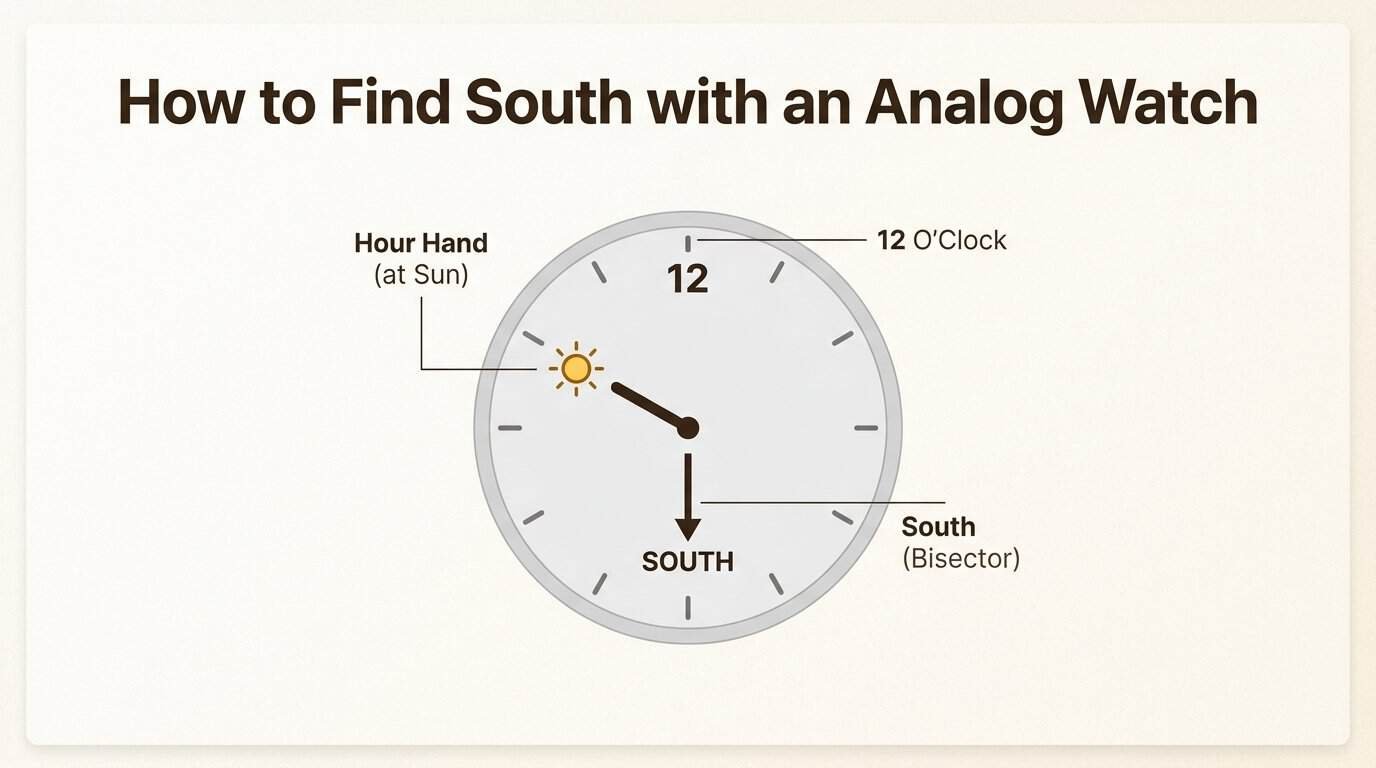
What happens if your electronic compass fails and you lost your Suunto? You use the sun. If you have an analog watch (or a digital one with an analog-style face), point the hour hand at the sun. Halfway between the hour hand and the 12 o’clock position is South (in the Northern Hemisphere). It’s not as precise as a mirror compass, but it’ll keep you from walking in circles.
Weather prediction
Your watch’s barometer is more than just a sensor; it’s a life-saving tool. If the pressure drops rapidly, most survival watches will trigger a “storm alarm.” When that happens, you stop navigating and start finding shelter. Don’t be the person who tries to push through a blizzard because “the GPS says we’re close.”
For more detailed training, you can learn how to use a survival watch in our deep-dive guide.
Keep your Tactical Watch close, as it can be instrumental during emergencies.
Master the calm operator mindset with the right gear
The best tools in the world are just expensive paperweights if you haven’t trained with them. In the Navy, we drilled until the movements were muscle memory. You should do the same. Buy your kit, then go to a local park and practice taking bearings and tracking your pace.
The goal isn’t to fear the world. The goal is to be ready for it. Be capable, not paranoid. When you have the right survival watch and a fail-safe kit, you can navigate with confidence even when the rest of the world is staring at their dead phone screens.
Your Tactical Watch should be intuitive and easy to operate in the field.
Frequently Asked Questions
What are the minimum sensors required for a survival watch?
A true survival watch must have Altimeter, Barometer, and Compass (ABC) sensors to provide the necessary data for precision navigation and weather monitoring.
Does the Garmin Instinct 2 Solar really have unlimited battery life?
Yes, with adequate solar exposure (at least 3 hours per day in 50,000 lux conditions), the Garmin Instinct 2 Solar can achieve unlimited battery life in smartwatch mode.
Why do I need a mirror compass if my survival watch has a digital one?
A mirror compass like the Suunto MC-2 provides sub-degree precision and adjustable declination that digital wrist compasses often lack, and it acts as a battery-free fail-safe.
How do Ranger Beads help with precision navigation?
Ranger Beads allow you to manually track distance traveled by counting your paces, which is essential for ‘Dead Reckoning’ when GPS signals are unavailable or inaccurate.
Can I write in a Rite in the Rain notebook with a normal pen?
While a standard pencil or an All-Weather pen works best, most Rite in the Rain notebooks allow you to write with various instruments even when the paper is completely wet.