

The EcoFlow DELTA 2 vs DELTA 3 question sounds like a capacity question. It isn’t. Same battery size, different everything else.
The ice storm took the power out and the roads were blocked by downed limbs. The DELTA 2 and its extra battery ran the fridge and freezer, plus phones, lights and a radio, for one to two days. Nobody wrote a review about it. It just worked, which is the whole job.
Later I added a DELTA 3 Plus for camping. So I’ve owned the older unit for a year or two and the newer one for less than a year, and the question I had to answer is the one you’re asking: is the upgrade worth it if both hold the same amount of power?
Here’s the short version. If you already own a DELTA 2, keep it. If you’re buying new, the DELTA 3 Plus is the better machine, but only if it’s priced close to a discounted DELTA 2.
Label: Tested. I own both units and use them the way this post describes: the DELTA 2 with an extra battery for home backup, and the DELTA 3 Plus for camping, recharged by solar. Specs come from EcoFlow’s published numbers, linked below.
The 30-Second Answer
- Already own a DELTA 2? Keep it. Same 1,024 Wh, same 1,800 W output. The upgrade doesn’t change what it can run.
- Buying your first unit? The DELTA 3 Plus, if it’s within about $150 to $200 of a discounted DELTA 2. Faster charging, faster switchover, longer cycle life, five-year warranty.
- Running a computer, modem or anything that can’t blink? DELTA 3 Plus. Its switchover is under 10 ms. The DELTA 2 manual says 30 ms.
- Tight budget? A discounted DELTA 2 is still a great home backup battery. It’s been sold far below list since the DELTA 3 launched.
EcoFlow DELTA 2 vs DELTA 3: What They Actually Are
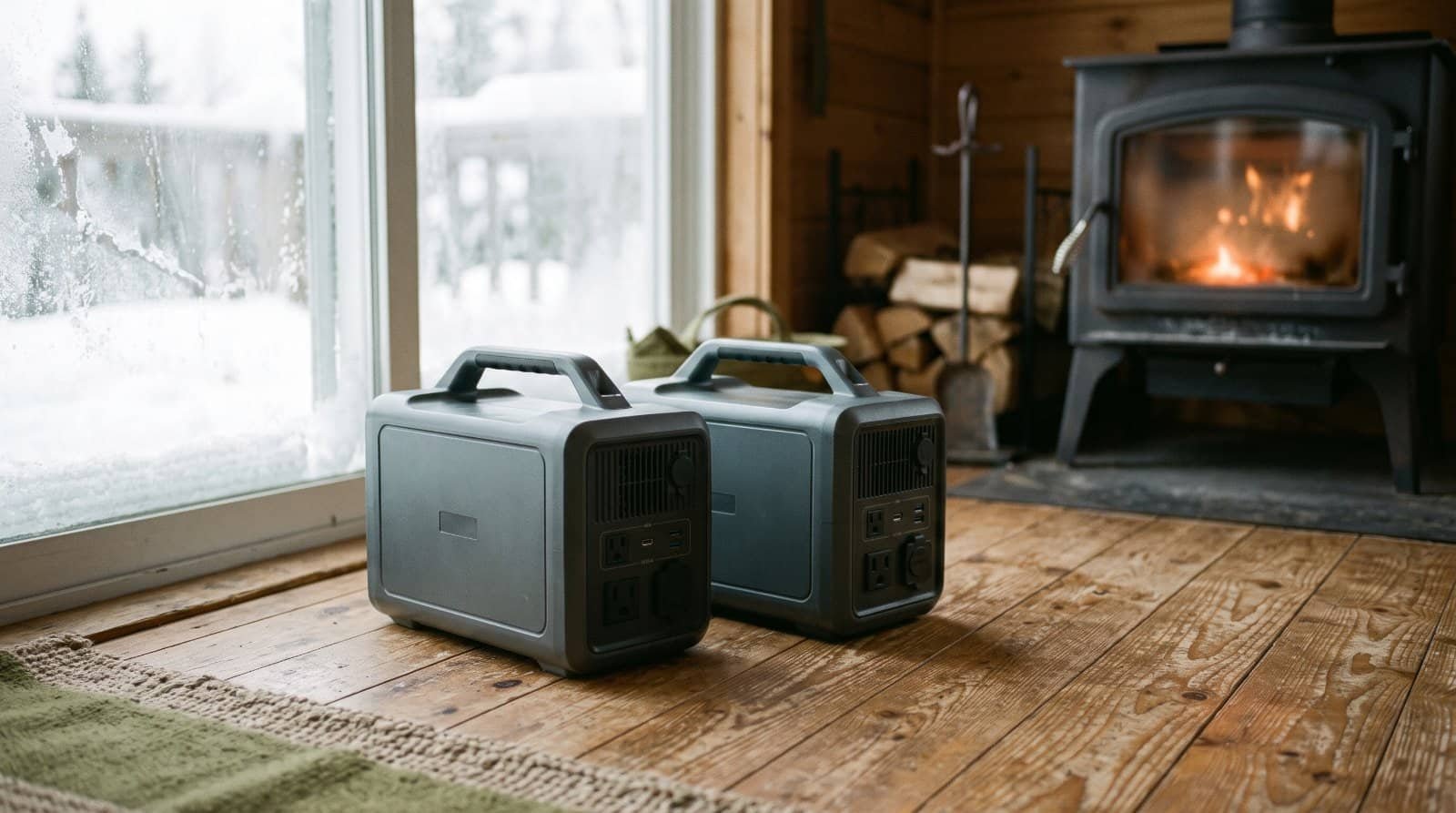
Both are lithium iron phosphate (LFP) power stations with 1,024 Wh of storage and 1,800 W of continuous AC output. Both weigh about 27 pounds. Both can run a refrigerator, a CPAP, a modem, lights and phones. Both accept an extra battery.
For the DELTA 2, EcoFlow lists 1,024 Wh, 1,800 W rated output, 2,700 W surge, 500 W of solar input and 80 minutes to a full AC charge, rated for 3,000 cycles to 80 percent capacity.
The DELTA 3 Plus is the newer generation. EcoFlow’s product page lists the same 1,024 Wh and 1,800 W, but with 3,600 W surge, two solar inputs, a 56-minute full AC charge, under 10 ms switchover, 4,000 cycles and a five-year warranty.
So the battery is the same size. What changed is how fast it fills, how fast it takes over when the grid drops, and how long it should last.
The Core Difference in DELTA 2 vs DELTA 3: Speed, Not Size
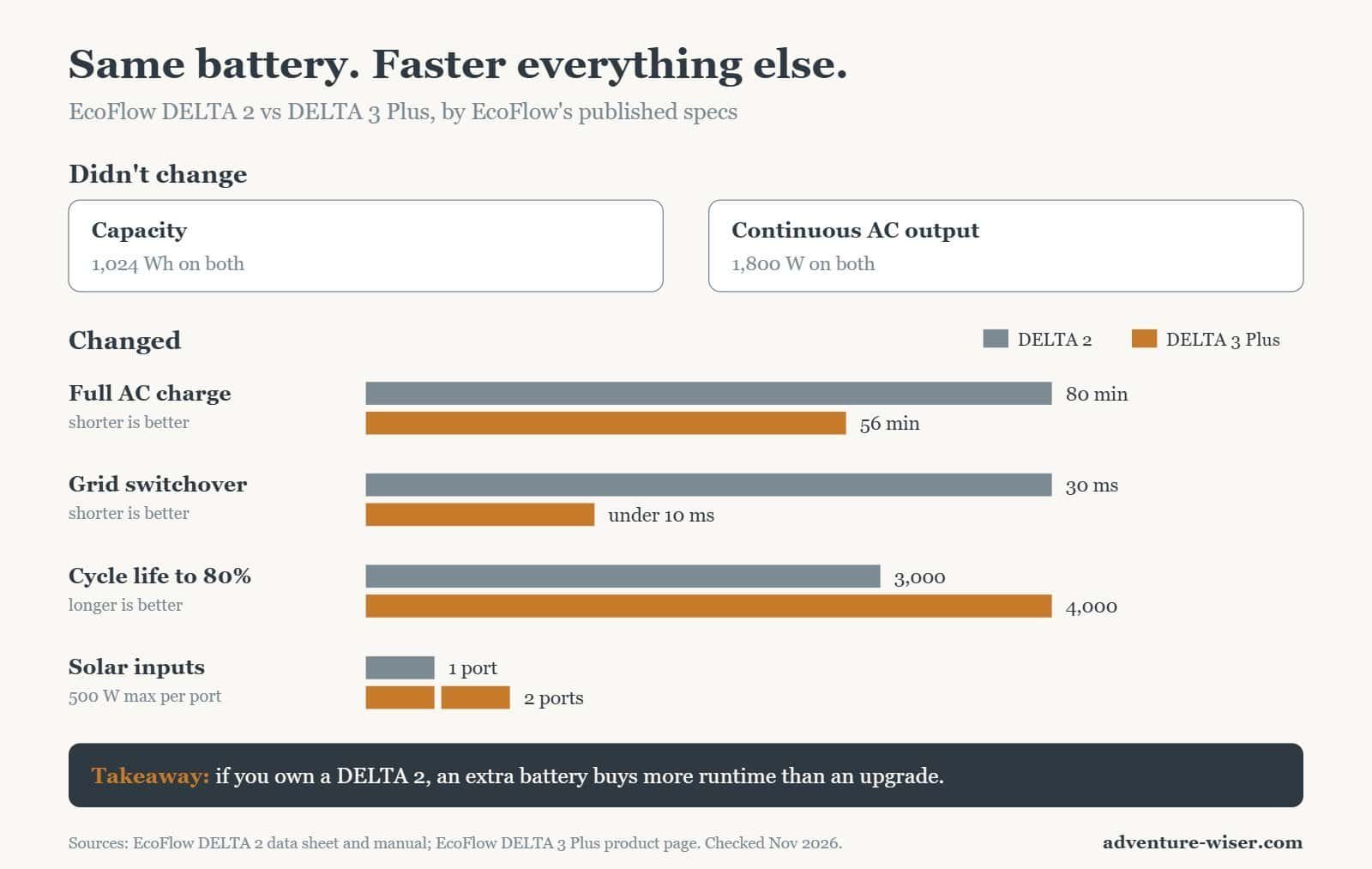
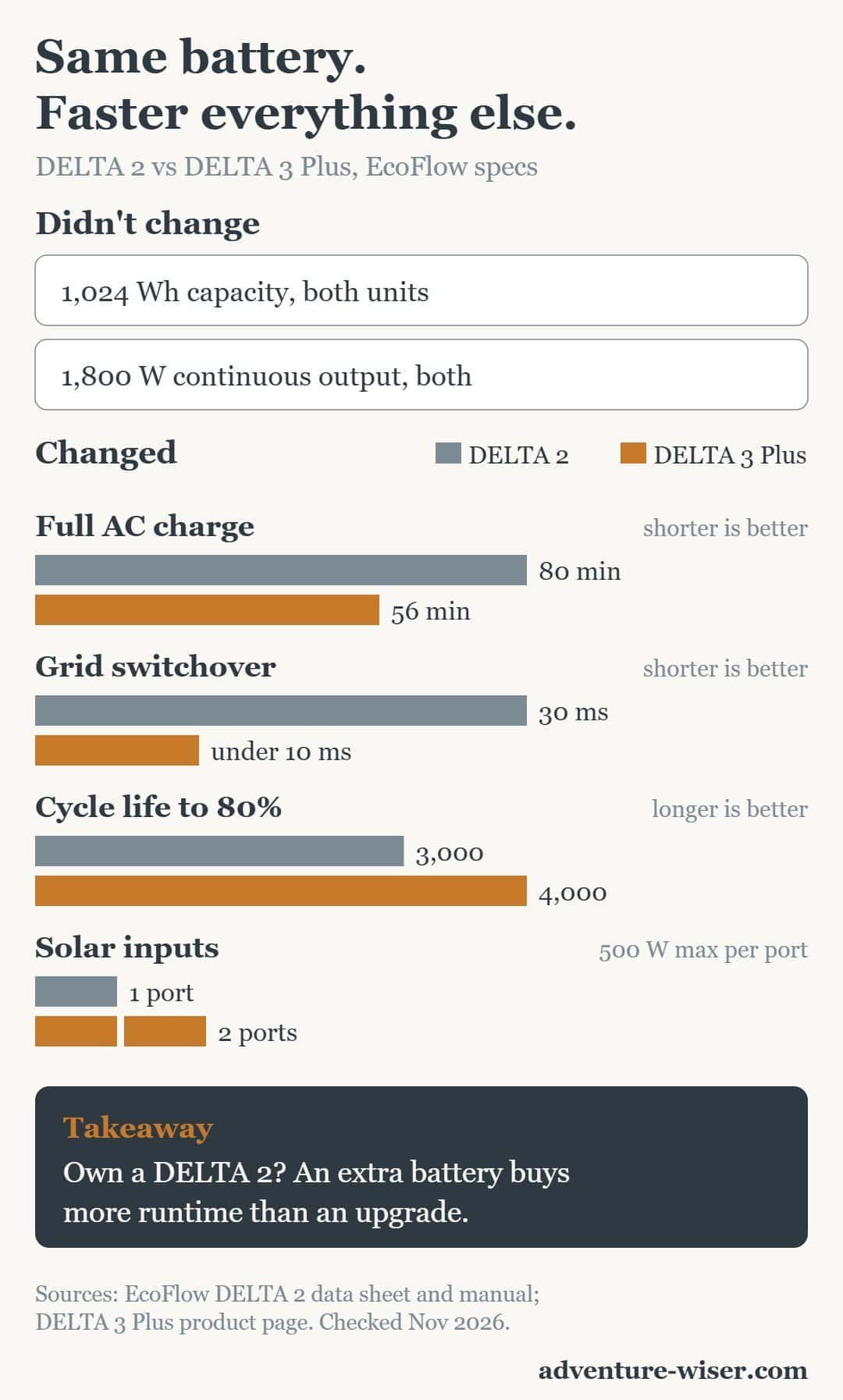
Capacity is the number everyone shops by, and it’s the one number that didn’t move. Every other upgrade is about time:
- Time to refill from the wall: 80 minutes on the DELTA 2, 56 minutes on the DELTA 3 Plus.
- Time to take over when the power fails: 30 ms versus under 10 ms.
- Time before the battery wears down: 3,000 cycles versus 4,000 cycles to 80 percent.
None of those matter much in a single outage. A fridge doesn’t care about 20 milliseconds. They matter if you run sensitive electronics, if you refill between short outages, or if you plan to keep the unit for a decade.
EcoFlow DELTA 2 vs DELTA 3 Plus: Head-to-Head
| Spec | DELTA 2 | DELTA 3 Plus |
|---|---|---|
| Capacity | 1,024 Wh LFP | 1,024 Wh LFP |
| AC output (rated / surge) | 1,800 W / 2,700 W | 1,800 W / 3,600 W |
| X-Boost | up to 2,400 W devices | up to 2,200 W devices |
| Full AC charge | 80 min (1,200 W) | 56 min (1,500 W) |
| Solar input | 1 port, 500 W max | 2 ports, 500 W max each |
| Switchover when grid fails | 30 ms (per manual) | under 10 ms |
| Cycle life to 80% | 3,000 | 4,000 |
| Max expansion | about 3 kWh | up to 5 kWh |
| Weight | about 27 lb | about 27.6 lb |
| Warranty | 5 years | 5 years |
| Price (checked Nov 2026) | often discounted; check | $719 at EcoFlow (list $799) |
Sources: EcoFlow DELTA 2 data sheet and manual; EcoFlow DELTA 3 Plus product page. X-Boost is EcoFlow’s reduced-voltage mode for resistive loads. It’s not extra power.
Where I’d Push Back on the Hype
On the DELTA 3 Plus: “Faster charging” sounds big. From a wall outlet it’s the difference between 80 minutes and 56, about 24 minutes. If you’re charging from the wall, you have power, and you’re probably not in a hurry. The speed matters more on solar, where the second input lets you run two panel strings.
On the DELTA 2: “UPS function” on the box doesn’t mean a real UPS. EcoFlow’s own DELTA 2 manual says the switchover is 30 ms, that it doesn’t support zero-millisecond switching, and that you shouldn’t count on it for servers or workstations. A refrigerator, lights and a radio don’t care. A desktop computer might reboot.
On both: 1,024 Wh is not “whole home backup.” It’s a refrigerator, communications and lights for a day or two, which is exactly what mine did. For a bigger load, start with how much off-grid power you actually need.
DELTA 2 vs DELTA 3 Plus by Situation
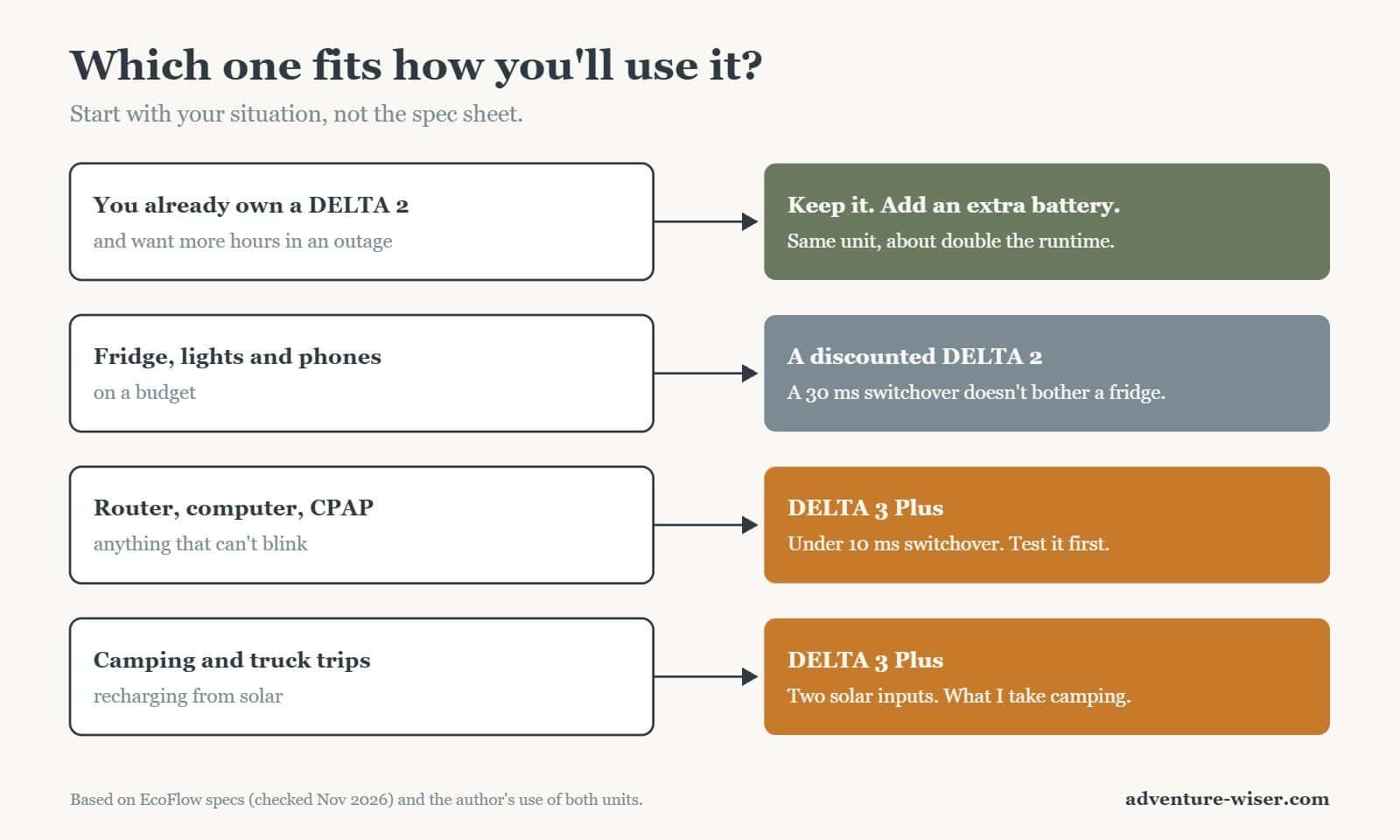
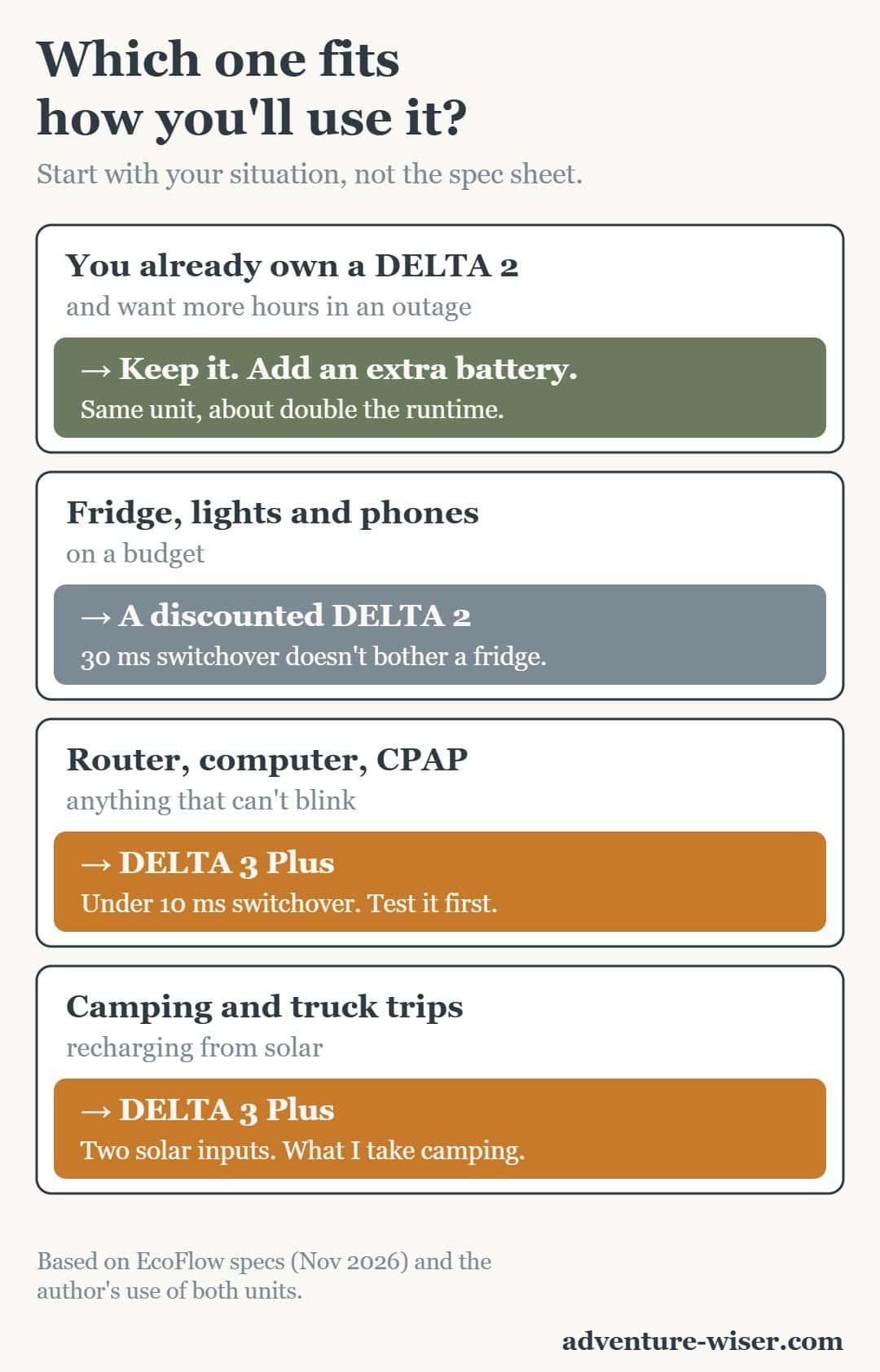
Home backup for fridge and essentials: either one. Add an extra battery if your outages last more than a day. That’s how my DELTA 2 carried the ice storm.
Home office, router, CPAP or medical devices: the DELTA 3 Plus, for the faster switchover. If a device is truly critical, confirm it with the device maker and test before you need it.
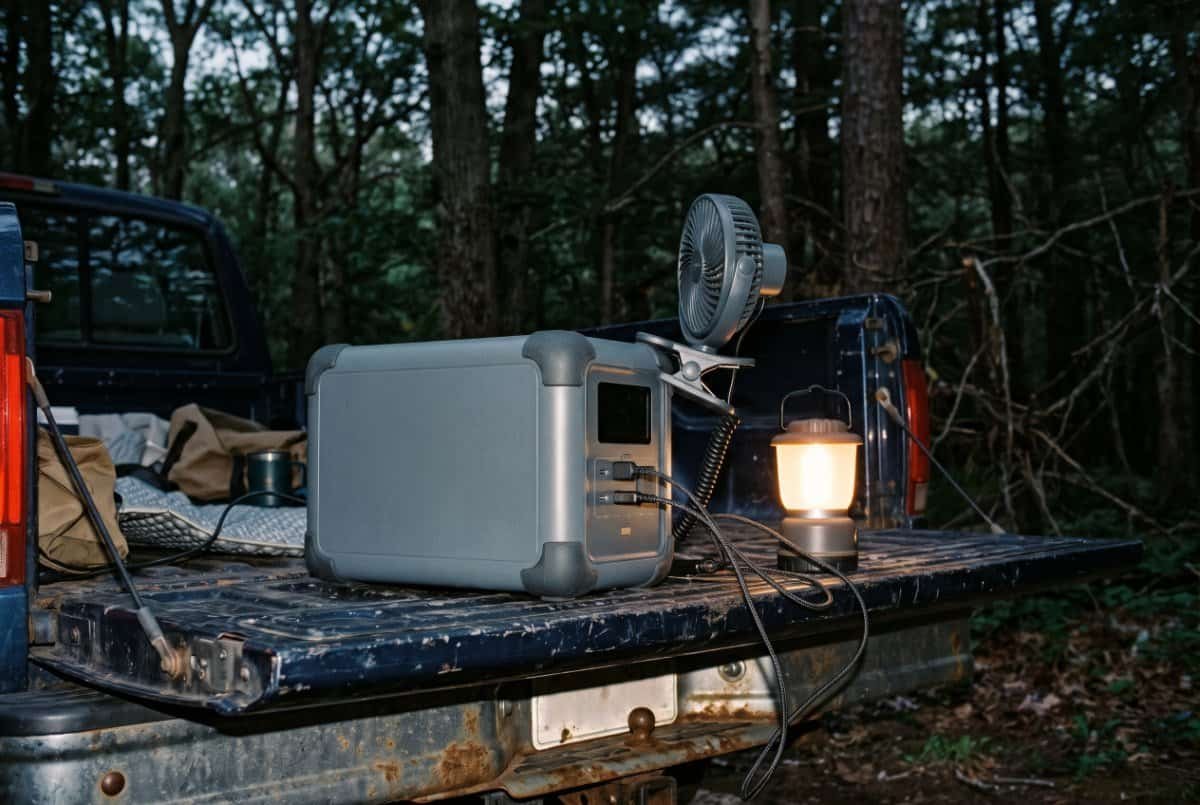
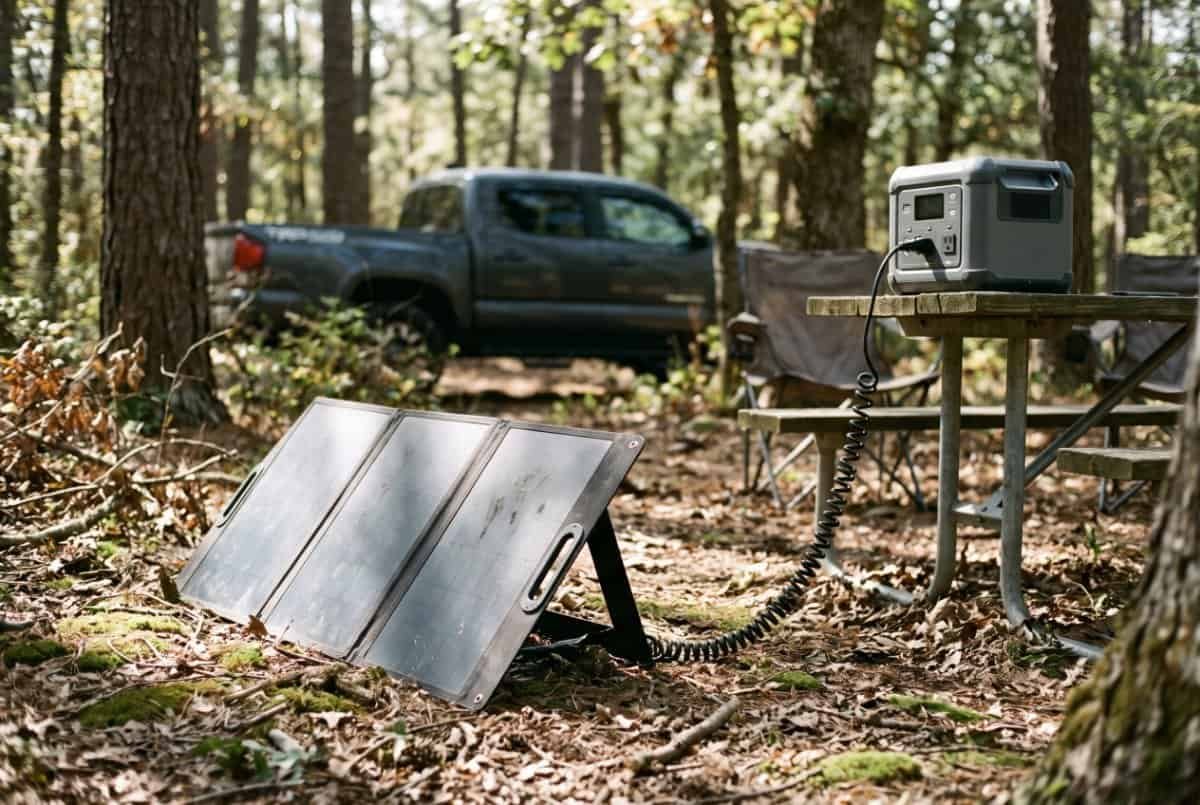
Camping and truck trips: the DELTA 3 Plus is what I take. Mine runs phones, lights and fans, and I recharge it with solar panels. The two solar inputs are the real camping upgrade.
The counterintuitive call: if you already own a DELTA 2 and want more runtime, don’t buy a DELTA 3 Plus. Buy an extra battery for the DELTA 2. You get double the hours for less money, and the battery is the part that matters in a long outage.
What Neither One Is
Neither is a whole-house generator. Neither runs central heat, a well pump or an electric range for any length of time. My house heats with a wood stove, which is why a 1 kWh battery covers what I actually need in an outage.
Neither replaces knowing your house. In the ice storm, the first job was isolating the house and knowing where the shutoffs were. Here’s how to shut off your utilities before the next storm.
Neither keeps you warm. For heat, see surviving a winter power outage. A 1,500 W space heater would drain either unit in well under an hour.

If You’re Buying In
- DELTA 3 Plus: EcoFlow’s own store listed it at $719, down from $799, when I checked in November 2026.
- DELTA 2: EcoFlow has been clearing DELTA 2 stock since the DELTA 3 launched. Kotaku reported it at $429 during an October 2025 clearance, down from $699. Prices since then have moved around, so check before you buy. EcoFlow’s US store now sends its DELTA 2 page to the DELTA 3, so a DELTA 2 today means clearance stock or a used unit.
- Extra batteries: per StorageReview’s DELTA 3 Plus review, DELTA 2 and DELTA 2 Max extra batteries work with the DELTA 3 Plus, so an existing battery isn’t stranded if you upgrade.
Whichever you buy, plug in the fridge you’d actually run in an outage, unplug the unit from the wall, and see how long it lasts. That number is worth more than any spec sheet.
If you’re still choosing a brand, here’s my EcoFlow vs Jackery breakdown.
Frequently Asked Questions
Is the DELTA 3 Plus worth upgrading from the DELTA 2?
Not for most owners. It holds the same 1,024 Wh. Buy an extra battery for the DELTA 2 instead, unless you need the faster switchover for sensitive electronics.
Do DELTA 2 extra batteries work with the DELTA 3 Plus?
Yes. DELTA 2 and DELTA 2 Max extra batteries are compatible, so you can upgrade the unit and keep the battery.
Can the DELTA 2 run a refrigerator?
Yes. With its extra battery, mine kept a fridge and freezer plus phones, lights and a radio going for one to two days in an ice storm.
Is either one a true UPS?
The DELTA 3 Plus switches in under 10 ms. The DELTA 2 switches in 30 ms, and its manual says not to rely on it for servers or workstations.
How long does each take to charge?
From the wall, about 80 minutes for the DELTA 2 and 56 minutes for the DELTA 3 Plus. Solar depends on panels and sun.
What’s the difference between the DELTA 3 and the DELTA 3 Plus?
The DELTA 3 Plus has two solar inputs and lists higher than the base DELTA 3. Check EcoFlow’s current product pages, because the lineup and prices change often.
The Bottom Line on EcoFlow DELTA 2 vs DELTA 3
The EcoFlow DELTA 2 vs DELTA 3 Plus decision isn’t about power. It’s about time and money. The DELTA 3 Plus charges faster, switches faster and should last longer. The DELTA 2 holds the same energy and is usually cheaper.
Mine both earn their keep: the DELTA 2 at home, the DELTA 3 Plus on the road. If I had to buy one today with no discount on the table, I’d buy the DELTA 3 Plus.
This weekend, plug your fridge into whatever battery you own and time it. Then grab the free trail-ready checklist and add that number to it.
Gear on Adventure Wiser is labeled for what it is: Tested, Owned or Researched. Here’s how that works.
