You can have the best pack money can buy. Top-tier gear. A dialed-in loadout. Backup plans for your backup plans. You’ve got a bug-out bag that would make a Navy SEAL nod in approval and a pantry stocked like a small grocery store.
But if your mind folds under pressure — none of that matters.
I’ve seen it firsthand in the Ouachitas and in disaster response situations. And I’ll tell you right now, mental resilience for preppers is the single most underinvested skill in the entire preparedness community. We’ll spend $400 on a knife we don’t need before we spend 20 minutes training our brains. That’s backwards, and I say that as someone who has made that exact mistake more times than I care to admit.
The Bible actually addresses this directly. Proverbs 24:10 says, “If you falter in a time of trouble, how small is your strength!” That verse has stuck with me for years. It’s not mean — it’s honest. And honest is what we need in the preparedness world.
The Gap Nobody in the Prepper Community Talks About

Here’s the uncomfortable reality about mental resilience for preppers: there are two versions of you.
- The version that plans, packs, and prepares on a Saturday afternoon with good coffee
- The version that actually shows up when things go sideways at 2am in bad weather
Those two versions are not always the same person. I’ve lived this. The guy who meticulously packed my bag was calm, caffeinated, and thinking clearly. The guy who had to use that bag during a real emergency? A little shakier than I’d like to admit.
That gap between who you think you are and who you actually are under stress? That’s your mental fitness deficit. And it’s exactly what mental resilience for preppers is designed to close. Want to understand your stress response better? Check out our guide on building your personal emergency action plan.
What Mental Breakdown Actually Looks Like in the Field
People imagine a breakdown looks like dropping to your knees and crying. Nope. Mental collapse in a survival or emergency situation is usually quiet, subtle, and sneaky. It looks like this:
- Rushing decisions because you feel pressure — and then regretting them 60 seconds later
- Forgetting simple steps you’ve done a hundred times in your backyard
- Snapping at the people you’re supposed to be leading or protecting
- Freezing for three to five seconds when you should already be moving
- Making small mistakes that stack on top of each other until you’ve got a full crisis
I’ve watched capable, well-equipped people fall apart over nothing more than bad weather, fatigue, hunger, and uncertainty. Not because they were weak people — but because they were mentally untrained. There’s a massive difference.
The research backs this up. According to the American Institute of Stress, even moderate psychological stress can reduce cognitive performance by up to 40%. That means under moderate pressure, you’re running at 60% capacity. Under severe stress without mental resilience training? Even lower.
Isaiah 41:10 says, “So do not fear, for I am with you; do not be dismayed, for I am your God. I will strengthen you and help you.” That’s a promise — but I believe promises are partnered with preparation. God gives us the strength; we still have to train ourselves to access it under fire.
Mental vs. Physical Preparedness: Where Preppers Actually Stand
| Factor | Physical Preparedness | Mental Resilience for Preppers |
| Training | Pack drills, fitness, shooting | Stress inoculation, decision drills |
| Equipment | Gear, tools, supplies | Mental frameworks, mindset habits |
| Failure Mode | Broken gear, physical injury | Poor decisions, panic, hesitation |
| Training Cost | High (gear, ammo, range fees) | Low (deliberate discomfort, reflection) |
| Most Neglected? | No — people train this | YES — most preppers skip this |
The “Gear Fixes Everything” Myth That’s Getting People Killed
I’m going to say something that might sting a little: buying gear feels like progress. And it IS progress — gear absolutely matters. I’m not going to stand here and tell you your kit doesn’t count. Of course it does.
But gear is predictable. Gear doesn’t panic. Gear doesn’t second-guess itself at 3am. You do. And I do. And without mental resilience for preppers built into our training, we become the weakest link in our own survival system.
There’s a saying in the military that’s stuck with me since my Navy days: “You don’t rise to the level of your equipment — you fall to the level of your training.” That applies doubly to mental resilience for preppers. If you’ve never trained your mindset under stress, you’re essentially gambling on a variable you haven’t tested.
I’ve written before about how navigation under pressure reveals mental weaknesses. The same principle applies to every other survival scenario — your brain is the operating system running your gear.
Mental Resilience for Preppers Is Built, Not Born
Here’s the good news: mental resilience for preppers isn’t some magical trait you either have or you don’t. It’s a skill. It’s trainable. And unlike your bug-out bag, it doesn’t weigh anything.
Romans 5:3-4 reminds us, “We also glory in our sufferings, because we know that suffering produces perseverance; perseverance, character; and character, hope.” That’s not just theology — that’s a training principle. Adversity builds the exact mental resilience for preppers that we need. The question is whether we pursue it deliberately or wait for disaster to teach us the hard way.
1. Train When You’re Uncomfortable — On Purpose
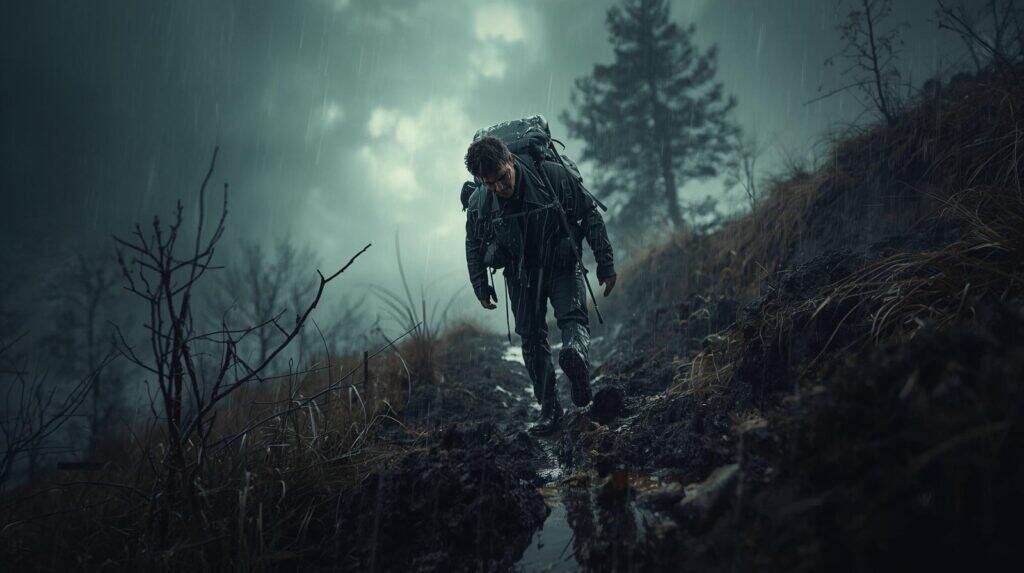
I used to only train on good days. Nice weather, good night’s sleep, clear schedule. Sound familiar? That’s training for a world that doesn’t exist in emergencies.
Now I deliberately schedule cold, wet, inconvenient training sessions. Ruck in the rain. Navigate at dusk. Cook a meal when I’m already exhausted. Your brain learns remarkably fast when conditions aren’t ideal because the stakes feel real. That’s exactly where mental resilience for preppers gets forged.
The folks over at Survival Sullivan have a great framework for stress-inoculation training that complements this perfectly — worth a read for anyone serious about mental resilience for preppers.
2. Slow Down Your Decisions Under Pressure
When stress hits, your brain desperately wants speed. That urgency is almost always a liar. In most survival situations — not all, but most — you have more time to think than your adrenal glands are telling you.
I’ve trained myself to do three things when I feel that rush-and-decide impulse: pause, breathe, and verbalize the next step. Even 10 seconds of deliberate control can prevent a decision that costs you hours or your life.
Proverbs 21:5 is blunt about this: “The plans of the diligent lead to profit as surely as haste leads to poverty.” Replace “poverty” with “bad outcomes in the field” and you’ve got yourself a prep doctrine.
3. Control What You Can — Let Go of What You Can’t
Mental resilience for preppers isn’t about controlling everything. That’s a fantasy. It’s about knowing the difference between what’s in your circle of influence and what isn’t, then ruthlessly focusing on the former.
- You CANNOT control: Weather, terrain, other people’s behavior, grid-down duration
- You CAN control: Your pace, your breathing, your next single action, your attitude
When I’m feeling overwhelmed in the field, I shrink my world down to the next 15 minutes. What do I need to do right now? That’s it. Mental resilience for preppers is often just radical focus on the immediate and actionable.
4. Practice Being Alone With Your Thoughts
This one gets uncomfortable for people, and I get it. Most of us in modern life have never truly been alone with our own thoughts for more than 30 seconds before reaching for a phone.
Here’s the problem: when things go wrong in the field, you’re going to be alone with your thoughts whether you like it or not. If that’s foreign territory to you, it becomes one more stressor on top of everything else. Mental resilience for preppers requires you to get comfortable in that silence.
My practice: 20 minutes outside with no phone, no earbuds, no distraction. Just sitting. Watching. Thinking. It’s harder than a workout. It’s also more valuable for mental resilience for preppers than almost anything else I’ve found.
The Prepared Mind Blog calls this “cognitive hardening” — getting your mind used to discomfort the same way you’d condition your body to carry weight.
5. Build a Simple Mental Reset Protocol
Every well-trained person I know has some version of a mental reset — a reliable pattern they return to when things feel like they’re spiraling. Mine is a five-step process I’ve used on trail, in vehicles, and during personal crises. Mental resilience for preppers means having a reset you can fire off when your brain is under load.
The 5-Step Mental Reset Protocol for Preppers
| Step | Action | Why It Works |
| 1 | Stop moving | Breaks the panic feedback loop immediately |
| 2 | Take 3 slow breaths | Activates parasympathetic nervous system, lowers cortisol |
| 3 | Name the problem out loud | Engages prefrontal cortex, overrides amygdala hijack |
| 4 | Identify ONE action | Creates forward momentum without overwhelm |
| 5 | Execute that action | Builds confidence and restores sense of control |
The beauty of this reset is that it doesn’t require any gear. It doesn’t cost anything. And it works at 2pm on a Tuesday or 2am when the grid’s down and your neighbor’s house is on fire. That’s mental resilience for preppers in practical form.
The Stress Response: What’s Actually Happening in Your Brain
Let me get briefly nerdy here, because understanding the biology actually helps you train mental resilience for preppers more effectively.
When you encounter a threat — real or perceived — your amygdala (the brain’s alarm system) hijacks your prefrontal cortex (the thinking part). This is the “amygdala hijack” that psychologist Daniel Goleman described, and it’s why smart, capable people make dumb decisions under stress.
Cortisol and adrenaline flood your system. Heart rate spikes. Vision narrows. You get tunnel vision — literally. Complex problem-solving degrades. Emotional reactivity spikes. You’re now running on survival software, not strategic thinking software.
Mental resilience for preppers is essentially training your prefrontal cortex to stay online when your amygdala is screaming. It’s not suppressing your stress response — it’s learning to work WITH it.
Stress Response Comparison: Trained vs. Untrained Mindset
| Stress Level | Untrained Mind | Trained Mental Resilience |
| Low (minor inconvenience) | Minor annoyance, quick recovery | Calm, barely registers |
| Moderate (bad weather, hunger) | Complaining, reduced focus | Adapts, stays task-focused |
| High (equipment failure, lost) | Panic, rash decisions | Pauses, resets, problem-solves |
| Extreme (life-threatening) | Freeze or flight response | Falls back on trained responses |
Our piece on terrain association and decision-making under pressure digs into how cognitive load in navigation mirrors the broader challenge of mental resilience for preppers in the field.
The Real Weak Point: Decision Failures
After years of studying what goes wrong in outdoor emergencies and disaster scenarios, I can tell you: the common thread almost never comes back to gear. It comes back to decisions. And decisions fail for three reasons:
- Stress that wasn’t trained against
- Fatigue that wasn’t accounted for
- Mental overload from too many variables at once
James 1:5 says, “If any of you lacks wisdom, you should ask God, who gives generously to all without finding fault, and it will be given to you.” I believe that. And I also believe that wisdom is partnered with preparation. Mental resilience for preppers means building the cognitive infrastructure to receive and act on that wisdom when everything’s loud and chaotic.
The Wilderness Medical Associates International found in their field training data that decision errors — not physical failures — are the primary contributing factor in backcountry emergencies. Mental resilience for preppers isn’t a soft skill. It’s a survival skill.
Building Mental Resilience for Preppers: A Weekly Practice
You don’t need a therapy couch or a meditation retreat. Mental resilience for preppers can be built through simple, consistent weekly practices. Here’s what I actually do:
- Monday: 20-minute screen-free sit outside — just observation and thought
- Wednesday: Train in suboptimal conditions on purpose (tired, hungry, or bad weather)
- Friday: After-action review of the week — what decisions did I make under pressure? What would I do differently?
- Weekend: At least one skill practice with artificial stress added (time pressure, distractions)
That’s it. Simple. Consistent. Over time, mental resilience for preppers compounds just like physical fitness does. You don’t notice it day to day, but six months in? You’re a different operator.
The Art of Manliness has an excellent breakdown of mental toughness practices drawn from military and athletic contexts — very applicable to mental resilience for preppers.
The Hard Truth About Mental Resilience for Preppers
If your mental game isn’t solid, your gear won’t save you. Your plan won’t hold. Your training won’t fully translate. Not because those things are bad — but because you’re the system running them. You’re the operating system. And an untrained mind running great hardware is still going to crash under load.
2 Timothy 1:7 declares, “For God has not given us a spirit of fear, but of power and of love and of a sound mind.” A sound mind. That’s the goal. That’s what mental resilience for preppers is actually building toward — not fearlessness, but soundness. Stability. The ability to function well when everything around you is falling apart.
I’ve spent 20+ years in the outdoors, and I can count on one hand the times when a gear failure was the primary problem. What I cannot count is the number of times a mental failure — mine or someone else’s — turned a manageable situation into a genuine emergency.
Wrapping It Up: From the Trail to Your Training Plan
The people who perform best when things go sideways aren’t always the strongest. They’re not always the most experienced. They’re not always the best equipped. They’re the most mentally prepared.
Mental resilience for preppers isn’t a luxury add-on to your preparedness stack. It’s the foundation everything else sits on. Without it, your gear is just expensive camping equipment. With it, even modest resources become powerful tools.
Start small. Train uncomfortable. Sit with silence. Build your reset protocol. Review your decisions. And keep showing up — because mental resilience for preppers, like any real skill, is built one intentional repetition at a time.
Philippians 4:13: “I can do all things through Christ who strengthens me.” That’s not a passive promise — it’s an active one. Claim it, then train like it’s true.
Frequently Asked Questions About Mental Resilience for Preppers
What exactly is mental resilience for preppers?
Mental resilience for preppers is the trained ability to maintain effective decision-making, emotional regulation, and purposeful action under stress, uncertainty, fatigue, and adversity. It’s not toughness for toughness’s sake — it’s the cognitive and emotional fitness to keep functioning when everything around you is pushing you toward panic or paralysis.
Is mental resilience for preppers more important than physical fitness?
They work together, but if I had to choose one to develop first, I’d choose mental resilience for preppers. A fit person who panics is still in trouble. A physically average person with solid mental resilience can problem-solve their way through most situations. Ideally, you train both.
How long does it take to build real mental resilience for preppers?
In my experience, you start noticing meaningful changes in 4-6 weeks of consistent practice. Significant resilience — the kind that holds under real pressure — takes 3-6 months. It’s not a quick fix, but it’s faster than most people think if you’re intentional about it.
Can I build mental resilience for preppers without military or tactical training?
Absolutely. The military has refined approaches to building mental resilience for preppers, but the core principles are accessible to everyone: deliberate discomfort, stress inoculation, controlled breathing, decision reviews, and silence practice. No rank required.
What are the most common mental failures in real survival situations?
Based on my reading, field experience, and study of emergency case reports, the most common mental failures are: task fixation (tunnel vision on one problem while ignoring others), plan continuation bias (sticking with a bad plan because you committed to it), panic freezing, and decision fatigue leading to poor choices late in a scenario.
Does faith help with mental resilience for preppers?
In my experience, yes — significantly. Having a solid faith foundation provides a perspective anchor that keeps existential panic at bay when circumstances are dire. Psalm 46:1 says, “God is our refuge and strength, an ever-present help in trouble.” That kind of foundational certainty is itself a form of mental resilience for preppers. It doesn’t replace practical training — but it gives that training a bedrock to build on.
How do I know if my mental resilience for preppers is improving?
Watch for these signs: you recover faster from unexpected problems, your first instinct under stress becomes observation rather than reaction, you find discomfort less disruptive, and you start naturally breaking down complex problems into single next actions. These are the markers of real mental resilience for preppers developing.