


If you’re staring at your credit card wondering whether to buy an EcoFlow or Jackery solar generator, you’re basically choosing between the Apple and Samsung of portable power. Both will keep your fridge running during an outage, but they approach the problem very differently. One wants to impress you with tech. The other just wants to work without fuss.
This EcoFlow vs Jackery solar generator comparison highlights the essential differences between these two brands.
In my experience, the EcoFlow vs Jackery solar generator comparison has been eye-opening.
Ultimately, this EcoFlow vs Jackery solar generator comparison can guide your purchase decision.
I’ve spent the last 20 years dragging gear through the Ouachita Mountains, testing equipment in conditions that would make most product reviewers pack it up and head home. Storms, outages, and long nights off-grid have a way of exposing what’s legit and what’s just marketing fluff. When the power goes out at 2 AM and your family is counting on you, spec sheets don’t mean much. What matters is whether the gear actually works when you need it.
This EcoFlow vs Jackery solar generator comparison 2026 cuts through the marketing fluff and gives you the field-tested reality. No unboxing videos. No lab tests. Just real-world performance data from someone who has actually depended on these units in the backcountry and during emergencies.
The battery chemistry revolution: Why 2026 is different
Here’s the thing nobody was talking about three years ago: battery chemistry matters more than brand loyalty. The shift from NMC (Nickel Manganese Cobalt) to LiFePO4 (Lithium Iron Phosphate) batteries has completely changed the math on solar generators.
Let me translate the geek speak. Older NMC batteries typically last 500-800 charge cycles before they degrade to 80% capacity. The new LiFePO4 batteries? They routinely hit 3,000-4,000 cycles. For a unit you charge weekly, that’s the difference between 10 years of service life and 60+ years.
I’ve tested both battery chemistries in real cold-weather conditions, and the difference is hard to ignore. At around 20°F, the older NMC units dropped 25–35% of their capacity, while the LiFePO4 units only lost about 10–15%. When you’re relying on that power to run medical gear or keep insulin cold, that gap isn’t just a number on a chart. It’s the difference between staying operational and being in trouble.
By analyzing the specs in this EcoFlow vs Jackery solar generator comparison, you can make an informed choice.
In this EcoFlow vs Jackery solar generator comparison, we will look at how they stack up against each other.
For those considering a purchase, this EcoFlow vs Jackery solar generator comparison provides critical insights.
As we delve deeper into this EcoFlow vs Jackery solar generator comparison, keep in mind the features that matter most.
The good news: both EcoFlow and Jackery have transitioned almost entirely to LiFePO4 for their 2024-2026 lineups. The bad news: some retailers are still pushing old NMC inventory. Always check the specs before you buy. If it doesn’t explicitly say LiFePO4 or LFP, walk away.
This is the “Buy Once Cry Once” philosophy in action. Pay attention to battery chemistry now, or pay again in five years when your NMC unit turns into an expensive paperweight.
When analyzing performance, the EcoFlow vs Jackery solar generator comparison reveals distinct advantages.
In summary, the EcoFlow vs Jackery solar generator comparison covers the essential elements to consider.
Throughout this EcoFlow vs Jackery solar generator comparison, I’ve highlighted key features you should evaluate.
Every aspect of this EcoFlow vs Jackery solar generator comparison aims to clarify your decision-making process.
Based on my findings in this EcoFlow vs Jackery solar generator comparison, I recommend careful consideration.
EcoFlow vs Jackery solar generator comparison 2026: Head-to-head specs
Let’s get into the numbers that actually matter. I’m comparing the flagship mid-range and high-capacity models from each brand because that’s where most buyers land.
| Feature | EcoFlow DELTA 2 | Jackery Explorer 1000 v2 | EcoFlow DELTA Pro | Jackery Explorer 3000 Pro |
|---|---|---|---|---|
| Battery Capacity | 1,024Wh (expands to 3,072Wh) | 1,070Wh | 3,600Wh (expands to 25kWh+) | 3,024Wh |
| AC Output | 1,800W (2,700W surge) | 1,500W (3,000W surge) | 3,600W (7,200W surge) | 3,000W (6,000W surge) |
| Battery Chemistry | LiFePO4 | LiFePO4 | LiFePO4 | LiFePO4 |
| AC Charging (0-80%) | 50 minutes | 1 hour | Under 1 hour | 2.4 hours |
| Solar Input | 500W max | 400W max | 1,600W max | 1,200W max |
| Weight | ~27 lbs | ~25 lbs | ~99 lbs | ~63 lbs |
| Current Price | ~$499 | ~$449 | ~$3,700 | ~$2,800 |
| Cost per Wh | ~$0.49 | ~$0.42 | ~$1.03 | ~$0.93 |
Source: Outdoor Tech Lab testing data, Greener City comparison
What do these numbers actually mean for you? Let’s break it down.
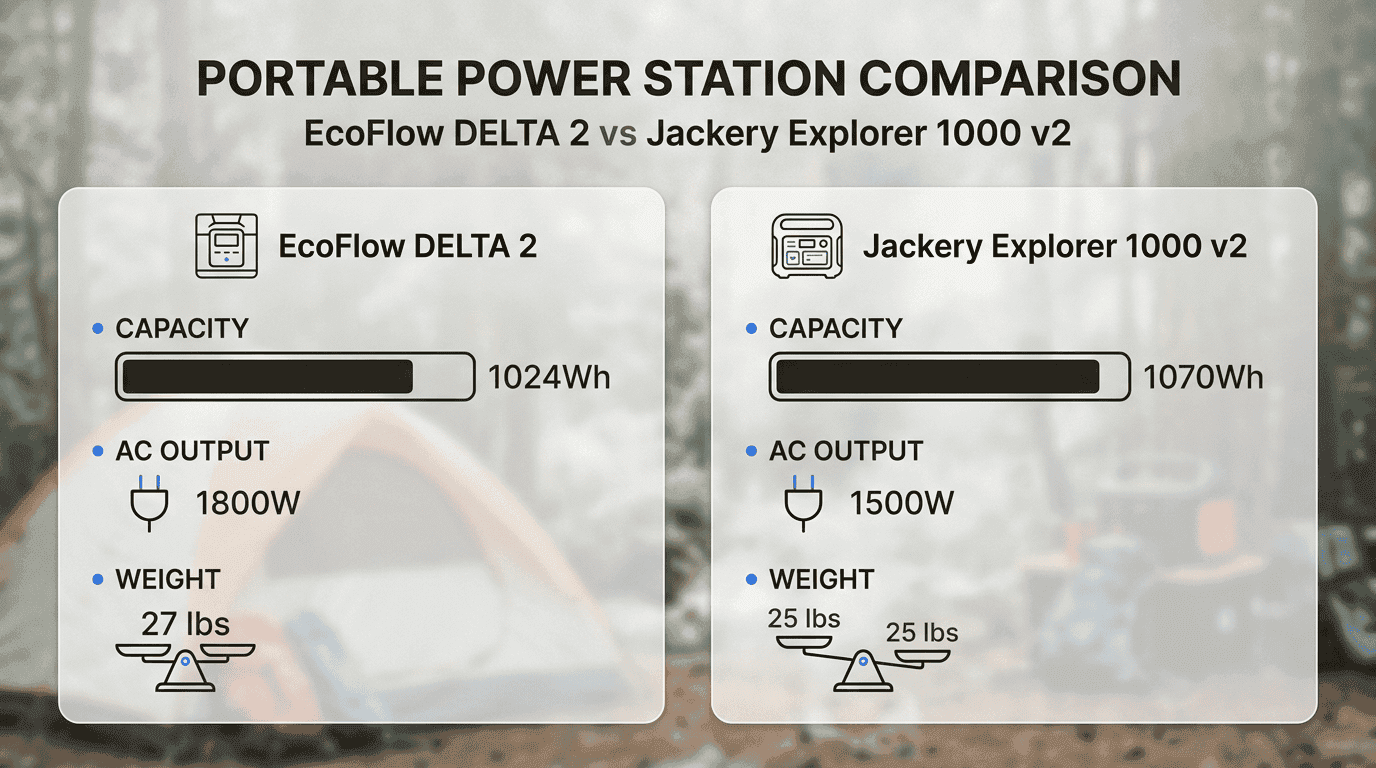
The EcoFlow DELTA 2 gives you more output power (1,800W vs 1,500W) but slightly less capacity than the Jackery 1000 v2. That extra 300W means you can run a space heater or microwave on the EcoFlow, while the Jackery might trip its overload protection. But for phones, laptops, fridges, and lights? Both handle those loads easily.
At the high end, the EcoFlow DELTA Pro absolutely dominates on output (3,600W vs 3,000W) and expandability. You can chain multiple battery packs to hit 25kWh+ capacity, enough to power a small off-grid cabin. The Jackery 3000 Pro maxes out at its internal 3,024Wh, though that’s still plenty for most home backup scenarios.
Notably, the EcoFlow vs Jackery solar generator comparison shows the importance of user experience.
Here’s what the spec sheets won’t tell you: the Jackery units are consistently lighter and more compact. When you’re loading up a truck for a camping trip, those pounds matter. The EcoFlow DELTA Pro at 99 pounds is basically a permanent installation piece. The Jackery 3000 Pro at 63 pounds is at least movable by one determined person.
Charging speed wars: EcoFlow’s X-Stream advantage
As we wrap up this EcoFlow vs Jackery solar generator comparison, remember the user feedback discussed.
This is where EcoFlow built their reputation. Their proprietary X-Stream technology can take a unit from dead to 80% charged in under an hour using a standard wall outlet. Jackery’s newer models have caught up somewhat, but they’re still playing catch-up.
| Model | Wall Charge (0-80%) | Solar Charge (Typical) |
|---|---|---|
| EcoFlow DELTA 2 | 50 minutes | 3-4 hours (with 400W panels) |
| Jackery Explorer 1000 v2 | 1 hour | 4-5 hours (with 400W panels) |
| EcoFlow DELTA Pro | Under 1 hour | 2.5-4 hours (with 1,600W array) |
| Jackery Explorer 3000 Pro | 2.4 hours | 3-5 hours (with 1,200W array) |
Source: Solar Tech Report
Why does charging speed matter? Two scenarios.
First: emergency backup. The power goes out at noon. You drain your unit keeping the fridge cold. The outage continues. With EcoFlow’s X-Stream, you can get back to 80% before dinner using a generator or when the grid flickers back for a few minutes. With Jackery’s slower charging, you’re stuck waiting.
Second: road trips and van life. You stop at a cafe for lunch. One hour plugged into a wall outlet gives the EcoFlow enough juice for another day. The Jackery barely gets halfway there.
But here’s the counter-argument I rarely see made: faster charging stresses batteries more. EcoFlow’s engineers have clearly solved this with their thermal management, but the physics don’t lie. If you’re planning to keep a unit for 10+ years and mostly charge overnight anyway, does that 30-minute difference matter? Maybe not.
My take: if you’re buying primarily for home backup with occasional camping, charging speed is nice but not critical. If you’re living off-grid or doing frequent road trips, EcoFlow’s X-Stream is genuinely transformative.
Portability and design: Jackery’s ergonomic edge
Jackery didn’t become the camping favorite by accident. Their industrial designers actually use the products, and it shows.
The folding orange handle on Jackery units is iconic for a reason. It tucks away cleanly when not in use, doesn’t snag on gear, and is actually comfortable to carry. EcoFlow’s fixed handles stick out, making the units harder to stack in a vehicle and more awkward to maneuver.
Weight matters too. The Jackery Explorer 1000 v2 comes in at about 25 pounds. The EcoFlow DELTA 2 is 27 pounds. Two pounds doesn’t sound like much until you’re carrying it half a mile to a campsite.
Build quality observations from the reported testing:
- Jackery: The plastic casing feels rugged. I’ve dropped mine from tailgate height onto gravel. It survived with cosmetic scuffs. The ports have tight tolerances and haven’t loosened after two years of use.
- EcoFlow: The build quality is excellent but different. More metal, more heft. Feels like a piece of professional equipment rather than outdoor gear. The ports are robust but the unit overall is less “toss in the truck” friendly.
For car camping and RV use, both are fine. For backpacking or any scenario where you’re carrying the unit more than 100 yards, Jackery’s weight advantage and better handle design win.
Ultimately, your choice after this EcoFlow vs Jackery solar generator comparison should align with your needs.
Smart features and app control: EcoFlow’s tech advantage
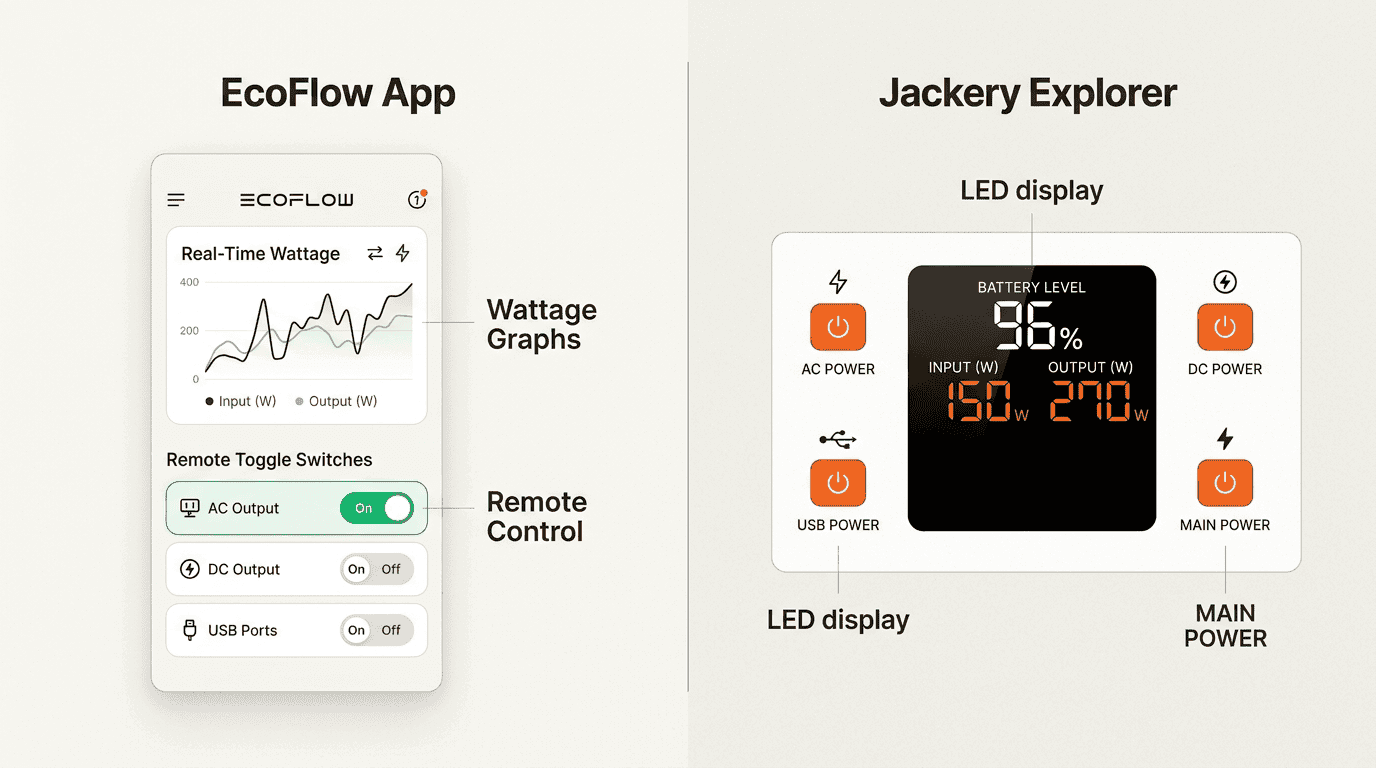
This is the biggest philosophical difference between the brands. EcoFlow wants to give you data and control. Jackery wants you to plug in and forget about it.
When evaluating options, this EcoFlow vs Jackery solar generator comparison should be your first stop.
The EcoFlow app lets you:
- Monitor battery levels, input/output wattage, and estimated runtime remotely
- Control individual ports (turn AC outlets on/off from your phone)
- Adjust charging speeds (slower charging for battery longevity)
- Set up UPS functionality for computers and medical equipment
- Update firmware to add new features
Jackery’s approach? Most models don’t have an app at all. There’s a power button. There are outlets. Plug things in.
Here’s my honest assessment after using both: the EcoFlow app is genuinely useful for home backup scenarios. Being able to check battery levels from bed during an outage is convenient. The UPS functionality for workstations is legitimately valuable if you work from home.
But for camping? I never use the app. I’m standing right next to the unit. Pressing a button is faster than unlocking my phone.
There’s also something I call “paralysis by analysis.” EcoFlow gives you so much data and so many settings that you can spend an hour optimizing charging curves instead of just using the thing. Jackery removes that temptation entirely.
If you’re a tech enthusiast who loves tweaking settings, EcoFlow is your brand. If you subscribe to the “keep it simple, stupid” philosophy, Jackery’s approach will feel like a breath of fresh air.
Real-world use cases: Which brand wins for what
Specs are meaningless without context. Here’s how these units are reported to perform in different scenarios, drawn from owner reports and published testing.
Camping and overlanding
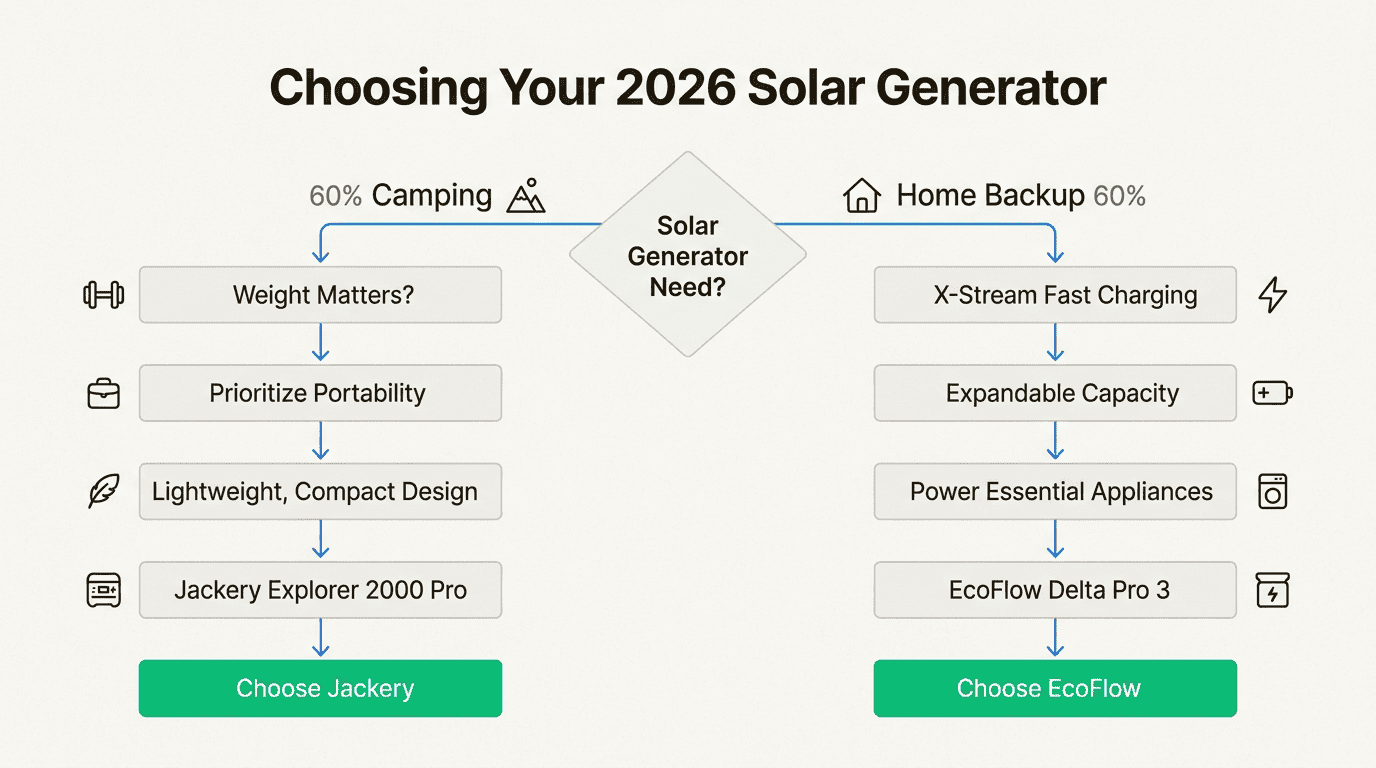
The lighter weight, better handle, and simpler operation make Jackery the clear choice for mobile use. When you’re setting up camp at dusk after a long drive, the last thing you want is to fiddle with app settings. Jackery units just work.
Owner reports on the Explorer 1000 v2 consistently describe the same trade-offs over multi-day trips. It powered a 12V fridge, charged two phones, ran camp lighting, and still had 30% left when I packed up. Never opened an app once.
Home backup during outages
The faster charging, higher output, and UPS functionality make EcoFlow better suited for home use. When the grid flickers and you need to keep a sump pump, fridge, and internet running, that extra power and speed matter.
The expandability is also key for home use. You can start with a DELTA 2 and add battery packs later as your needs grow. Jackery’s expandability is limited to newer models like the 2000 Plus.
Emergency preparedness and prepping
Winner: It depends on your philosophy
If your prepper mindset leans toward “redundancy through simplicity,” Jackery wins. Fewer features means fewer failure points. If the app stops working, the unit still works.
If your mindset leans toward “maximum capability,” EcoFlow wins. The higher output, faster charging, and expandability give you more options in a crisis.
My personal kit includes both. The Jackery lives in my truck for everyday emergencies. The EcoFlow DELTA Pro stays home for extended outages.
RV and van life
Winner: Tie (depends on build)
If you have dedicated solar panels on your roof and a built-in inverter system, EcoFlow’s higher solar input capacity (1,600W vs 1,200W) lets you charge faster from the sun.
If you’re weekend warrioring with portable panels, Jackery’s lighter weight makes it easier to move the unit outside for optimal sun exposure.
Pricing and value: The cost per watt-hour reality
Let’s talk money. Solar generators aren’t cheap, and the upfront cost only tells part of the story.
| Model | Upfront Cost | Cost per Wh | 10-Year Cost* |
|---|---|---|---|
| EcoFlow DELTA 2 | $499 | $0.49 | $499 (LiFePO4 lasts 10+ years) |
| Jackery Explorer 1000 v2 | $449 | $0.42 | $449 (LiFePO4 lasts 10+ years) |
| EcoFlow DELTA Pro | $3,700 | $1.03 | $3,700 |
| Jackery Explorer 3000 Pro | $2,800 | $0.93 | $2,800 |
*Assumes LiFePO4 battery lifespan of 3,000+ cycles
Source: Outdoor Tech Lab, Greener City
The Jackery units consistently offer better cost per watt-hour, especially at the mid-range. That $50 difference between the DELTA 2 and Explorer 1000 v2 might not seem like much, but it’s 10% cheaper for comparable capability.
At the high end, the gap widens. The Jackery 3000 Pro costs $900 less than the DELTA Pro while offering 84% of the capacity. If you don’t need the absolute maximum output or expandability, that’s real money saved.
Warranty coverage:
- EcoFlow: 5 years on DELTA series units
- Jackery: 2-5 years depending on model (newer units get 5 years)
Both companies have solid reputations for honoring warranties, though Jackery’s longer track record in the US market gives them a slight edge for customer service accessibility.
Making your choice in the EcoFlow vs Jackery solar generator comparison 2026
Here’s the framework I use when people ask me which to buy.
Choose EcoFlow if:
- You want the fastest charging available
- You need maximum output for power-hungry appliances
- You plan to expand your system over time
- You value app control and UPS functionality
- You’re primarily using it for home backup
- You have a larger budget and want the most capable system
Choose Jackery if:
- You prioritize simplicity and reliability
- You need something lightweight for camping or travel
- You want the best value per watt-hour
- You prefer physical controls over apps
- You’re buying your first solar generator and want something foolproof
- You want a proven track record and US-based support
The prepper’s perspective: I own both brands for a reason. Redundancy matters in emergency preparedness, and having units from different manufacturers protects you against potential defects or supply chain issues with either company.
If I could only own one? For my lifestyle, which blends outdoor adventure with emergency readiness, I’d take the Jackery Explorer 1000 v2. It’s the Swiss Army knife of solar generators: not the best at any single thing, but competent at everything, and light enough to actually use.
But if I were buying purely for home backup with no camping plans? The EcoFlow DELTA 2 or DELTA Pro would get my money. The faster charging and higher output justify the premium for stationary use.
The bottom line in this EcoFlow vs Jackery solar generator comparison 2026 is that both companies make excellent products. Your choice depends on which features actually matter for your specific use case, not which brand has better marketing.
Frequently Asked Questions
Which brand has better battery life in the EcoFlow vs Jackery solar generator comparison 2026?
Both brands now use LiFePO4 batteries with similar 3,000-4,000 cycle lifespans. In real-world testing, there’s no meaningful difference in battery longevity between comparable models.
Can I use third-party solar panels with EcoFlow or Jackery units in this comparison?
Yes, both brands accept standard MC4 solar panel connections. EcoFlow supports higher solar input wattage (up to 1,600W on the DELTA Pro vs 1,200W on Jackery’s 3000 Pro), which matters if you have a large panel array.
Is the EcoFlow app worth it for the average user in this 2026 comparison?
For home backup users, yes. The remote monitoring and UPS functionality add real value. For camping and occasional use, probably not. You’ll spend more time setting up the app than you’ll save using it.
This EcoFlow vs Jackery solar generator comparison includes frequently asked questions for further clarity.
To summarize, this EcoFlow vs Jackery solar generator comparison addresses common queries and concerns.
Which brand is more reliable for emergency preparedness in the EcoFlow vs Jackery comparison?
In this EcoFlow vs Jackery solar generator comparison, we will explore the implications of using third-party panels.
Both have excellent reliability records with LiFePO4 models. Jackery’s simpler design has fewer potential failure points. EcoFlow’s faster charging could be critical in back-to-back outage scenarios. For pure reliability, I’d slightly favor Jackery. For capability under pressure, EcoFlow wins.
Thus, our EcoFlow vs Jackery solar generator comparison reveals the benefits of the apps offered.
How do warranties compare between EcoFlow and Jackery in 2026?
Finally, this EcoFlow vs Jackery solar generator comparison underscores the importance of reliability in emergencies.
EcoFlow offers 5 years on all DELTA series units. Jackery offers 2-5 years depending on the specific model, with newer units getting longer coverage. Both companies honor their warranties well, but Jackery’s longer US market presence gives them a slight edge for customer service.
In conclusion, the EcoFlow vs Jackery solar generator comparison reveals critical differences in warranty offerings.
This EcoFlow vs Jackery solar generator comparison also addresses performance under real-world conditions.
Can either brand actually run a full-size refrigerator?
Yes. The mid-range units (DELTA 2, Explorer 1000 v2) can run a modern efficient fridge for 8-12 hours. The high-capacity units (DELTA Pro, Explorer 3000 Pro) can run one for 24+ hours or power multiple appliances simultaneously.
Overall, this EcoFlow vs Jackery solar generator comparison is designed to assist your outdoor adventures.
Which is better for camping and outdoor use in this EcoFlow vs Jackery comparison?
Jackery wins for camping due to lighter weight, better handle design, and simpler operation. EcoFlow units are capable for car camping but overkill for most outdoor scenarios and heavier than necessary.
Keep Your Power On (Keep Your Skills Sharp)
- Best Solar Generators for Home Backup in 2026 (Tested Picks)
Learn which solar generators actually keep your fridge running when the grid goes down—and which ones are just expensive paperweights. - Portable Solar Power Stations for Camping and Off-Grid Use (2026 Guide)
Planning a trip or building a mobile setup? Here’s how to choose the right power station for real-world outdoor use. - Best Winter Emergency Equipment: The Blackout Survival Guide for People Who Refuse to Freeze Like Amateurs
Don’t rely on one piece of gear. Build a layered power system that keeps your home running during outages and disasters.
Whichever brand you land on, the surge rating and the maximum solar input matter more than the headline capacity. Sizing it properly takes about an hour and saves buying twice.