
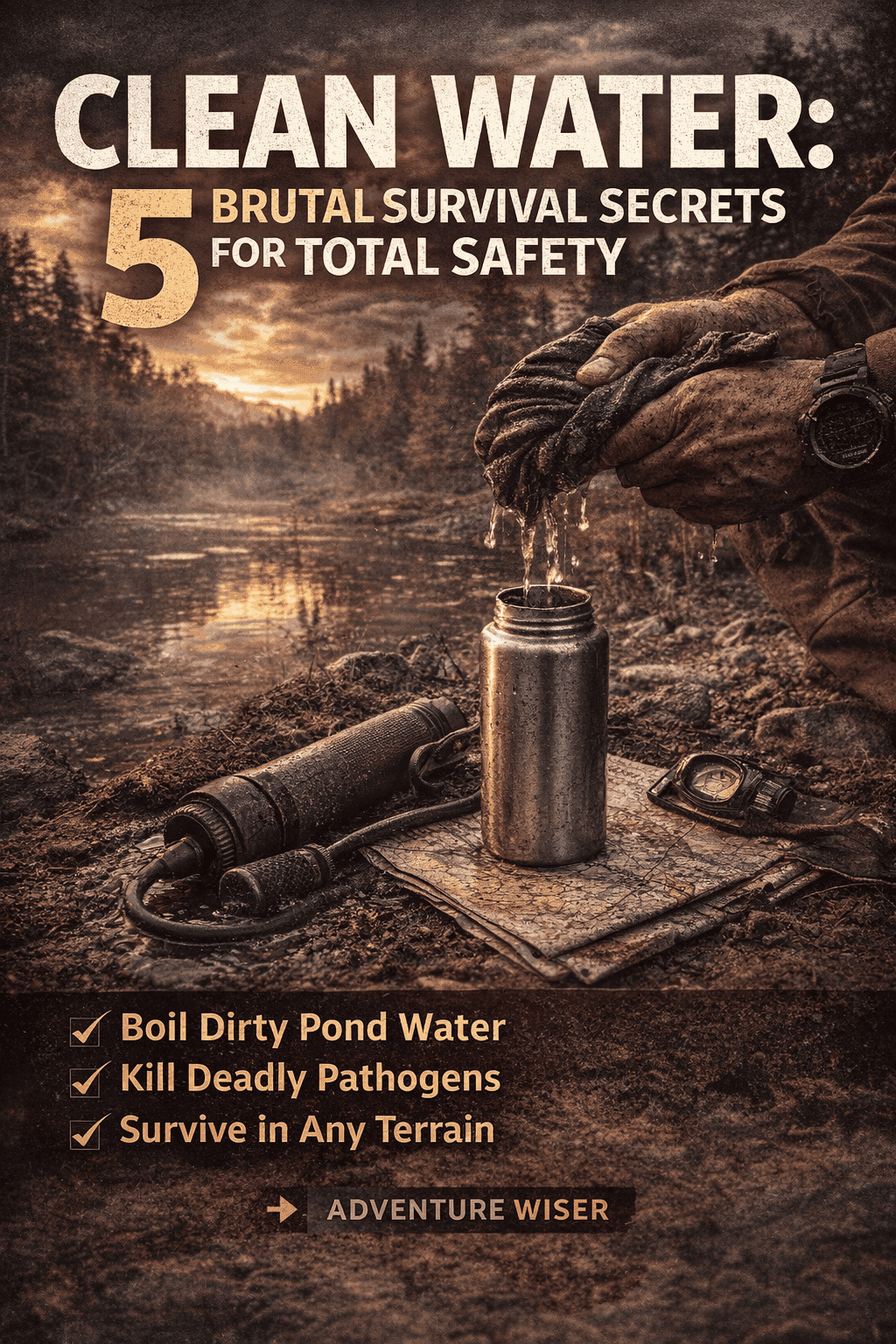

Clean water: 5 Brutal Survival Secrets for Total Safety
To ensure access to clean water in any survival scenario, you must utilize a tiered approach of mechanical filtration followed by chemical or thermal purification to eliminate 100% of pathogens. Based on my 20+ years of backcountry experience, relying on a single method is a rookie death sentence; always carry a portable squeeze filter and have the means to boil water to guarantee absolute safety.
At-a-Glance: The Hydration Hard Truths
| Feature | The Goal | The Reality |
| Daily Intake | 1 Gallon (Minimum) | You’ll actually want 2 if you’re rucking. |
| Primary Method | High-quality hollow fiber filter | Don’t buy the cheap knock-offs. |
| Backup Method | Boiling / Chemical Tabs | Essential for when the gear breaks. |
| Long-Term | Off-grid catchment | Requires a “Buy Once, Cry Once” mindset. |
The Invisible Horror in Your Canteen
Listen, I’ve spent more than two decades in the dirt. I’ve trekked the Ouachitas in humidity so thick you could chew it, and I’ve rucked through freezing mountain passes where your breath turns to ice before it leaves your mouth. In all that time, I’ve learned one immutable truth: water looks innocent right up until it turns your insides into a high-velocity slip-n-slide.
Most people think “survival” is about fighting bears or building elaborate log cabins (don’t get me started on the guys who waste calories on bushcraft furniture). In reality, survival is about not dying of diarrhea. Clean water isn’t a luxury; it’s the only thing keeping your kidneys from shutting down while you’re miles from a paved road.
In this guide, I’m stripping away the marketing fluff. We’re going to talk about the five expert ways to secure clean water anywhere, from stagnant puddles to grid-down urban environments.
Why Clean water is Your Only Real Priority
You can go three weeks without a cheeseburger, but three days without clean water and you’re just a very thirsty corpse. When you’re dehydrated, your brain turns into a dry sponge. You make stupid mistakes. You lose the ability to navigate. You stop being a woodsman and start being a liability.
The Invisible Threats in Untreated Water
If you can see the dirt in the water, that’s the easy part to fix. It’s the stuff you can’t see—the microscopic biological warfare—that I worry about.
- Bacteria: Think E. coli and Salmonella. They love a good host.
- Protozoa: Giardia and Cryptosporidium. These are the “greatest hits” of backcountry misery.
- Viruses: Usually a concern in high-traffic areas or post-disaster scenarios.
- Chemicals: Runoff from farms or industrial sites. This is where standard filters often fail.
Lessons from the Ouachita’s: When My Filter Froze
Early in my career—back when I still thought I knew everything—I left a wet hollow-fiber filter in my pack overnight during a hard freeze. The next morning, the expansion of the ice had shattered the internal membranes. I didn’t realize it until I was two days deep into the backcountry, drinking what I thought was clean water. I spent the next week in a hospital bed with a Giardia infection that made me wish for the sweet release of death.
The lesson: Gear is a tool, not a miracle. You need to know how to protect it and how to pivot when it fails.
How to build a reliable off-grid water system for emergency prep
If you’re planning for a long-term grid-down situation, you need to move beyond the “backpacking” mindset and into the “homestead” mindset. A portable filter is great for a bug-out bag, but for a permanent residence, you need volume. Building a reliable off-grid water system starts with collection and ends with multi-stage sterilization.
Method 1 — Boiling (The Gold Standard)
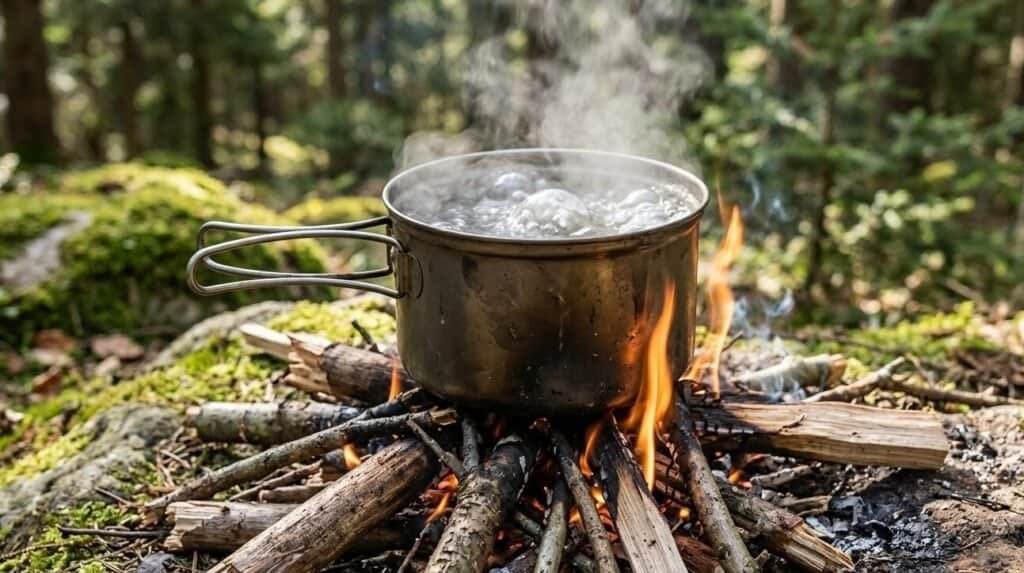
Boiling is the only method I trust 100% of the time for clean water. If it’s living, boiling kills it. It doesn’t matter if it’s a virus, a bacteria, or a stubborn protozoan—none of them survive a rolling boil.
How to do it right:
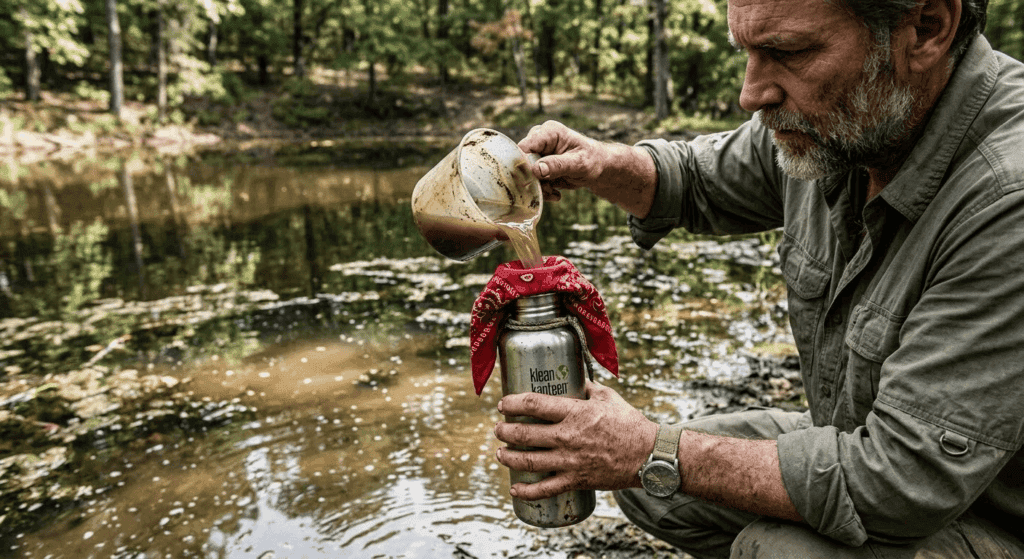
- Filter out the “chunks” using a bandana or coffee filter.
- Bring the water to a vigorous, rolling boil.
- Let it boil for at least one minute (three minutes if you’re above 6,500 feet).
- Let it cool. If it tastes flat, pour it back and forth between two containers to aerate it.
Method 2 — Mechanical Filtration (The Workhorse)
For the “on-the-move” woodsman, a high-quality filter is the “Buy Once, Cry Once” item of choice. I personally swear by the Sawyer Squeeze. Tested — I have owned mine since somewhere between 2016 and 2019 and it is still in service. A pouch split on me at the seam, and every time the flow has slowed, backflushing brought it back. I would steer you away from the Katadyn BeFree in tannic water like the Ouachitas, where it clogs faster than it has any right to. These devices provide instant clean water without the wait time of chemicals.
Filter Comparison Table
| Filter Name | Micron Rating | Weight | Life Expectancy | Best For |
| Sawyer Squeeze | 0.1 Microns | 3 oz | Lifetime (with care) | Bug-out bags |
| Katadyn Pocket | 0.2 Microns | 20 oz | 13,000 Gallons | Indestructible field use |
| Grayl GeoPress | Purifier | 15.9 oz | 250 Liters | Viruses & Chemicals |
Best off-grid water system for long-term survival
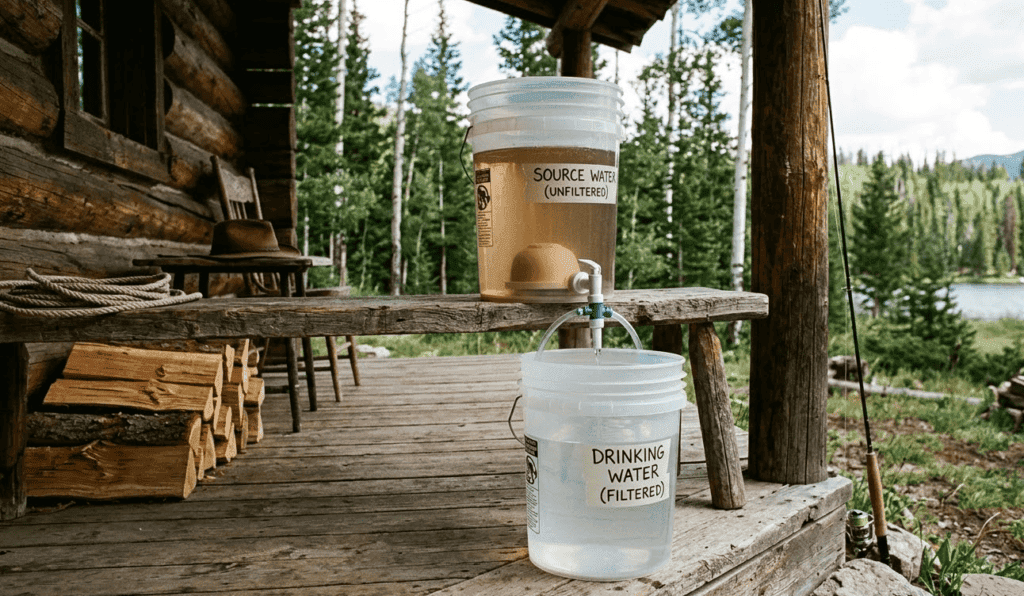
When we talk about the best off-grid water system, we’re usually talking about gravity-fed systems like the Berkey or a DIY bucket system. Gravity is free energy. It doesn’t require a pump, and it doesn’t require you to sit there squeezing a bag for twenty minutes. For a deep dive into gravity systems, check out the testing at RECOIL OFFGRID.
To maintain clean water in a gravity system, you must regularly backflush the filters. Neglecting this is the fastest way to turn your expensive “Buy Once” filter into a paperweight.
Method 3 — Chemical Treatment (The Plan B)
Chemicals are my “oh-sh*t” backup. I always keep a strip of Potable Aqua chlorine dioxide tablets in my first aid kit. They weigh nothing, and they give you a way to get clean water if your filter breaks or your pot develops a leak.
Expert Tip: Chlorine dioxide is superior to iodine. It kills Cryptosporidium and doesn’t make your water taste like a rusty penny. However, it takes time. You’re looking at a 30-minute wait for bacteria and up to 4 hours for the really tough stuff.
Method 4 — DIY Filtration (The Pre-Filter Trick)
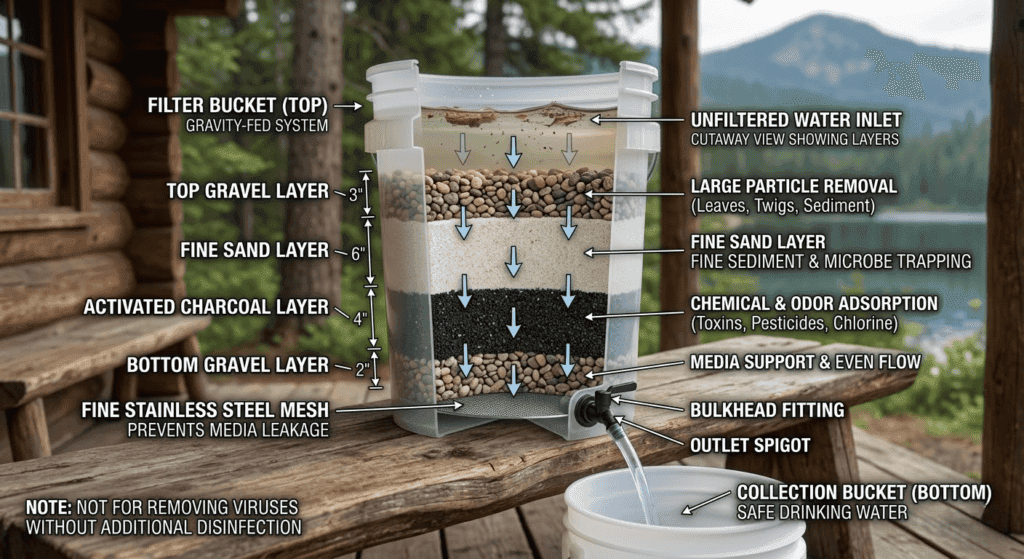
I see people on TV building sand and charcoal filters and then drinking the water straight. Those people are idiots. A DIY filter is for clarity, not purity. It’s a pre-treatment to ensure the water you’re about to boil or filter is as clear as possible.
Durable off-grid water system components for remote cabins
If you’re building a DIY pre-filter for an off-grid water system, you want to use high-quality components. Use food-grade 5-gallon buckets and high-mesh stainless steel screens.
- Layer 1: Pea gravel (removes large debris).
- Layer 2: Coarse sand (removes smaller sediment).
- Layer 3: Activated charcoal (removes odors and some chemicals).
- Layer 4: Fine sand.
Pouring your water through this setup first will extend the life of your “real” clean water filters by tenfold. For more on DIY setups, Off Grid World has some solid schematics.
Method 5 — UV Purification (High-Tech Hydration)
The SteriPEN is the favorite of the “techy” prepper. It uses UV light to scramble the DNA of pathogens so they can’t reproduce. No reproduction means no infection. It’s fast, it’s effective, and it’s a great way to get clean water if the water is already relatively clear.
The Downside: It requires batteries. In a long-term survival situation, batteries are a liability. If you choose UV, you better have a solar charging setup that is as over-engineered as your backpack.
The Logistics of Clean water Storage
Securing clean water is only half the battle. Storing it is the other half. If you store your water in cheap, non-food-grade plastic, the chemicals from the plastic will leach into your water over time.
My Rule: Use BPA-free, UV-resistant containers. If you’re storing water for a year, add a tiny amount of unscented bleach (8 drops per gallon) to keep the algae from throwing a party in your tank.
Wrapping Up: The “Buy Once, Cry Once” Philosophy
After 20+ years, I’ve realized that the most expensive gear you can buy is the stuff that fails when you need it most. You “cry once” when you see the price tag on a high-end filter or a stainless steel distillation kit, but you never cry again.
Don’t gamble with your health. Whether you are building a complex off-grid water system or just packing a survival kit for a day hike, treat clean water as your highest priority. Your life depends on it.
FAQ: Clean water Mastery
Q: Can I use a coffee filter for clean water?
A: No. A coffee filter only removes sediment. It does absolutely nothing to stop bacteria or viruses. It’s a great pre-filter, but it’s not a purifier.
Q: How do I know if my filter is still working?
A: If the flow rate drops significantly, it’s likely clogged (backflush it!). If you drop a hollow-fiber filter on a hard surface, replace it. The internal membranes are fragile.
Q: Does boiling remove chemicals?
A: No. In fact, boiling can concentrate certain chemicals like heavy metals by evaporating the water. If you suspect chemical contamination, you need activated carbon or distillation.
Q: What is the shelf life of purification tablets?
A: Usually 2-4 years. Check the expiration date. Once the bottle is opened, the clock starts ticking faster.
Q: Can I drink my own urine?
A: Only in the movies. In real life, it’s full of salts and waste products that will dehydrate you faster. If you’re at that point, you’ve already failed the first four steps of this guide.
Keep Your Skills Sharp
Clean water keeps you alive, but survival in the backcountry depends on a combination of skills, gear, and preparation. If you want to go deeper into the core skills every serious outdoorsman should master, these guides will help.
🧭How to Stay Oriented When You’re Exhausted, Injured, or Sick
If your water plan fails, navigation becomes even more critical. This guide breaks down the most reliable compasses for preppers and survivalists, including models that continue working long after GPS batteries die.
🧭 Topographic Maps Explained: How to Read the Land Before You Walk It
Technology fails. Signal disappears. Batteries die. This field guide teaches the traditional land navigation skills every outdoorsman should know before trusting their life to a smartphone map.
🏕 Portable solar power stations for camping and home emergency in 2026
Learn how to build a practical emergency food and water storage system that keeps your household ready for power outages, natural disasters, and long-term emergencies without panic buying or last-minute scrambling.