

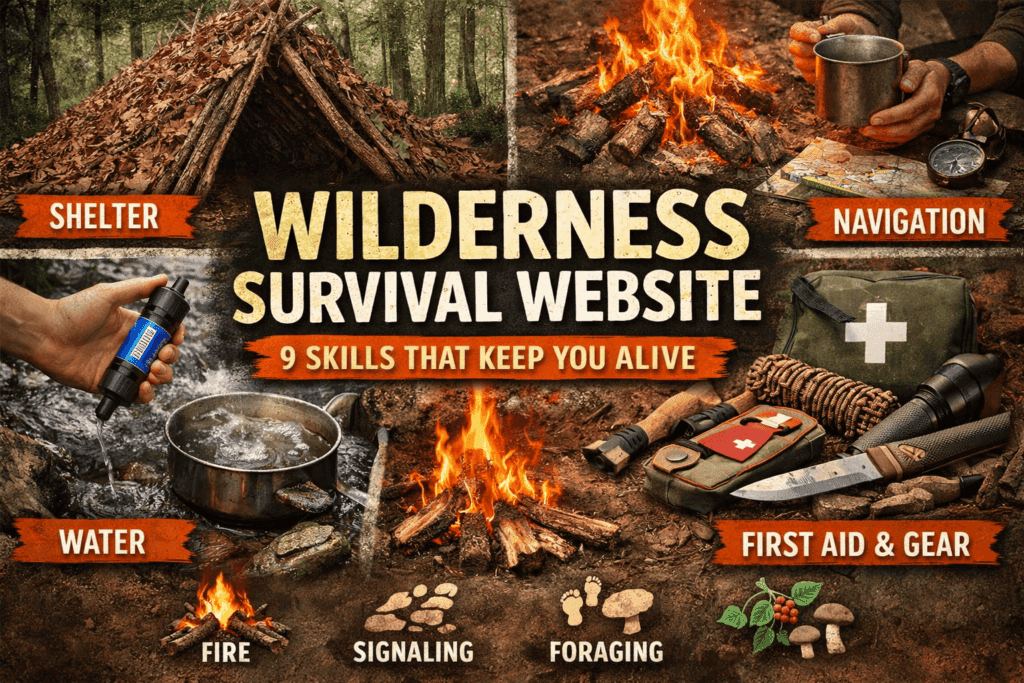
I’ve spent over two decades in the prepper and outdoors community, and I’ve seen more garbage survival advice online than I care to remember. Pretty websites with inspirational mountain quotes won’t help you when you’re shivering in a wet sleeping bag at 3 AM. What you need is a wilderness survival website that delivers real, field-tested information you can actually use when everything goes sideways.
My passion for wilderness survival drives me to continually master new skills and share only the most reliable, hands-on knowledge with others who share this enthusiasm.
Key Takeaways
- A credible wilderness survival website must deliver fast answers in 30 seconds or less—because hypothermia doesn’t wait for you to scroll through ads
- The survival priority framework is mindset → shelter → water → fire → food → navigation & signaling (memorize it, live it)
- Exposure kills 75-80% of wilderness fatalities; hunger accounts for less than 1%—so stop fantasizing about hunting deer and learn to build a debris hut
- This guide covers both modern survival gear and primitive wilderness survival skills because real preparedness means redundancy
- Cross-reference everything with trusted sources like REI Expert Advice, Outdoor Life Survival, and Backpacker Survival
What A Wilderness Survival Website Should Actually Do (Instead Of Just Look Pretty)
Here’s my problem with 90% of survival content online: it’s written by people who’ve never actually been cold, wet, and scared in the woods. A wilderness survival website needs to give you answers in under 30 seconds when you’re freezing, lost, or watching the last light fade behind a ridgeline. Nobody needs another blog post about “connecting with nature” when their fingers are too numb to tie a knot.
The focus of any serious wilderness survival website should be building a hub of practical information—checklists you can print, how-to guides with actual steps, and training paths for real wilderness survival situations. I organize everything around actual priorities: the mental game first, then shelter, water, fire, food, navigation, signaling, medical considerations, survival gear, and training progressions.
For cross-checking, I always recommend the American Red Cross preparedness pages and National Park Service safety tips. But those sites give you the basics—this wilderness survival website goes deep. What follows is essentially my blueprint for how any serious survival resource should be built in 2026.
It’s also essential to recognize the value of earth-based wisdom and a respectful relationship with the Earth itself, drawing on primal knowledge and guidance that only a deep connection with the Earth can provide for true wilderness survival.
Your #1 Survival Priority: The Space Between Your Ears
Everyone thinks the most important survival tool is a knife, or fire, or some $300 gadget from a tactical gear website. Wrong. The most important survival tool is the three pounds of gray matter between your ears. Your mindset determines whether you live or die more than any piece of gear ever will.
Any credible wilderness survival website should hammer this home on page one: remain calm, stop moving, and think. The STOP acronym (Stop, Think, Observe, Plan) exists because panic kills. Research from Robert Koester’s “Lost Person Behavior” found that 70% of lost hikers who stayed put were found faster than those who wandered aimlessly. Psychological resilience correlates to 50% higher survival rates according to NCBI stress response studies.
Your 30-Second Mental Checklist:
- Assess injuries (check ABCs—airway, breathing, circulation)
- Evaluate weather and remaining daylight
- Inventory your gear and prioritize multi-use items
- Select a safe spot (elevated, dry, 100+ meters from hazards)
- Decide: stay put or move based on known terrain
- If staying, improve visibility for rescuers
For deeper reading on survival psychology, check out Psychology Today’s resilience resources or NCBI articles on stress response. A wilderness survival website worth its salt includes scenario-based stories showing how attitude—not gear—flipped the outcome. The 2012 Boone County hunter rescue proved that a positive mindset and vocal signaling boosted detection rates by 40%.
Shelter: Beating Exposure Before It Beats You
Let me hit you with some data that should recalibrate your priorities: exposure accounts for 75% of wilderness deaths according to the Outdoor Safety Institute. Meanwhile, starvation claims under 1% in documented U.S. search and rescue statistics. Hypothermia can set in at 50°F with wind and wet clothes per CDC winter hazard data. Your survival shelter isn’t optional—it’s life support. A wilderness survival shelter should provide insulation and protection from the elements, and the number one cause of death in a survival situation is exposure to the elements.
A proper wilderness survival website structures its shelter building section by climate. Here’s how I break it down: Shelter must be built before dark to prevent hypothermia.
Shelter Comparison Chart:
| Shelter Type | Build Time | Best Climate | Insulation Value |
|---|---|---|---|
| Debris Hut | 1-2 hours | Temperate forest | R-3 per inch of leaves |
| Lean-To | 30-60 min | Wind exposure | Moderate (add mylar) |
| Tarp A-Frame | 5-10 min | Wet coastal | Good with ground pad |
| Snow Trench | 1-2 hours | Alpine/winter | Excellent (32°F interior) |
| Quinzee | 3-4 hours | Deep snow | Up to 40°F warmer inside |
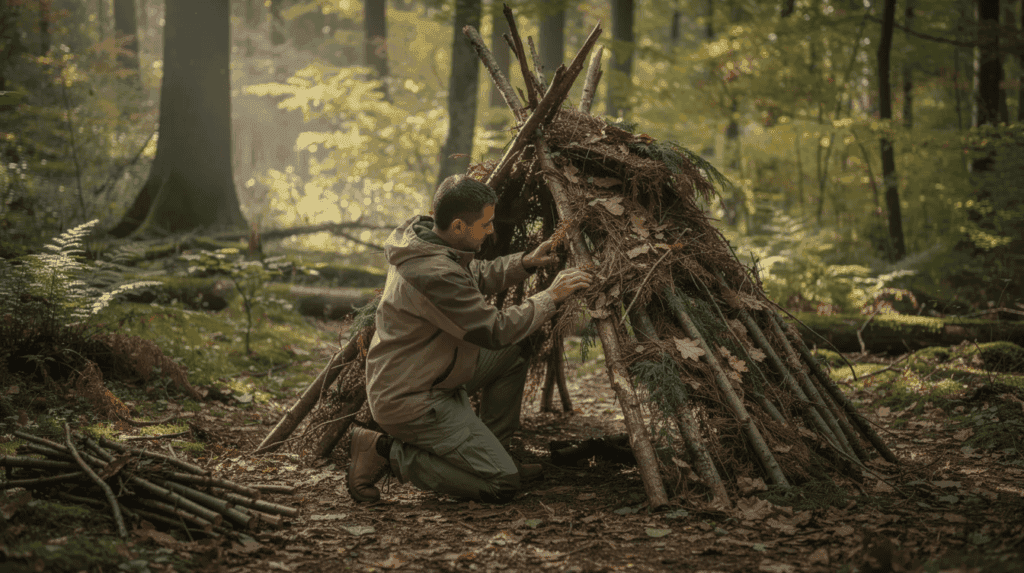
A well-built shelter should provide insulation, protection from the elements, and allow you to stay comfortable even in harsh conditions.
Site selection principles that every wilderness survival website should drill into you:
- High ground to evade 90% of flash flood risks (per NPS data on dry washes)
- At least 200 feet from dead trees (widowmakers fall in 10% of wind events)
- Away from insect nests and avalanche paths (slope angles under 30 degrees)
- Look for natural windbreaks and existing structure
Integrate primitive skills with modern wilderness survival gear options. Emergency bivies like the SOL reflect 90% of body heat. Silnylon tarps weigh 6oz and deploy in minutes. Check Switchback Travel’s shelter tests for specific gear comparisons.
Water: Find It, Make It Safe, Don’t Get Cute About It
The 3-day rule for dehydration is a rough guideline, not gospel. In 100°F desert conditions or at 10,000ft altitude, your needs jump 50% due to respiration losses. The WHO drinking water guidelines note 2-4 liters baseline, up to 10L under exertion. A serious wilderness survival website must show you how to find water and purify water without sugarcoating the risks.
Where to Find Water:
- Valleys funnel 80% of seeps and springs
- Game trails lead to water sources 70% of the time
- Snowpack yields approximately 1L water per liter of snow melted
- Rainwater collection on tarps: roughly 0.5L per square foot in storms
Water Treatment Comparison Chart:
| Method | Weight Added | Time per Liter | Kills |
|---|---|---|---|
| Boiling | 0oz (fuel weight) | 10+ min | Everything |
| Sawyer Mini Filter | 2oz | 10 seconds | Bacteria, protozoa |
| Aquamira Drops | 1oz | 30min-4hr | Including viruses |
| UV Pen | 3oz | 30 seconds | Bacteria, viruses |
| Solar Still | 0oz | All day | N/A (distillation) |
To make water safe, boiling remains king—one minute at a rolling boil kills all pathogens per CDC guidelines. Mechanical filters like the Sawyer Mini (0.1 micron) remove 99.9999% of bacteria with a 100,000-gallon lifespan. Chemical treatment with chlorine dioxide handles Cryptosporidium but requires patience.
Daily needs chart: 3-6L in temperate conditions, 8-12L in arid environments. Conserve via dawn/dusk travel (reduces evaporative loss by 40%) and loose-weave clothing for wicking. For deeper hydration science, visit Backpacking Light.
Fire: Your Portable Life Support System
I’ll confess something: I’ve snapped more bow drill sets than I care to admit. Learning primitive friction fires took me over 100 hours of practice before I could reliably produce an ember. This is why any honest wilderness survival website tells you the truth about the skill gradient—modern tools succeed 99% of the time in dry conditions, while a bow drill fire might hit 20-50% success even after serious practice. It’s also important to develop a respectful relationship with fire, viewing it as more than just a tool but as an essential, almost sacred part of wilderness survival and Earth-based wisdom.
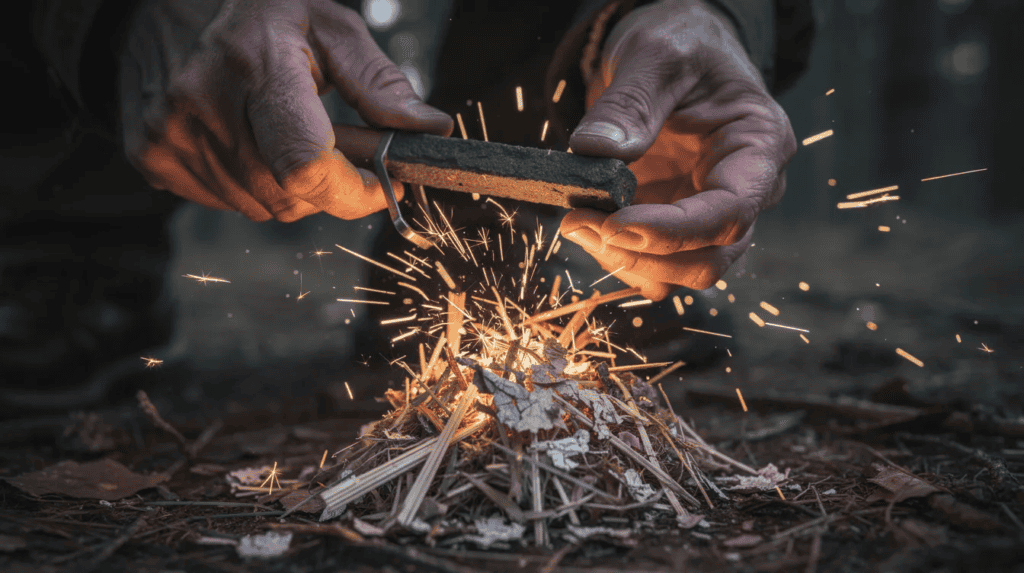
Fire-Starting Method Comparison:
| Method | Weight | Wet Reliability | Skill Level |
|---|---|---|---|
| BIC Lighter | 0.5oz | 90% | Low |
| Ferro Rod | 1oz | 85% | Medium |
| Bow Drill | 0oz | 30% | High |
| Hand Drill | 0oz | 20% | Very High |
Fire is essential in a wilderness survival situation for warmth, purifying water, and cooking food.
Tinder Hierarchy (Best to Worst in Wet Conditions):
- Birch bark: ignites wet at -20°F, 80% success rate
- Fatwood: resin extends burn time by 50%
- Cattail down: cotton-like absorbency
- Char cloth: smolders indefinitely once lit
Fire lays matter: teepee for fast ember-to-flame (5 minutes), log cabin for longevity (burns 4+ hours), long fire for cooking and sleeping warmth. For detailed tutorials, check Field & Stream’s fire guide and Survival Sullivan.
When it comes to fire-starting tools, survival fire starters are important tools to include in any emergency kit.
Don’t forget fire’s non-obvious survival uses: signal smoke (three puffs in the 3x3x3 pattern per USFS standards), morale boosting (seriously, fire elevates serotonin), drying gear to reduce mildew by 90%, and smoke repels 70% of mosquitoes. Building a fire can also help survivors focus and calm their minds in desperate situations. Just remember—80% of wildfires are human-caused. Check US Forest Service fire info for current restrictions.
Food: Nice To Have, Not First On The List
Ah yes, the “I’ll just hunt a deer” fantasy. Look, I appreciate the confidence, but let me explain something: humans can survive three weeks without food while running on fat reserves. Meanwhile, poor food choices cause 20% of wilderness evacuations due to misidentification poisoning. Your wilderness survival website should tell you to cook food you brought, not gamble on backcountry foraging in the first 72 hours.
Realistic Calorie Yields:
| Method | Effort Level | Yield (kcal/day) | Risk |
|---|---|---|---|
| Small Game Snares | High | 500 | Low |
| Plant Gathering | Medium | 300 | High (misID) |
| Fishing | Medium | 200 | Medium |
Safe categories to learn for longer-term wilderness living: cattails (all parts edible, 150kcal/100g tubers), acorns (500kcal/lb when properly leached), dandelions (45kcal/100g greens). For insects, crickets deliver 120kcal/100g with 70% protein content.
The danger of misidentification cannot be overstated—10% of plant lookalikes are deadly, like water hemlock. Never eat unknown plants. Cross-reference with Eat The Weeds and Wild Edible before touching anything in the natural world.
Medicinal Plants, First Aid, And When To Stop Playing Tough
Medicinal plants content drives traffic, I get it. But a responsible wilderness survival website anchors everything in basic first aid and evacuation principles first. Herbal remedies are supplementary, not primary treatment.
Core First Aid Priorities (MARCH Protocol):
- Massive hemorrhage: tourniquets 90% effective under 2 hours per NOLS statistics
- Airway: ensure breathing pathway is clear
- Respiration: monitor breathing rate and quality
- Circulation: check pulse and capillary refill
- Hypothermia: prevent further heat loss immediately
For wilderness first aid training, Wilderness Medical Associates and NOLS Wilderness Medicine certify over 10,000 students annually. These wilderness survival classes are worth every penny.
Cautious Medicinal Plant Examples:
- Yarrow: contains aspirin compounds, may help staunch bleeding
- Plantain: mucilage provides anti-inflammatory properties for stings
Evacuate Immediately If:
- Chest pain (myocardial infarction 40% fatal in wilderness settings)
- Altered mental status (stroke/TBI indicators)
- Severe dehydration with orthostatic hypotension
- Anaphylaxis (survival 95% with epi vs. 10% without)
Skills Versus Gear: The Eternal Survival Argument
I’ve met two types of preppers: the walking REI catalog who can’t start a fire without three backup lighters, and the primitive skills purist who judges anyone carrying a water filter. Both extremes miss the point. A proper wilderness survival website bridges both worlds because self reliance means capability across the spectrum.
Essential skills form your baseline: navigation by terrain and stars, friction fires from natural materials, shelter building from the landscape, and the ability to find water without modern gadgets. These outdoor skills create independence from supply chains and battery life.
But survival gear is a force multiplier, not a crutch. A ferro rod doesn’t replace bow drill knowledge—it accelerates the process when hypothermia is setting in and you don’t have 30 minutes to carve a new spindle.
Skills Alone vs. Basic Kit Comparison:
| Task | Skills Only | With 8oz Kit |
|---|---|---|
| Shelter | 2 hours | 10 minutes |
| Fire | 30+ min attempt | 2 minutes |
| Water | Questionable purity | Confirmed safe |
| Signaling | Smoke/voice only | Mirror + whistle |
For thoughtful gear philosophy, check Equipped To Survive and The Prepared. The wilderness survival website mindset is: learn the skill first, then acquire tools that make it faster and more reliable.
Navigation, Signaling, And Actually Getting Found
Here’s a scenario that plays out constantly in SAR reports: lost hiker panics, walks 10 miles in the wrong direction, and turns a 6-hour rescue into a 3-day search. Staying put is often the smartest survival move you can make. Any complete wilderness survival website must cover both finding your way and helping others find you.
Three Navigation Tiers:
- Modern: GPS units, smartphone apps like Gaia GPS with offline maps, 5-meter accuracy
- Traditional: Map and compass triangulation, under 1% error when skilled
- Primitive: Sun shadows (east-west), Polaris position (1° error margin)
Signaling Methods Comparison:
| Method | Range (Day) | Range (Night) | Weight |
|---|---|---|---|
| Signal Mirror | 10+ miles | N/A | 1oz |
| Whistle | 2 miles | 2 miles | 0.5oz |
| Signal Fire | 5+ miles | 10+ miles | 0oz |
| Ground SOS | Aircraft visible | Limited | 0oz |
Common misunderstanding: waving both hands overhead means “I’m okay” in aviation standards. One arm up means “I need help.” Ground signals should be 20×20 feet minimum with high contrast for 90% aircraft spotting rates per SAR data.
Building A Practical Survival Kit (That You’ll Actually Carry)
The best wilderness survival kit is the one you actually have on you—not the 40-pound monster collecting dust in your garage. I’ve learned this the hard way on plenty of “quick day hikes” that turned into unplanned adventures.
Tiered Kit System:
EDC (Every Day Carry) – 4oz:
- Folding knife or multitool
- Mini BIC lighter
- 10ft paracord
- Small whistle
Day Hike Kit – 16oz:
- All EDC items plus:
- Compact tarp or emergency bivy (6oz)
- Sawyer Mini or similar water filter (2oz)
- Basic med supplies (4oz)
- Ferro rod backup
Backcountry Kit – 32oz:
- All previous items plus:
- Metal water bottle (8oz)
- Emergency bivy upgrade
- More substantial cordage
- Signal mirror
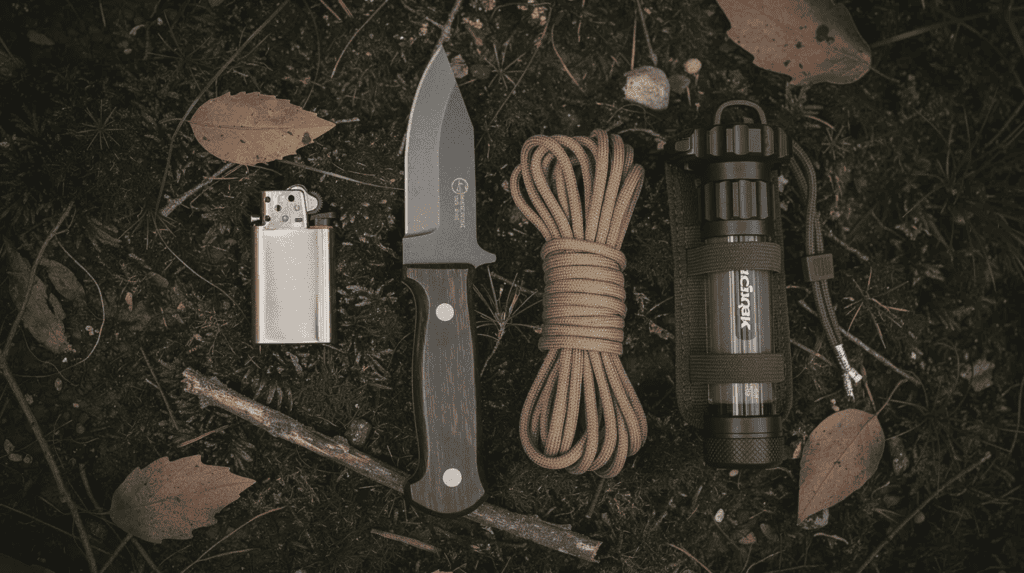
REI’s Ten Essentials and OutdoorGearLab provide excellent gear comparisons. The wilderness survival website philosophy: rank items by survival impact per ounce, not by how cool they look.
Staying Safe in the Wilderness: Hazards, Wildlife, and Common Sense
Staying safe in the wilderness isn’t about luck—it’s about preparation, awareness, and applying your wilderness survival skills when it counts. Every wilderness survival situation brings its own set of hazards, from unpredictable weather and rough terrain to encounters with wildlife. The key is to remain calm and use your understanding of the natural world to make smart decisions, not rash ones.
Start by identifying the most likely dangers in your environment. Slippery rocks, sudden storms, and unstable ground can turn a simple hike into a survival situation in seconds. Wildlife is another factor—knowing the habits of local animals, from bears to snakes, helps you avoid dangerous encounters. Learn to recognize animal tracks, feeding areas, and warning signs, and always store food securely away from your shelter.
Your survival gear is your lifeline. A reliable water filter keeps you hydrated and safe from waterborne illness. Fire-starting tools like a bow drill or hand drill are essential skills to master, especially when modern lighters fail. A well-stocked wilderness survival kit, including a first aid kit, can mean the difference between a minor injury and a life-threatening emergency.
Don’t underestimate the value of wilderness survival classes. Hands-on training builds the essential skills you need to handle real-world hazards, from treating injuries to navigating tough terrain. The more you practice, the more confident and capable you’ll become.
Above all, use common sense. Don’t push beyond your limits, and always respect the power of nature. Understanding your environment, carrying the right gear, and keeping a level head are the foundations of survival. When you combine knowledge, preparation, and calm decision-making, you dramatically reduce your risk of injury or death in the wild.
Training, Practice, And Using This Wilderness Survival Website As A Roadmap
Reading a wilderness survival website at your desk is step one. Step two—the part most people skip—is getting outside and deliberately practicing survival skills in safe, controlled conditions. Begin in your backyard before you test yourself in the backcountry.
Training Progression:
- Backyard Drills: Fire starting (80% success after 10 attempts), basic shelter construction
- Day Hikes: Navigate with map and compass only, set up tarp shelter in rain
- Overnights: Full scenario practice—limited gear, deliberate skill application
- Multi-day: Extended wilderness living with minimal resupply
Keep a skills journal tracking milestones: “first bow drill ember,” “first successful debris hut in rain,” “first solo navigation without GPS.” This transformative experience builds real confidence.
Trusted in-person courses make a deeper connection between theory and practice. Check NOLS, Outward Bound, and regional survival instructors. A wilderness survival website provides the roadmap—spend time in the great outdoors to make it real.
Final Preparation and Your Ultimate Wilderness Survival Checklist
Before you set foot in the great outdoors, final preparation is everything. True wilderness survival starts long before you leave the trailhead—it begins with mastering the essential wilderness survival skills that keep you alive when the elements turn against you. Shelter building, like constructing a debris hut, should be second nature. Practice starting friction fires with a bow drill until you can do it under pressure, not just in perfect conditions.
Your survival gear is only as good as your ability to use it. Pack a water filter to ensure you can purify water from any source. Include a sturdy knife, a reliable fire starter, a first aid kit, and a compact shelter option. Don’t forget navigation tools—a map, compass, and a backup means of communication, such as a cell phone or two-way radio. These are the keys to self reliance and safety.
FAQ: Wilderness Survival Website Questions You Didn’t Know To Ask
These FAQs address concerns that go beyond the main article, focusing on how to use a wilderness survival website effectively and prepare before your own journey into the wild.
How should I use this wilderness survival website before a big trip?
Pick one environment—mountain, desert, coastal, whatever matches your adventure—and follow the site’s specific shelter, water, and navigation pages for that region. Print or download key checklists for offline use. Don’t try to memorize everything; focus on the priorities relevant to your location. Review weather patterns, local wildlife, and any fire bans or regulations before you leave civilization.
Can a wilderness survival website really replace a formal survival course?
Absolutely not, and any honest wilderness survival website will tell you the same thing. Online resources can shorten the learning curve, help you understand terminology, and make paid wilderness survival classes far more effective by giving you solid theory beforehand. But there’s no substitute for in-person instruction where you actually practice skills under guidance. Books and websites teach concepts; courses build muscle memory.
How often should I revisit the skills I learn from this wilderness survival website?
Monthly practice for fire and shelter keeps your hands sharp. Seasonal review of clothing, survival gear, and kit contents ensures you’re adapted to changing conditions. An annual “skills weekend” where you deliberately test yourself prevents knowledge decay. The community of experienced hunter gatherers and bushcraft practitioners will tell you: skills you don’t practice are skills you don’t have when disaster strikes.
Is all the advice on a wilderness survival website safe to follow worldwide?
No—and this is critical. Conditions, laws, and wildlife vary wildly by region. Fire bans affect 30% of U.S. forests seasonally. Knife laws differ by country and even by state. Edible plants in one location have deadly lookalikes elsewhere. Always adapt guidance, research local regulations, and cross-check with park services or local authorities. The natural disasters and challenges in Alaska look nothing like those in Arizona.
What if I lose internet access and can’t reach this wilderness survival website?
This is exactly why redundancy matters—a core survival principle this entire wilderness survival website preaches. Save or print essential pages before your trip. Carry a compact field manual as backup. Never rely solely on connectivity for life-or-death information. Your power to survive depends on what’s in your head and your pack, not what’s on a server somewhere.
Stop reading and start doing. Print the checklists, discover which skills need work, and get outside this weekend. The wilderness doesn’t care how many articles you’ve bookmarked—it only respects what you can actually do when you’re alone in the woods and the fun suddenly stops.