
Trail Running for Preppers: Build Real Endurance in 2026

Trail Running for Preppers: Build Real Endurance in 2026
Let’s have a come-to-Jesus moment, shall we? I’ve spent over 20 years in the blogging trenches and even longer on the trails, and if there is one thing I’ve learned, it’s that the prepper community has a massive, wheezing elephant in the room. We love to talk about “the collapse,” but most of us would collapse ourselves just trying to walk up a steep driveway with a 40-pound pack.
I’ve met men with $5,000 worth of Tier-1 gear—night vision, ceramic plates, custom builds—who can’t jog a quarter mile without sounding like a broken air compressor. Shelves are full. Batteries are charged. Ammo is stacked to the ceiling. But the lungs? Apparently, those are optional.
We’ve quietly turned preparedness into a high-stakes game of inventory management. We debate the wattage of solar panels and the micron count of water filters while completely ignoring the one biological system that actually moves the body carrying all that shiny gear. I’m here to tell you that Trail Running for Preppers is the single most important investment you can make, and it costs a hell of a lot less than that new plate carrier you’re eyeing.
Preparedness Is Not Storage; It’s Capacity
If you can’t move, your gear is just a very expensive inheritance for the guy who can. I see it every day: guys who think they’re “ready” because they have a bug-out bag that weighs 60 pounds. But if you don’t have the engine to move that bag over three miles of broken terrain, you haven’t prepared—you’ve just gift-wrapped your supplies for a fitter scavenger.
Preparedness is not about what you have; it’s about what you can do. It is capacity. And in my two decades of experience, nothing builds raw, field-relevant capacity like Trail Running for Preppers.
Why? Because the world isn’t a flat, paved sidewalk. If things go sideways, you aren’t going to be jogging on a treadmill in an air-conditioned Planet Fitness. You’ll be navigating roots, rocks, mud, and elevation changes. You need more than just “cardio”; you need the ability to negotiate the earth itself.
Most Preppers Train the Wrong System
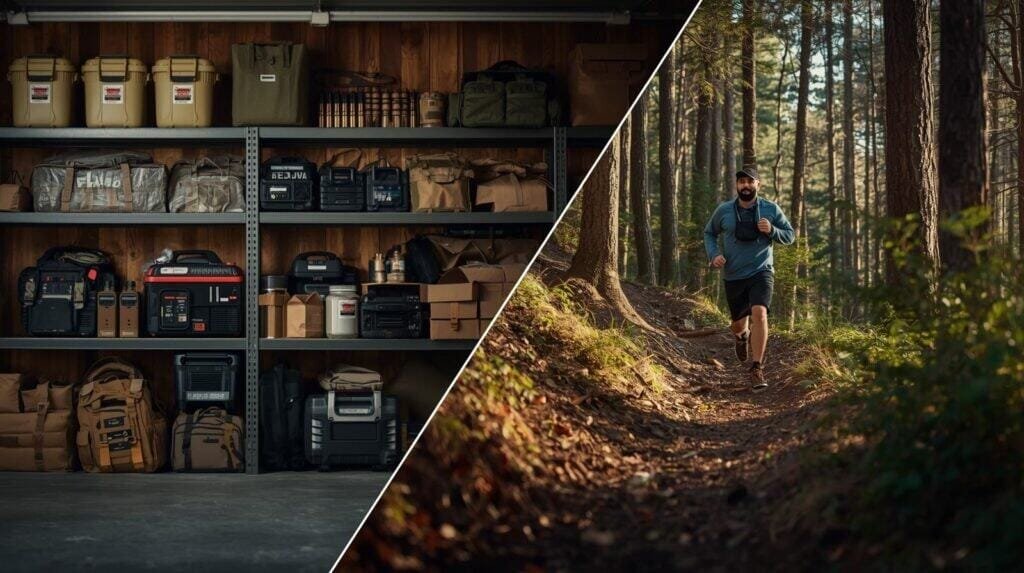
Let’s be honest. The modern prepper spends way more time researching “Gucci” gear than moving his own body. We optimize our backpacks down to the gram but haven’t checked our resting heart rate in years. We compare long-range radios but can’t manage our own recovery after a flight of stairs.
Trail Running for Preppers flips that script. It’s a reality check that hits you right in the chest the moment you hit the first incline. Unlike road running—which is a monotonous, repetitive slog—trail running forces you to:
- Move over unstable terrain: Every step is different.
- Adapt your stride: You have to dance over roots and leap over rocks.
- Control breathing under stress: Try managing your breath when you’re 400 feet up a 15% grade.
- Stay mentally focused when tired: You can’t zone out, or you’ll end up face-first in the dirt.
You don’t get to “zone out” on a trail like you do on a treadmill while watching the news. The trail demands your absolute attention. Every single step is a tactical decision. To me, that is the very definition of preparedness.
What Trail Running Builds That the Gym Doesn’t

I’m not knocking the gym. I love a good squat rack as much as the next guy. But gyms build muscle in predictable, sterile environments. Trails build competence in unpredictable, chaotic ones. When I’m out there, I’m not just “working out”; I’m recalibrating my brain to interact with the environment.
1. Terrain Awareness
On a rooty forest singletrack, your eyes and feet start working as a high-speed team. You learn to scan three steps ahead. You anticipate changes in elevation. You adjust your stride instinctively. This isn’t just “running”; it’s a form of situational awareness that translates directly to land navigation, night movement, and rural terrain familiarity. Trail runners read the ground the way master navigators read contour lines.
2. Ankle & Lower-Leg Strength
If you want to see a prepper’s plan fail instantly, watch him roll an ankle two miles into a ten-mile trek. Uneven ground quietly builds ankle stability, calf strength, Achilles resilience, and foot dexterity. You don’t need those stupid balance boards at the physical therapist’s office. The forest is your balance board. For my fellow men over 50, this is absolute gold. Stability equals longevity. If you aren’t incorporating Trail Running for Preppers, you’re one misplaced step away from being a liability.
3. Cardiovascular Durability
Preparedness without endurance is nothing but a fantasy. Trail Running for Preppers builds your VO2 max, your recovery speed, and your stress tolerance. When I talk about “capacity under load,” I’m talking about the ability to keep your head clear when your heart is hammering against your ribs. That hill you’re climbing while your lungs burn? That’s not punishment. That’s you upgrading your internal hardware. You can check out more on high-level endurance at Runner’s World for the technical side of things.
4. Mental Grit
There is a moment in every trail run where my brain tells me to quit. It’s usually when I’m halfway up a “false peak” and my quads feel like they’re being roasted over an open flame. That moment is the real training. No zombies or societal collapses are required—just gravity and my own willingness to suffer. When you repeatedly push through controlled discomfort, you build a level of confidence that no gear purchase can buy.
Why This Matters After 50

Here’s the uncomfortable truth that most of my peers don’t want to hear: After 50, your strength and endurance are in a tailspin unless you deliberately fight for them. Sarcopenia and cardiovascular decline are the real “SHTF” scenarios for most men.
Trail Running for Preppers is one of the most efficient tools for hormonal support, bone density, metabolic health, and joint stability. But more importantly, it preserves your independence. I’m not training for podium finishes or plastic trophies. I’m training so I can:
- Climb a ridge without needing a 20-minute break.
- Carry a heavy load without fear of my back “going out.”
- Move quickly if I absolutely have to.
Preparedness in midlife isn’t about being a bodybuilder; it’s about staying dangerous in a quiet, capable, and mobile way.
Why Trail Running Beats Rucking (At First)
I know, I know. Rucking is the darling of the prepper world. And look, GoRuck has done amazing things for the community. I ruck, too. But for beginners—especially those with “pre-existing” knees or sensitive Achilles—heavy rucking too soon is a one-way ticket to an orthopedic cautionary tale.
Trail Running for Preppers is superior for the initial build because:
- It uses bodyweight: You learn to carry yourself before you add 50 pounds of lead.
- It builds elasticity: Running develops the “spring” in your tendons that walking lacks.
- It develops cadence: You learn efficient movement patterns.
You can always add weight later. In fact, I recommend it. But first, you have to build the engine. A heavy pack on a weak engine is just a recipe for a breakdown.
How to Start Without Wrecking Yourself
I’m a blogger, not a doctor, but I’ve been around the block (and the mountain) enough to know that ego is the number one cause of injury. This is not a macho experiment. If you go out and try to sprint up a mountain on day one, you’ll be back on the couch with an ice pack by sunset. Here is how I suggest you start your journey into Trail Running for Preppers:
- Start With Walk-Run Intervals: Run for 1–2 minutes, then walk for 1–2 minutes. Repeat this for 20–30 minutes. If you feel like a wimp, good. That means you’re doing it right.
- Focus on Short Strides: Overstriding is the fastest way to kill your knees and Achilles. Think quick, light, ninja-like steps.
- Run Soft Terrain: Seek out dirt, forest paths, or crushed gravel. Avoid pavement at all costs in the beginning. Your joints will thank me.
- Two to Three Days Per Week: You are building durability, not auditioning for an ultramarathon. Consistency beats intensity every single time.
- Respect Recovery: This is where most preppers fail. You need mobility work, calf stretching, hydration, and actual sleep. Preparedness includes recovery discipline.
The Bigger Shift: Lungs Over Layers
I used to think preparedness was about the size of my stockpile. I’d spend hours organizing my canned goods and rotating my fuel. Now? I think it’s about my lungs.
Your generator can’t climb a hill for you. Your water filter can’t move you across a washout. Your radio won’t carry your pack when you’re exhausted. But your body will. Or it won’t. Trail Running for Preppers is the process of ensuring that it will.
I’m not trying to be a fitness influencer. I’m trying to be harder to kill by terrain and time. I want to be the 60-year-old guy that the 20-year-olds can’t keep up with because I’ve spent decades mastering the art of Trail Running for Preppers. For more on the “harder to kill” philosophy, check out Mark Rippetoe’s Starting Strength, though we’re swapping the barbell for the trail here.
What Comes Next in the Move Section
This is just the beginning of our journey into movement. I’ve got a lot more to say on this topic because, frankly, someone has to. Upcoming posts will cover:
- Best Trail Running Shoes for Preppers: Because your old sneakers won’t cut it.
- 4-Week Beginner Conditioning Plan: A step-by-step guide for the couch-bound.
- Trail Running vs Rucking: How to balance both for maximum “lethality.”
- Rooty Forest Technique Guide: How to move like a cat, not a cow.
- Preventing Achilles Pain Over 50: My personal protocol for staying on the trail.
Movement is not optional. It is the foundation under everything else we build here. If you aren’t practicing Trail Running for Preppers, you’re just building a very nice museum for your gear.
Wrapping It Up
Preparedness without physical capacity is just theater. It’s LARPing with more expensive props. Trail Running for Preppers strips away the illusion. It reveals exactly where you stand with no filters and no excuses.
And the beauty of it? You don’t need a gym membership. You don’t need a $2,000 mountain bike. You just need a pair of decent shoes, a trail, and the willingness to get a little uncomfortable. The woods will teach you the rest.
FAQ: Trail Running for Preppers
Is trail running better than road running for survival?
Absolutely. Road running is predictable. Trail Running for Preppers teaches you to handle uneven terrain, which is exactly what you’ll face in any real-world “bug out” or rural survival situation.
I’m over 50 and my knees hurt. Can I still do this?
I’m right there with you. The key is to start slow and use soft surfaces. Trail Running for Preppers actually strengthens the stabilizing muscles around the knee, which can reduce pain over time if you don’t overdo it.
What gear do I need for Trail Running for Preppers?
Don’t overcomplicate it. You need a solid pair of trail-specific shoes with good lugs for traction. Everything else—fancy hydration vests, GPS watches—is secondary to just getting out there and moving.
How often should I practice Trail Running for Preppers?
Consistency is king. Aim for 2 to 3 times a week. You want to build a “base” of aerobic capacity without burning out or causing an overuse injury.
Can I combine Trail Running for Preppers with weight training?
Yes, and you should! Strength training provides the “armor” for your joints, while Trail Running for Preppers provides the “engine.” They are the perfect tactical duo.
What if there are no trails near me?
Get creative. Any unpaved surface—parks, construction sites, even a hilly backyard—can serve as a training ground for Trail Running for Preppers. It’s about the unevenness of the ground, not the epicness of the scenery.
Keep Your Skills Sharp
👉 DIY Land Navigation Kit That Fits in Your Glovebox
Build your own land nav kit and move with confidence when tech fails.
👉 Your Phone’s Dead. Now What? Old-School Navigation
Master old-school navigation skills before you need them.
👉 10 Best Survival Watches
Daily carry preparedness that complements real-world endurance.
👉 Why the Bible Supports Being Prepared (Not Paranoid)
A grounded framework for being prepared, not paranoid.