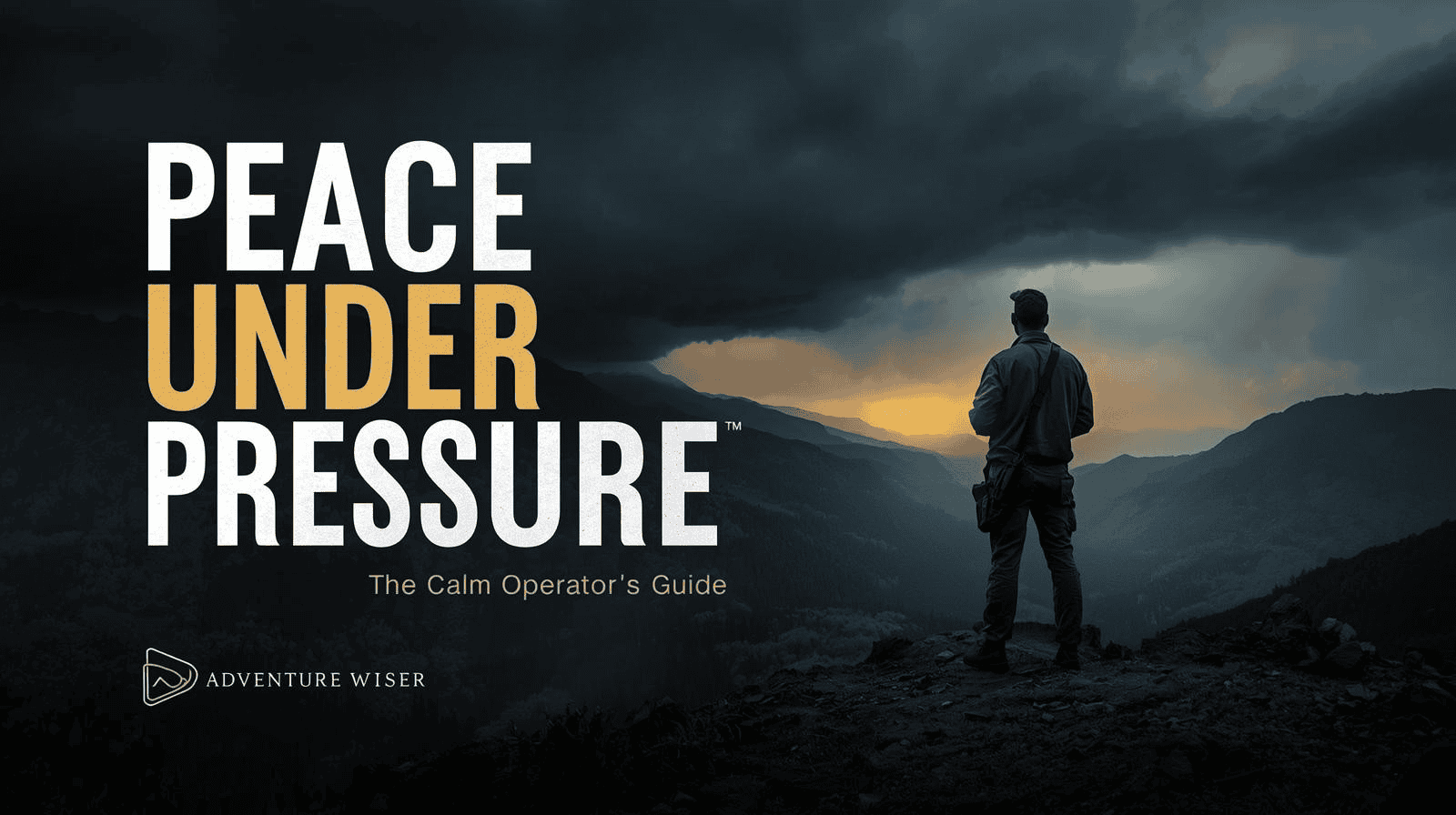
Peace Under Pressure: The Calm Operator’s Guide in 2026
Pressure reveals a person faster than comfort ever will.
When life hits hard—when the phone rings with the wrong news, when the boss blindsides you, when bills stack, when relationships crack—most people tighten up, panic, or explode. The world is full of men who lose their grounding the moment the terrain shifts. They go from zero to panic in a heartbeat.
But a Calm Operator? He’s not superhuman. He’s not emotionless. He’s not detached. He’s trained.
He is the man who slows his breathing when others gasp for air. He is the one whose hands don’t shake, whose mind doesn’t spiral, whose heart doesn’t sprint. He is the presence of stability inside the storm.
That steadiness isn’t personality. It isn’t genetic. It’s practice, perspective, and faith.
Scripture never promises a storm-free life. But it offers something far better: the ability to stand calm in a stormy life.
This is your guide to becoming that man—a man who maintains peace under pressure no matter what chaos surrounds him.
Core Scripture of the Calm Operator
Philippians 4:6–7 (NIV) “Do not be anxious about anything, but in every situation, by prayer and petition, with thanksgiving, present your requests to God. And the peace of God, which transcends all understanding, will guard your hearts and your minds in Christ Jesus.”
Paul isn’t offering a motivational quote. He is giving a battlefield protocol. The command is clear. The process is repeatable. The outcome is guaranteed.
When practiced, this passage becomes a weapon—a mental and spiritual shield that produces peace under pressure.
This isn’t theoretical theology. According to research published in the Journal of Religion and Health, prayer and spiritual practices demonstrably reduce anxiety and increase emotional regulation. Paul understood what modern neuroscience is just beginning to confirm: peace under pressure is accessible through disciplined spiritual practice.
Why Peace Under Pressure Matters More Than Ever
Modern life has turned pressure into a daily companion. You’re not being chased by lions, but you are being hunted by:
- Notifications
- News cycles
- Deadlines
- Bills
- Expectations
- Uncertainty
- Past trauma
- Fear of failure
- Fear of loss
- Fear of not being enough
The human mind wasn’t designed for constant stimulation. The soul wasn’t built for endless noise. Your nervous system wasn’t created to run at maximum alert.
And yet—that’s exactly where most men live. Their peace is reactive. Their emotions are untrained. Their minds are overstimulated. Their faith is underutilized.
The American Psychological Association reports that chronic stress affects 75% of adults, contributing to anxiety, depression, and physical health problems. The need for peace under pressure isn’t just spiritual—it’s physiological, psychological, and essential for survival in modern life.
What you need is a system. A protocol. A way to anchor your body, mind, and spirit—on command.
That’s the Calm Operator mindset. And that’s what you’ll learn to build—a framework for maintaining peace under pressure when everything around you demands panic.
The Neuroscience of Peace Under Pressure
Before we dive into practical skills, understand this: peace under pressure isn’t just “positive thinking” or wishful spiritual sentiment. It’s a trainable neurological response.
Your brain contains what neuroscientists call the autonomic nervous system—which governs your fight-or-flight response. When pressure hits, your amygdala (the threat-detection center) activates before your prefrontal cortex (the reasoning center) can respond.
This creates the panic spiral most men experience.
But here’s what changes everything: your vagus nerve—the primary nerve of your parasympathetic system—can be deliberately activated to override panic and create peace under pressure. This isn’t mystical. It’s mechanical. God designed your body with built-in calm switches.
The techniques you’re about to learn activate those switches intentionally. You’re not suppressing emotions—you’re regulating your nervous system through practices that align with how God engineered you.
Peace under pressure becomes automatic when you train the override systems consistently.
The 7 Core Practices of the Calm Operator

These are the seven skills that build unbreakable peace under pressure—practical, biblical, and field-ready.
You don’t need all seven at once. But you do need all seven over time.
1. Name the Threat, Not the Catastrophe
Most anxiety comes from jumping straight to worst-case scenarios.
“This is going to ruin everything.”
“I can’t handle this.”
“This is going to fall apart.”
“What if I lose everything?”
The untrained mind catastrophizes. The Calm Operator names things exactly as they are—not worse, not bigger, not fictional.
This is not denial. This is discipline.
Instead of “My life is falling apart,” try:
- “I received difficult information.”
- “This situation requires a response.”
- “This is stressful, but not impossible.”
- “Here’s what is true right now.”
That last phrase is your anchor:
✅ Calm Operator Phrase:
“What is true right now?”
When your brain tries to lie to you, feed it truth. Clarity cuts anxiety in half and restores peace under pressure.
This technique draws from Cognitive Behavioral Therapy principles that distinguish between actual threats and catastrophic thinking. According to the National Institute of Mental Health, challenging distorted thoughts is one of the most effective interventions for anxiety.
From my years as a mental health therapist, I’ve watched this single practice transform men who lived in constant panic. Naming reality accurately—without exaggeration or minimization—creates the mental space where peace under pressure can take root.
The biblical parallel is powerful. Throughout Scripture, God commands His people to “fear not” over 300 times. Not because threats don’t exist, but because accurate threat assessment prevents catastrophic thinking. Peace under pressure begins with honest naming.
2. The 60-Second Nervous System Reset
Your nervous system listens to your breath more than your thoughts.
When pressure spikes, your breath:
- Shortens
- Sharpens
- Rises to the chest
- Signals “danger!”
Your body reacts before your brain interprets.
To override this and restore peace under pressure:
✅ Do the 60-second exhale-first reset
- Inhale: 4 seconds
- Exhale: 6 seconds
- Repeat: 5–8 times
This forces your vagus nerve to trigger calm.
Add these micro-adjustments:
- Drop your shoulders
- Unclench your jaw
- Open your hands
- Loosen your stomach
You cannot panic physiologically if your body is in calm mode.
This is not “self-help.” This is design—God wired you this way.
The science behind this is remarkable. According to research from Stanford University, extended exhalations activate the parasympathetic nervous system and reduce cortisol levels. The Navy SEALs teach similar breathing protocols—called “box breathing” or “tactical breathing”—to maintain peace under pressure during combat operations.
I learned breath control during my Navy service, and it remains the fastest intervention I use when pressure spikes. Within 60 seconds, your heart rate drops, your thoughts clear, and peace under pressure replaces panic.
The biblical connection runs deep. In Genesis 2:7, God breathes life into Adam. In John 20:22, Jesus breathes the Holy Spirit onto His disciples. Breath is sacred. When you control your breath intentionally, you’re partnering with the design God built into your body—activating peace under pressure through divine architecture.
3. Pray Before You React (The Attack Pause)
When pressure hits, people either:
- React emotionally
- React impulsively
- React defensively
- React aggressively
A Calm Operator reacts spiritually first, which creates peace under pressure before any external response.
This takes 3–5 seconds:
“Lord, steady my thoughts.” “Lord, lead my response.” “Lord, help me see clearly.”
You are not asking God to do your job. You are asking Him to guide the way you do your job.
Even Jesus Himself prayed under pressure—in the wilderness, in Gethsemane, on the cross.
If the Son of God used prayer to maintain clarity and peace under pressure, you can too.
This practice aligns with what psychologists call the “sacred pause“—a brief interruption between stimulus and response that allows higher-order thinking to engage. Neuroscientist Andrew Huberman describes this as “top-down control” where your prefrontal cortex overrides your amygdala’s panic response.
The spiritual dimension adds exponential power. You’re not just pausing—you’re inviting the God who calms storms to calm your internal chaos. That invitation creates peace under pressure that transcends natural human capacity.
I’ve practiced the Attack Pause for over 15 years across countless high-stress situations—financial crises, family emergencies, ministry conflicts, business failures. Every single time, that 5-second prayer shifts my internal state from reactive to responsive. Peace under pressure becomes the foundation from which I act rather than the goal I’m chasing.
4. Control Your Inputs Like a Professional
Your peace under pressure is only as strong as your input pipeline.
Most anxiety doesn’t come from life—it comes from the voices around life.
You are being discipled by:
- Digital noise
- Notifications
- Crisis headlines
- Social comparison
- Endless entertainment
- Low-value conversations
For encouragement on how to find peace despite these distractions, read Faith Over Fear: Trust God When Life Feels Unstable in 2025.
If you feed your mind chaos, you cannot expect peace under pressure.
✅ Decrease:
- Breaking news
- Doomscrolling
- Endless notifications
- Caffeine during stress
- Rehearsing imaginary scenarios
✅ Increase:
- Scripture
- Stillness
- Silence
- Walks
- Prayer
- Slow mornings
- Healthy routines
A Calm Operator protects his signal. Input discipline = emotional discipline = sustained peace under pressure.
The data on this is overwhelming. According to research from the Pew Research Center, constant exposure to negative news increases anxiety, depression, and stress. Studies from the Journal of Social and Clinical Psychology show that limiting social media to 30 minutes daily significantly reduces anxiety and improves well-being.
Your nervous system wasn’t designed for 24/7 crisis monitoring. Every notification, every doom headline, every comparison-fueled scroll session degrades your capacity for peace under pressure.
I maintain strict input boundaries: no news before 10 AM, no social media doomscrolling, notifications turned off for most apps. These aren’t restrictions—they’re protections that preserve peace under pressure in an environment designed to steal it.
Romans 12:2 commands, “Do not conform to the pattern of this world, but be transformed by the renewing of your mind.” Input discipline is how you renew your mind. It’s how you protect the mental and spiritual real estate where peace under pressure lives.
5. Use the Grounding Drill (Situational Reboot)
This tool resets your brain when it wants to flee or freeze, restoring peace under pressure in seconds.
✅ The 5–4–3–2–1 Grounding Drill
- 5 things you can see
- 4 things you can feel
- 3 things you can hear
- 2 things you can smell
- 1 truth you can speak
The last one is the anchor:
“I am here. God is near.”
This pulls your mind out of the storm and into the present, creating immediate peace under pressure.
The Grounding Drill is rooted in evidence-based grounding techniques used by trauma therapists worldwide. When your brain perceives threat, it time-travels—catastrophizing about the future or ruminating about the past. Grounding techniques anchor you in the present moment, where peace under pressure actually exists.
From my clinical experience, I’ve used this with combat veterans experiencing PTSD, executives facing burnout, and fathers navigating family crises. The results are consistent: present-moment awareness interrupts the panic cycle and restores peace under pressure.
The spiritual component amplifies effectiveness. Psalm 46:1 declares, “God is our refuge and strength, an ever-present help in trouble.” The grounding drill makes that theological truth experiential. You’re not just noticing sensory details—you’re recognizing God’s presence in this moment, which produces peace under pressure beyond psychological techniques alone.
6. Build Gratitude Under Pressure (The Stability Engine)
Scripture doesn’t connect gratitude to anxiety by accident.
Philippians 4 says:
“In every situation…with thanksgiving.”
Gratitude is not a soft virtue. It is psychological and spiritual warfare that generates peace under pressure.
Gratitude forces your thoughts to reroute:
- From scarcity → to provision
- From fear → to presence
- From panic → to perspective
Here’s the Calm Operator gratitude drill for building peace under pressure:
✅ The Triple Thankfulness Sequence
Write down today:
- Something God has already done
- Something God has already provided
- Something God has already brought you through
This shifts your heart instantly and restores peace under pressure.
Gratitude is spiritual Velcro. Fear slides off men who practice it.
The science behind gratitude is extraordinary. Research from UC Berkeley’s Greater Good Science Center shows that regular gratitude practice rewires neural pathways, increases dopamine and serotonin, and significantly reduces anxiety. Studies published in the Journal of Personality and Social Psychology demonstrate that gratitude practices improve mental health, relationships, and stress resilience.
Gratitude doesn’t deny reality—it reframes it. When you practice gratitude under pressure, you’re training your brain to recognize God’s faithfulness even when circumstances look threatening. This creates peace under pressure rooted in historical evidence rather than wishful thinking.
I maintain a daily gratitude journal, writing three specific items every morning. During crisis seasons, this practice becomes my anchor. When my income dropped 60% during 2020, gratitude for God’s past provision sustained peace under pressure while I rebuilt. The practice didn’t eliminate pressure—it changed my relationship with pressure.
7. Don’t Fight Alone: Build Your Calm Operator Circle
You don’t need many people. You need the right people.
When pressure rises, isolation amplifies it. When you talk to a grounded brother, perspective returns and peace under pressure becomes accessible again.
Find men who:
- Pray
- Speak truth
- Stand steady
- Don’t exaggerate
- Don’t panic
- Don’t gossip
- Don’t fuel fear
This is your battle buddy system. Every operator has one. Every believer needs one.
Scripture says, “Bear one another’s burdens” (Galatians 6:2). Not because you’re weak. Because you’re human. In practical matters, like navigating the wilderness together, you might find land navigation basics with map and compass helpful when technology fails.
The right community protects peace under pressure when your internal resources are depleted—or when you need the best GPS units for preppers to stay safe and on course.
Research from the Harvard Study of Adult Development—one of the longest longitudinal studies in history—shows that quality relationships are the strongest predictor of health, happiness, and resilience. Men with strong social connections handle stress significantly better than isolated men.
But here’s the critical distinction: not all relationships produce peace under pressure. Toxic relationships, dramatic friendships, and panic-prone associates actually degrade your calm. The Calm Operator Circle must be selective, intentional, and grounded.
I have three men I can call at 2 AM. Not dozens of superficial connections—three deep, tested, faith-grounded brothers who maintain peace under pressure themselves. When my world shakes, their stability reminds me of God’s. That’s not weakness—that’s warfare strategy.
Proverbs 27:17 says, “As iron sharpens iron, so one person sharpens another.” Your circle either amplifies peace under pressure or erodes it. Choose accordingly.
The Difference Between Worldly Calm and Biblical Peace Under Pressure

The world teaches calm through control—control your environment, control your circumstances, control the variables.
Biblical peace under pressure operates differently.
It acknowledges:
- You can’t control circumstances
- You can’t predict outcomes
- You can’t eliminate all threats
But you can control:
- Your relationship with God
- Your disciplined responses
- Your trained reactions
- Your spiritual anchors
Jesus demonstrated ultimate peace under pressure in John 14:27: “Peace I leave with you; my peace I give you. I do not give to you as the world gives. Do not let your hearts be troubled and do not be afraid.”
Christ-given peace under pressure doesn’t require perfect conditions. It operates in the middle of chaos. It functions during betrayal. It remains steady approaching crucifixion.
That’s the peace you’re building—not circumstantial calm, but transcendent peace under pressure rooted in the unchanging character of God.
According to research on religious coping, individuals who maintain active faith practices during crises experience significantly lower anxiety and faster recovery than those without spiritual frameworks. Peace under pressure anchored in faith isn’t just theological theory—it’s empirically measurable resilience.
Faith Survival Takeaway

When others panic, you breathe. When others freeze, you move. When others react, you pray. When others crumble, you stand.
And when people ask why—
You’ll say: “Because the God who calms storms also calms me.”
This is your strength. This is your witness. This is your identity.
You are becoming the Calm Operator your family, community, and calling need—a man who maintains peace under pressure when everyone else loses theirs.
That steadiness becomes your ministry. People don’t just need your skills—they need your peace under pressure when their world unravels.
Field Drill: The Peace Protocol (7-Day Training)
Perform this routine every day for one week to build reflexive peace under pressure:
Morning:
- 60-second breathing reset upon waking
- 10-second prayer: “Lord, steady me.”
- 1 gratitude statement
- One next step (clear, small, doable)
Evening:
- Check-in: What made me lose peace under pressure today? Why?
- What practice would have helped?
- One thing I’ll do differently tomorrow
This builds the reflex. Discipline becomes instinct. Instinct becomes identity. Peace under pressure becomes your default setting.
Reflection Questions
- What part of pressure causes you to lose peace under pressure the fastest?
- Which of the seven skills can you start practicing today to build peace under pressure?
- What input (news, chatter, fear) do you need to eliminate to protect your peace under pressure?
- Where is God calling you to be a calming presence for others who lack peace under pressure?
Use these for journaling, small groups, or Sunday reflection.
Final Word: Your Peace Is Your Witness
The world is watching.
Not your words. Not your theology. Your peace under pressure.
When you remain steady while others spiral, people notice. When you breathe slowly while others gasp, they wonder. When you pray first while others panic, they’re curious.
Your peace under pressure becomes apologetics—lived proof that God is real, present, and powerful.
This isn’t about superiority. It’s about stewardship.
God gave you these practices. God built these systems into your nervous system. God offers supernatural peace under pressure through His presence.
Your job is simple: Train. Practice. Apply. Repeat.
And watch as peace under pressure transforms from an aspiration into your identity—the defining characteristic of a Calm Operator in a chaotic world.
Build it. Protect it. Live it.
Your family needs your peace under pressure. Your community needs your peace under pressure. Your calling requires your peace under pressure.
Start today.