
How to Purify Water in the Wild (Without Fancy Gear)
You’re out on a trail. The sun’s dropping faster than my patience in a DMV line. Your water bottle just went dry like a politician’s promise, and that familiar, cotton-mouthed panic is starting to creep in.
You spot a creek. Clear. Cold. It looks like a scene straight out of a Patagonia commercial, the kind where everyone is suspiciously clean and smiling. You kneel down, cup your hands, ready to take a life-saving gulp…
And your brain whispers: “This is how people get dysentery.”
Congratulations. Your instincts just saved you from a week of explosive regret and a very embarrassing medical evacuation.
If you want to know how to purify water in the wild, you have to stop thinking like a tourist and start thinking like a tracker. I’ve spent over 20 years in the woods, and I’ve seen more fancy $400 filtration gadgets fail than I can count. Batteries die, ceramic filters crack, and pumps clog with silt. But physics? Physics never breaks.
Let’s fix your hydration problem. Here’s exactly how to purify water in the wild using real skills, some basic chemistry, and a little bit of common sense—no influencer nonsense required.
Why Water Is Priority 1 (And Why You’re Already Behind)
You can skip meals for weeks. You can sleep cold and wake up miserable but alive. You can walk on a sprained ankle until your boots fill with swelling. But bad water? That’ll drop you faster than a bad stock tip.
When people ask me how to purify water in the wild, they usually ask because they are thirsty now. But the trick is anticipating the need before the headache sets in. Dehydration is a ghost; by the time you feel it, it’s already haunting you. It hits harder in cold weather, high elevation, and wind—places where you trick yourself into thinking, “I’m not sweating, so I’m fine.”
Spoiler: You are not fine.
Your body is a radiator, and without fluid, the engine seizes. But drinking raw water is playing Russian Roulette with microbes that view your intestines as a luxury resort. Learning how to purify water in the wild isn’t just a cool party trick; it is the difference between walking out on your own two feet or being carried out on a litter while uncontrollable fluids ruin your pants.
Step-By-Step Water Purification Methods
This is the meat and potatoes. No fluff. No “just buy this $500 UV wand.” We are talking about skills that work when your credit card doesn’t. When you are learning how to purify water in the wild, remember this equation: Skills > Gear.
Method 1: Boiling Water (The Gold Standard)
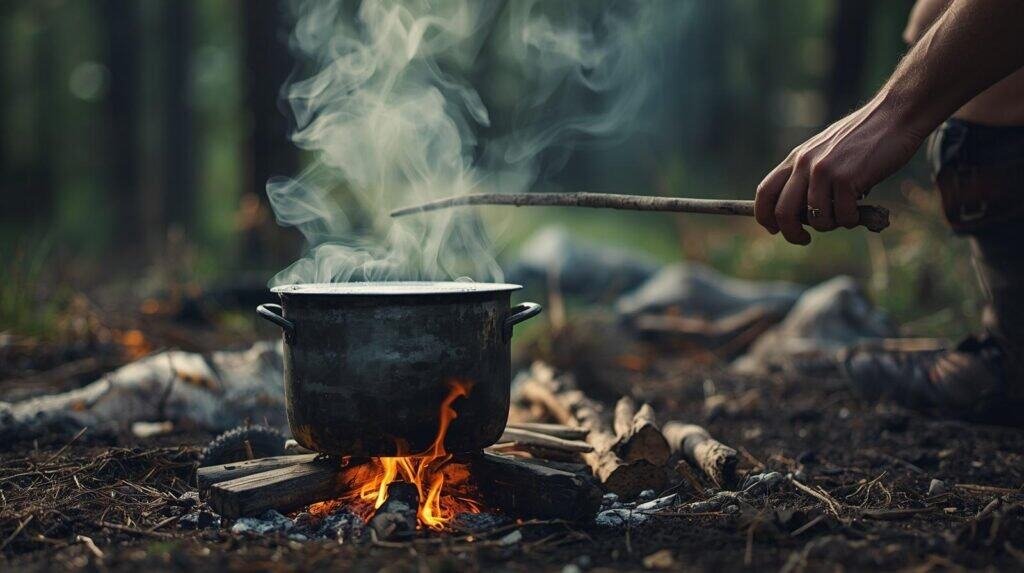
If cavemen could do it, so can you. Honestly, if you can’t manage this, nature might just be selecting you for extinction.
Boiling is the absolute king of water purification. It is the only method that is 100% effective against bacteria, viruses, and parasites every single time, provided you don’t mess it up. When I teach students how to purify water in the wild, we start with fire and a metal cup.
What You Need
- Fire: Or a stove, if you’re glamping.
- Metal Container: A single-walled stainless steel canteen is my go-to.
- Patience: A quality that is critically rare these days.
The Steps
- Collect your water. Try to get it from a flowing source if possible.
- Pre-filter debris. If the water looks like chocolate milk, strain it through a shirt, a bandana, or a reasonably clean sock. You want to drink water, not chew it.
- Bring to a rolling boil. Not just little bubbles. I want to see violent, angry bubbles.
- Maintain the boil.
- 1 minute at low elevation.
- 3 minutes if you are above 6,500 feet (because physics is weird and water boils at a lower temp up there).
Why It Works Heat kills everything. Bacteria? Dead. Viruses? Cooked. Parasites like Giardia and Cryptosporidium? They don’t stand a chance. Understanding how to purify water in the wild by boiling is essentially just understanding pasteurization. It’s a mic drop for microbes.
Common Mistakes Don’t mistake “steaming” for boiling. I’ve seen guys pull the cup off the fire the second they see a wisp of steam. That’s not how to purify water in the wild; that’s how to make warm bacteria soup. Also, don’t let ash fall into your clean water, and for the love of all that is holy, don’t dip your dirty “collection cup” back into your boiled water.
Method 2: Solar Disinfection (SODIS)
Think of this as nature’s microwave, but much, much slower. If you are stuck in a desert with nothing but trash, knowing how to purify water in the wild using the sun can save your life.
What You Need
- Clear plastic bottle (PET plastic works best).
- Full, unblocked sun.
- Time (lots of it).
The Steps
- Fill the bottle. Leave a little air space.
- Shake it. You want to oxygenate the water; it helps the chemical reaction.
- Lay it flat in the sun. On a rock or metal surface is best to reflect heat.
- Wait.
- 6 hours in full, blazing sun.
- 2 days if it’s cloudy (at which point, you might die of thirst anyway).
What It Kills UV-A radiation kills most bacteria and some viruses. However, if you are researching how to purify water in the wild because you are in a chemical runoff area, SODIS won’t help you. It does not remove chemicals, and it struggles with some tougher parasites. This is a backup method for when you have zero fuel and zero options.
Learn more about the science of SODIS from the CDC here.
Method 3: DIY Charcoal Filter
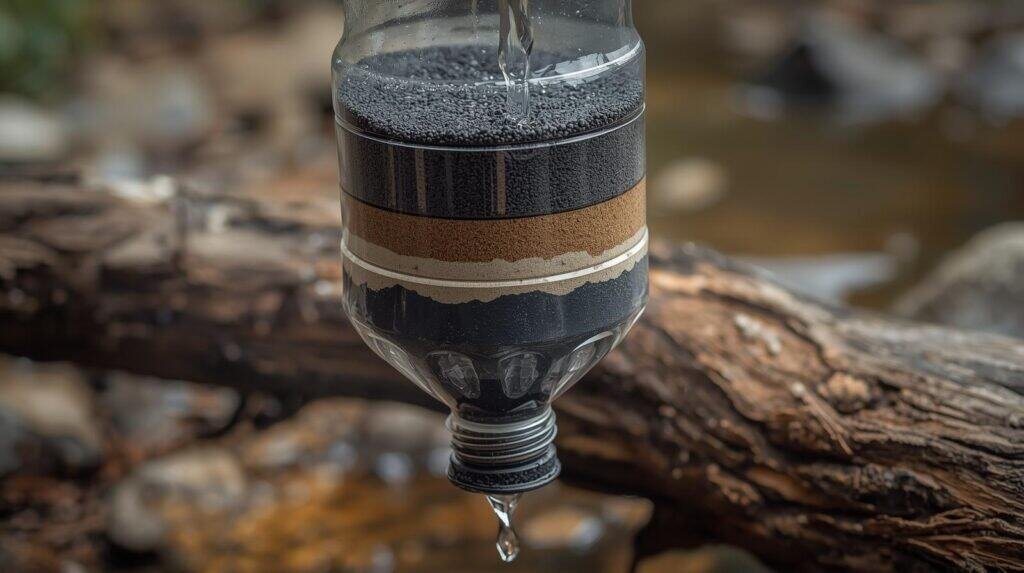
This is for when you forgot your filter, you have no tablets, and you are questioning your life choices. This method makes you feel like MacGyver, but don’t get cocky. This is a filter, not a purifier.
What You Need
- A bottle, a hollow log, or a cone of birch bark.
- Cloth.
- Charcoal (from your campfire, crushed up—NOT Kingsford briquettes with lighter fluid, you idiot).
- Sand.
- Gravel.
The Layer Order (Bottom Up)
- Cloth: To keep the charcoal from falling into your mouth.
- Crushed Charcoal: The active filtration layer.
- Sand: To catch smaller particles.
- Gravel: To catch the big chunks of crud.
The Process Pour the dirty water into the top. Let it trickle through the layers. The charcoal absorbs toxins and improves the taste. When people ask how to purify water in the wild and mention this method, I always correct them: This cleans the water, it doesn’t sterilize it.
What It Does NOT Do It does not kill pathogens. If there is viral hepatitis in that water, the charcoal will just give it a nice smoky flavor before it infects your liver. You MUST boil the water after filtering it through this contraption. Knowing how to purify water in the wild means knowing the difference between “clear” and “safe.”
Method 4: Chemical Tablets
Tiny pills. Big power. I always carry these because they weigh nothing and they work.
Types
- Iodine: Old school. Tastes like a hospital.
- Chlorine Dioxide: The modern standard. Takes longer but kills more bugs (like Crypto).
The Steps
- Drop the tablet.
- Wait 30 minutes. (Read the package; some require 4 hours for cold water).
- Unscrew the cap slightly. Shake the bottle so the treated water cleans the threads of the cap. I see people fail at how to purify water in the wild because they drink the untreated droplets on the rim of their Nalgene.
Pros & Cons They are lightweight and reliable. But the taste? It’s bad. Pro Tip: If you are using Iodine, drop a little Vitamin C powder (or Tang) in after the treatment time is up. It neutralizes the iodine taste. Just don’t do it before, or it neutralizes the purification power.
Check out the EPA’s guide on emergency water disinfection.
Method 5: Improvised Cloth Pre-Filter
This is Step Zero for everything. Before you even think about how to purify water in the wild, you need to think about how to strain it.
Use:
- Shirt
- Bandana (I carry a giant orange one for this reason)
- Sock (fresh sock… preferably, but survival is nasty business)
Strain out:
- Bugs
- Mud
- Leaves
- Unidentified floating objects
This doesn’t purify anything. Microbes pass through a sock like a mosquito through a chain-link fence. This just keeps the crunch out of your water. If you want to know how to purify water in the wild effectively, you have to get the solids out first so your chemical tablets or UV rays can actually hit the bugs.
Combining Methods (Smart Survival)
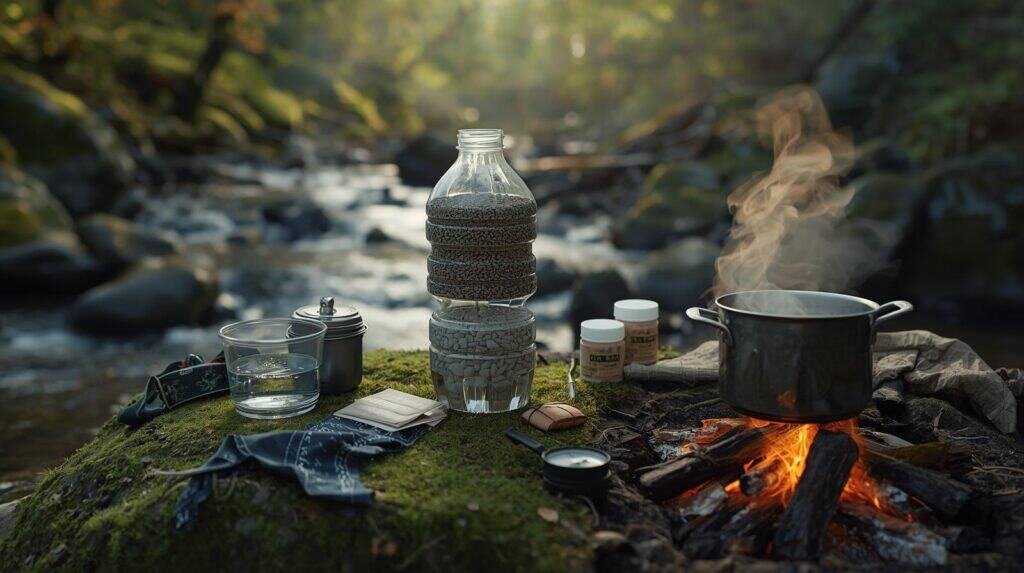
The guys who survive are the guys who stack the deck. Why use one method when you can use two? When I consider how to purify water in the wild, I look at “Redundant Systems.”
Best Practice: Filter first, then purify.
- DIY Filter ➜ Boil: This makes the water taste decent and ensures it is sterile.
- Cloth Strain ➜ Tablets: Keeps the big chunks out so the chlorine dioxide can work efficiently.
- Dirty Pond ➜ Filter ➜ Boil: If the source is truly nasty, you throw the kitchen sink at it.
Stacking methods is survival IQ boost. It shows you aren’t just memorizing how to purify water in the wild, but you actually understand the principles of filtration vs. purification.
Read more on water treatment techniques from the Red Cross.
Finding Water (So You Can Actually Purify It)
You can’t purify what you can’t find. Part of knowing how to purify water in the wild is knowing where to look.
- Follow Gravity: Water flows downhill. Head to the valleys.
- Watch the Green: A patch of bright green vegetation in a brown landscape is a neon sign pointing to water.
- Insect Activity: Bees and mosquitoes usually stay within a few miles of water. If the bugs are eating you alive, you’re probably close to a drink.
Dangerous Sources to Avoid Not all water is worth the risk. Even if you know how to purify water in the wild, avoid:
- Agricultural Runoff: Chemicals and pesticides don’t boil out.
- Dead Animals: If there is a rotting deer in the creek upstream, walk away.
- Saltwater: You can’t boil the salt out. Distillation is a whole other beast.
REI has a great guide on finding water sources.
What I Personally Carry
I don’t carry much, but what I do carry works. My loadout for how to purify water in the wild hasn’t changed in a decade.
In my kit:
- Single-Walled Metal Cup: For boiling. It doubles as my coffee cup. It can take a beating.
- Chlorine Dioxide Tablets: My backup. They live in my first aid kit.
- Cotton Bandana: Pre-filter. Also a pot holder. Also a bandage.
- Headlamp: Because trying to see if water is boiling in the pitch black sucks.
Because gear fails. Plastic pumps snap. Batteries corrode. But knowing how to purify water in the wild with a fire and a cup? That skill weighs nothing and lasts forever.
Princeton University’s Outdoor Action guide is a great resource for deeper study.
Common Mistakes That Will Kill You
I see rookies make the same mistakes over and over when they try to figure out how to purify water in the wild.
❌ Trusting clear water. Just because it looks clean doesn’t mean a beaver didn’t poop in it 50 yards upstream. ❌ Rushing tablet wait time. 15 minutes is not 30 minutes. Don’t be impatient. ❌ Drinking straight from snow. It lowers your core temperature and burns more calories to melt than it provides in hydration. Melt it first. ❌ Contaminating clean containers. Don’t put clean water into a bottle that just held dirty water without washing it. ❌ The “It’ll be fine” mentality. Famous last words.
Practice Drill (Do This)
Reading a blog post about how to purify water in the wild is nice. Doing it is better.
This weekend:
- Go to a creek.
- Grab some muddy water.
- Filter it through a bandana.
- Boil it on a camp stove.
- Let it cool and taste test it.
Skills rot when unused. If you don’t practice how to purify water in the wild when the stakes are low, you will fail when the stakes are high. Stay sharp.
FAQ
Can I drink rainwater?
Yes, generally speaking, rainwater is cleaner than ground water. However, if you collect it off a dirty tarp or a rusty roof, it’s contaminated. To be safe, treat it. If you are asking how to purify water in the wild, rainwater is the “low hanging fruit” but I’d still boil it if I had the fuel.
Is snow safe to eat?
NO. Do not eat yellow snow, and don’t eat white snow either. Eating snow lowers your core body temperature drastically, inviting hypothermia. Plus, snow can trap atmospheric pollutants. Melt it first, then boil it. That is the only correct answer for how to purify water in the wild in winter.
Stream vs Pond?
Always choose moving water. Stagnant water is a breeding ground for mosquitoes, algae, and bacteria. Look for water that is moving, upstream from human habitation, and away from animal trails. But remember: Moving water is not sterile water. You still need to apply what you learned about how to purify water in the wild.
Do filters replace boiling?
No. Most commercial filters remove bacteria and protozoa (like Giardia), but many do not remove viruses (like Hepatitis A or Rotavirus). Boiling kills everything. If you are in an area with high viral risk (often developing countries), knowing how to purify water in the wild means knowing how to boil or use chemical purifiers, not just pumping water through a filter.
How much water do I need per day?
Minimum 2 liters for normal survival situations. If you are hiking, stressed, or in heat, you need 3 to 4 liters. If you are learning how to purify water in the wild, you better plan on processing a lot of it, because boiling 4 liters of water one cup at a time takes all day.
Wrapping Up
Water kills more adventurers than bears ever will. It’s not sharks, snakes, or serial killers in cabins that get you. It’s bad water decisions.
You don’t need fancy gear to survive. You don’t need a $300 titanium pump. You need:
- Fire
- Knowledge
- Patience
- And a healthy fear of creek water.
Master the skill of how to purify water in the wild. Test the method. Stay alive.
More Great Reads – Keep Your Skills Sharp
Sharpen your preparedness game with these guides:
How to Navigate Without a Compass (Without Crying, Panicking, or Calling Your Mom)
Lost your gear? These dead-simple techniques still get you home.
Crucial Water Storage for Preppers: Proven Ways to Stay Hydrated When the Grid Goes Dark
How much you really need and where to keep it without wrecking your house.
The Ultimate Winter Car Survival Kit
What to keep in your trunk so you’re not freezing on the side of the road.
Building Mental Toughness in the Wilderness
Staying calm when things go sideways matters more than your gear.