
How to Create a Fail-Safe “Get Home Plan” for Your Family
The Scenario You Haven’t Planned For
It is 2:00 PM on a Tuesday. You are sitting at your desk, 15 miles from home. Your spouse is at their workplace across town, and your kids are at school.
Suddenly, the power goes out.
At first, it seems like a standard outage. You wait for the generator to kick in, but it doesn’t. You check your phone, but there is no signal—just the spinning wheel of death or “SOS” in the corner of the screen. You look out the window and realize the traffic lights are dark. The streets below are beginning to gridlock. The hum of the city has changed from a busy drone to the sharp sounds of honking horns and rising panic.
Panic begins to set in for you, too. Not because you don’t have supplies—I know you do. You have the freeze-dried food, the water filters, and the ammo stockpiled in your basement. The panic sets in because your supplies are at home, and you are not.
Most people prepare for the “end of the world,” but they fail to prepare for the Tuesday afternoon disaster. In the survival community, I’ve seen an obsession with “Bugging Out” to the woods for three decades. Everyone wants to talk about their cabin in the mountains. But statistically, the most likely survival scenario you will face isn’t escaping into the wild; it is navigating the chaos to get back to your sanctuary.
This is why you need a Get Home Plan.
Without a comprehensive Get Home Plan, your family is vulnerable during those critical first hours of a disaster. All the gear in the world won’t save you if you can’t reach it. This guide isn’t about theory; it’s about the hard-learned logistics of getting back to your fortress when the world falls apart.
Why Most Plans Fail (And The Protocol That Works)
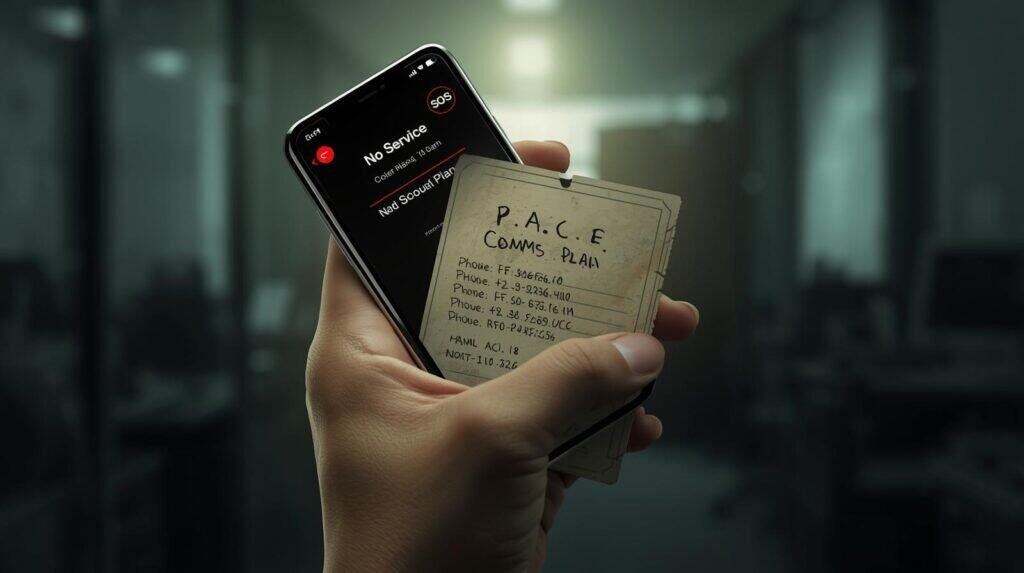
I have audited hundreds of survival plans over the years. Do you know why most families fail to reunite during emergencies? It isn’t a lack of love; it is a lack of logistics. When the grid goes down, the gap between “panic” and “safety” is a solid Get Home Plan.
The average person relies entirely on fragile systems. They assume their GPS will work. They assume their cell phone will have a signal. They assume the police will direct traffic. In a true SHTF (Shit Hits The Fan) event, none of those things are true. To build a plan that actually works when cell towers are down and roads are blocked, we need to borrow a strategy from the military.
It is called the P.A.C.E. Protocol (Primary, Alternate, Contingency, Emergency).
Applying P.A.C.E. to your family emergency communication plan turns chaos into a checklist. When your brain is flooded with cortisol (stress hormone), you don’t want to make decisions; you want to follow a script. Here is how to structure the comms section of your Get Home Plan.
1. Primary: Voice and Text
This is your standard method. Call or text.
- The Reality: In a regional emergency—be it a hurricane, terror attack, or grid failure—voice networks fail first. The bandwidth required for voice traffic is high, and the towers get saturated instantly.
- The Fix: If calls fail, do not keep dialing. Send an SMS text. Text data packages are tiny and often squeeze through jammed networks in milliseconds when a voice channel opens up. If that fails, move to the “Alternate” step of your Get Home Plan immediately.
2. Alternate: Internet-Based Apps
If cell towers are jammed but you still have a weak data signal or access to a functional Wi-Fi hotspot (like a coffee shop with a generator), standard calls won’t work, but data might.
- The Fix: Apps like Signal or WhatsApp are essential here. They operate over the internet, not the voice network. Your Get Home Plan should specify exactly which app is the “family channel.” Don’t make your spouse guess whether to check Telegram or Messenger.
3. Contingency: The “Out-of-Area” Contact
This is a technique I learned back in the days of landlines, but it applies today. often, local lines (or local cell towers) are jammed, but the switching stations for long-distance calls are open.
- The Fix: Designate one family member who lives in a different state (e.g., “Aunt Sarah in Ohio”). Everyone in your family calls her to check in. She acts as the central hub for your Get Home Plan, relaying messages between you and your spouse when you can’t connect directly. According to Ready.gov, this is often the most reliable way to reunite separated families.
4. Emergency: Physical Protocol
This is the “Total Blackout” scenario. No phones, no internet, no electricity. This is where 99% of people fail because they are addicted to digital comms.
- The Fix: You must have a pre-agreed upon protocol in your Get Home Plan. For example: “If comms are down for 4 hours, I will leave work and walk immediately to the house. Do not leave the house unless it is on fire.” You need a physical meeting place (Rally Point) if the home is inaccessible, which we will discuss later.
The Tools and Tactics to Get You Home
Now that you know how to communicate, the desire to physically get home is paramount. However, hoping for the best is not a strategy. You need to desire the skills and gear that make your Get Home Plan viable.
I want you to visualize the walk. It’s not a sunny Saturday hike. It is raining, people are looting stores, emergency vehicles are screaming but not moving, and you are alone. To survive this, you need a map, a bag, and a brain.
The Rule of Three: Mapping Your Route
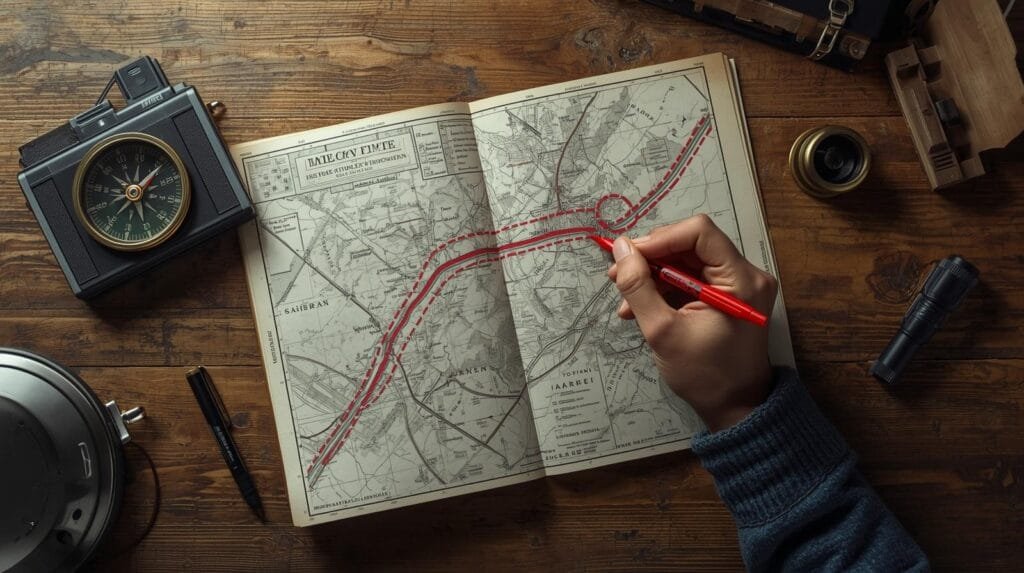
If your Get Home Plan relies on Google Maps or Waze, you do not have a plan. In a disaster, GPS satellites may remain active, but the cellular data required to download the map tiles will likely fail. Even if they work, the algorithms will route you onto highways that will turn into parking lots within minutes.
To create a robust Get Home Plan, you need to scout three distinct routes.
Route A (Vehicle Primary)
Your standard drive, but with a survivalist’s eye. You need to identify “Choke Points.”
- Choke Points: Bridges, tunnels, and long stretches of highway with concrete dividers.
- The Strategy: If you are driving Route A and see brake lights ahead near a choke point, do not wait to see if it clears. Abandon the route immediately. This is the “Pivot Point” of your Get Home Plan.
Route B (Surface Streets)
This route avoids highways entirely. It uses back roads, residential streets, and industrial parks.
- The Strategy: This part of your Get Home Plan requires local knowledge. You should practice driving this route on a Sunday afternoon to ensure roads haven’t been closed or turned into one-ways.
Route C (The Footpath)
This is the most critical part of emergency get home route planning. If your car runs out of gas, or the roads are physically impassable, your Get Home Plan transitions to foot travel.
- The Path: Walking along a highway is dangerous and makes you a target. Look for “Linear Danger Areas” that offer travel paths: Railroad tracks, power line cuts, and bike trails.
- The Map: You need a physical, paper map of your local area. I highly recommend the DeLorme Atlas & Gazetteer series for your specific state. Mark these routes with a highlighter. A digital map is not a reliable backup for your Get Home Plan.
The Gear: Speed Over Comfort
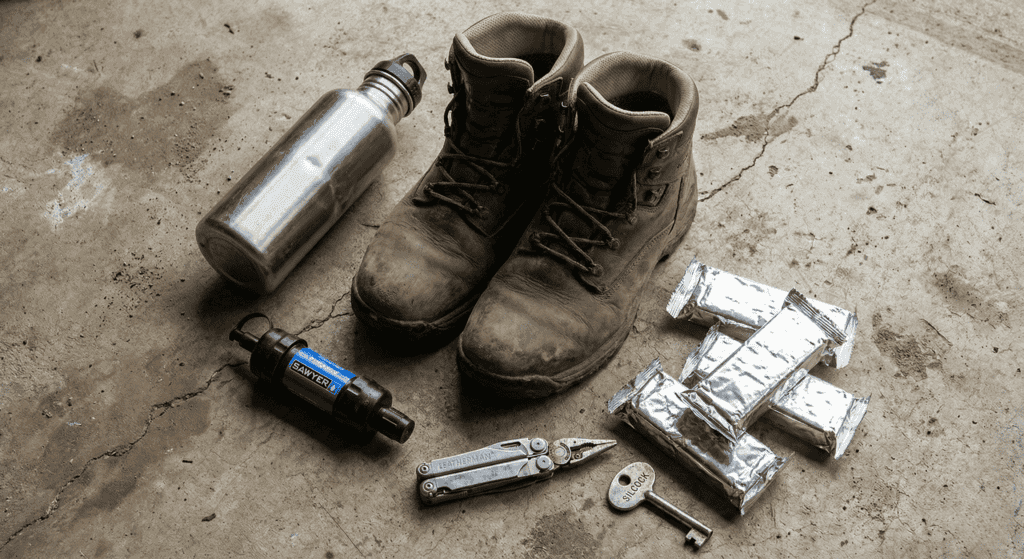
You might desire a massive survival bag, but for a Get Home Plan, speed is life.
Many people confuse a Get Home Bag (GHB) with a Bug Out Bag (BOB). They are completely different tools, and understanding the difference is vital for your Get Home Plan.
- A Bug Out Bag is designed to keep you alive in the woods for 72+ hours. It is heavy.
- A Get Home Bag is the tactical engine of your Get Home Plan. It is a lightweight kit designed purely for speed and mobility to cross 10 to 30 miles of urban terrain.
If the gear for your Get Home Plan weighs 40 pounds, you have failed. You need to be agile. Here are the absolute essentials:
1. Footwear is Non-Negotiable
I cannot stress this enough. If you work in an office wearing dress shoes, heels, or stiff work boots, you cannot walk 15 miles home. You will have blistering feet by mile 3, and you will be immobile by mile 10. Your Get Home Plan ends there.
- The Fix: Keep a pair of broken-in hiking boots or trail runners in your trunk. Include two pairs of wool socks (one to wear, one to change into). This is the single most important item in your kit.
2. Water and Calories
You don’t need a camping stove. You don’t need a mess kit. You need ready-to-eat energy to fuel your Get Home Plan execution.
- Water: Carry 1 Liter of water in a metal single-walled bottle (which can be boiled if absolutely necessary). Carry a Sawyer Mini or LifeStraw for scavenging water from urban sources (creeks, water fountains, toilet tanks).
- Food: High-calorie energy bars or ration blocks. You just need fuel to keep your legs moving for 8 hours.
3. Protection and Tools
You are moving through a potentially hostile environment. Civil unrest often accompanies blackouts. You need to be able to access secure areas or defend yourself.
- Tools: A Silcock key (a 4-way key used to open commercial water spigots on the sides of buildings) is a secret weapon for urban water procurement. A reliable multitool is also vital.
While a bag in your trunk is essential, disaster can strike when you are away from your vehicle. You should always have the basics on your person. Check out my guide on the Best Realistic Everyday Carry Gear to see the specific tools, lights, and items I personally recommend keeping in your pockets to ensure your Get Home Plan is always viable, even without a backpack.
The Reality Check: Can You Make the Walk?
A robust Get Home Plan requires an honest look at your fitness.
In a car, 15 miles is a 20-minute commute. On foot, carrying a 20-pound backpack, under high stress, in bad weather? 15 miles is a 6 to 8-hour hike. Most people overestimate their physical ability to execute a Get Home Plan on foot.
If you haven’t walked 5 miles continuously in the last year, you are not going to walk 20 miles home easily. I recommend doing a “proof of concept” walk. Park your car 5 miles from home and walk back. It will reveal every flaw in your physical conditioning.
Urban Survival Navigation Tips
When moving through a city in chaos, the shortest distance is rarely the safest. Your Get Home Plan must account for threats.
- Avoid Skylines: Do not walk on the very top of a hill or ridge where you are silhouetted against the sky. Stay low.
- Cornering: When walking around city corners, take them wide. Do not hug the wall where someone could be waiting.
- Gray Man Theory: Look boring. If you have a MOLLE-covered tactical backpack with morale patches, you look like a “loot drop.” You look like you have supplies. Your Get Home Plan relies on stealth. Use a dirty gym bag or a generic diaper bag. You want to look poor, tired, and empty-handed.
Execute Your Plan Today
You have the knowledge. You understand the risks. Now, you must take action.
A Get Home Plan that only exists in your head will not save your family. A plan that isn’t rehearsed is just a wish. You need to take tangible steps immediately to secure your family’s safety.
Here is your immediate checklist to activate your Get Home Plan:
- Print the Cards: Create a P.A.C.E. card for every family member’s wallet. Laminate it. Do it tonight.
- Mark the Map: Buy a physical map of your city and highlight your three routes (Vehicle, Backroad, Footpath). Keep this in your glovebox, not your office.
- Pack the Bag: Put old hiking boots and a bottle of water in your trunk today. You likely already have these items in your house—move them to the car.
- Establish the Rally Point: Agree on where to meet if your home is unsafe (e.g., a neighbor’s house, a local church, or a water tower).
- The Dead Drop: Establish a “Dead Drop” location at your home (under a specific rock or inside a fake electrical box). If your family has to leave before you arrive, they leave a physical note there. This closes the communication loop of your Get Home Plan.
The Final Transition
Getting home is the most dangerous part of the initial disaster. It is the period of highest exposure. But once you execute your Get Home Plan and walk through your front door, the mission changes.
You are no longer “getting home”—you are now “surviving home.”
You need to ensure your home is stocked, secure, and ready for the long haul. A successful return is only a victory if you have the supplies to sustain yourself. To ensure you are ready for what comes next, read my breakdown of the 15 Best Survival Tools for Preppers in 2025. This guide covers the heavy-duty gear you need to survive comfortably once your family is reunited.
Continue Your Survival Training
You have the plan, but do you have the gear and the skills to back it up? Don’t stop your preparation here. Read these three guides next to complete your safety system.
- The Daily Essentials: You can’t execute a Get Home Plan if you don’t have the right tools in your pockets when disaster strikes. 👉 Read: Best Realistic Everyday Carry Gear
- The Long-Term Solution: Making it home is only the first victory. Ensure your fortress is stocked with the heavy-duty equipment needed for a grid-down scenario. 👉 Read: 15 Best Survival Tools for Preppers in 2025
- The Critical Skillset: Walking home requires more than just walking; it requires avoiding threats. Learn how to become invisible in an urban environment. 👉 Read: How to Master Situational Awareness and the “Gray Man” Technique