
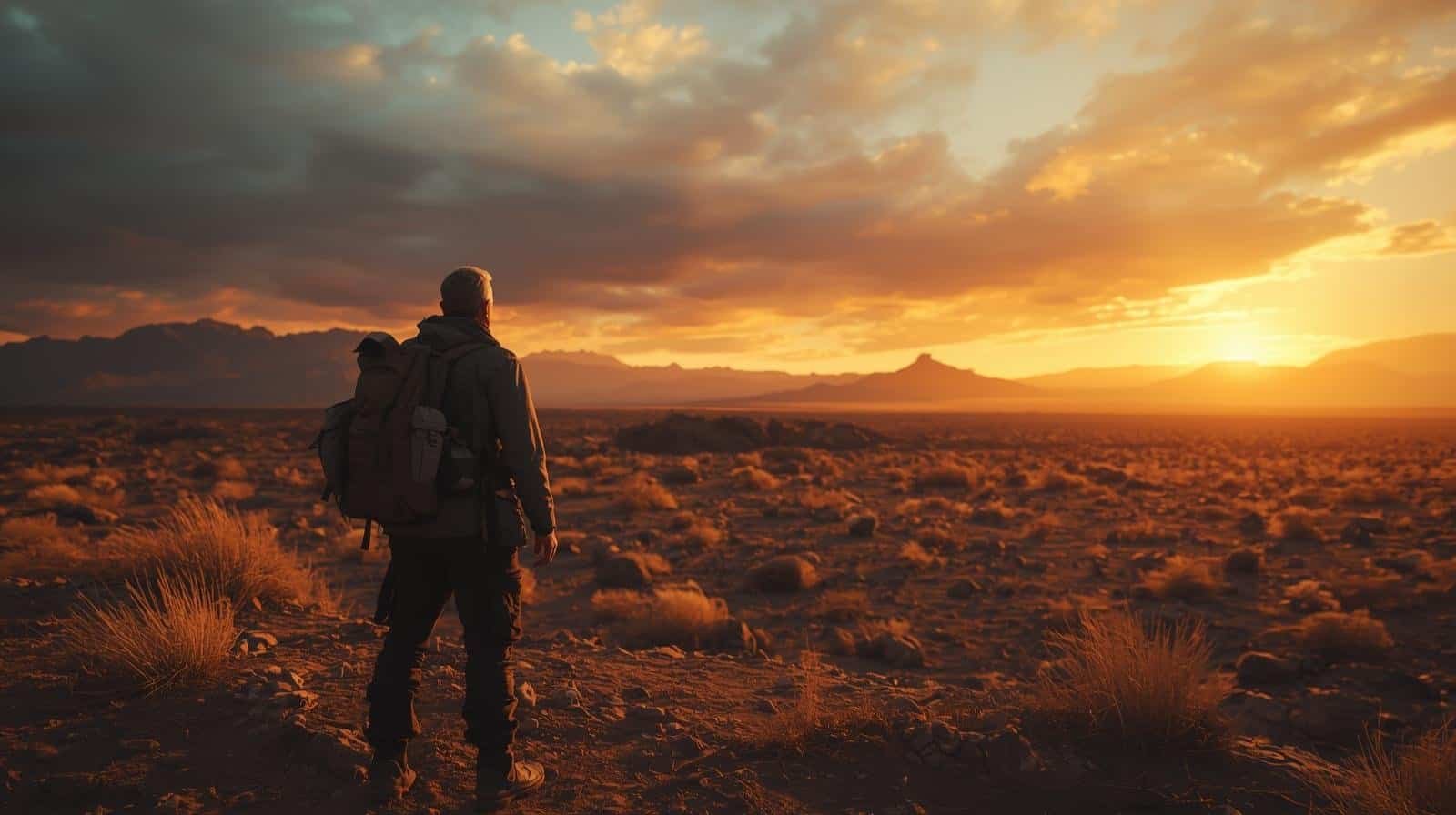
Why God Allows Wilderness Seasons: A Biblical Guide for Men in Transition

Why God Allows Wilderness Seasons: A Biblical Guide for Men in Transition
Exodus 3 — Purpose in Trials & Calling
A gritty guide for men who feel stuck, unseen, or unsure what God is doing next.
When a Man Finds Himself in the Wilderness
There comes a point in every man’s life — especially around midlife — where you stop, look around, and think:
“How did I end up in this wilderness?”
The job feels dry.
Your confidence feels cracked.
Your prayers feel like they hit God’s voicemail.
Your purpose feels like it got lost somewhere between who you were and who you’re supposed to become.
And God?
He feels quiet — painfully quiet.
But here’s biblical truth that doesn’t care about your feelings:
Wilderness seasons are not punishment. They’re preparation.
Understanding why God allows wilderness seasons is critical to surviving them with your faith intact. These spiritually dry periods are where God stops the noise, strips away the old identity, and rebuilds a man who can carry a calling with courage instead of pride.
If you want to see it clearly, look at Moses in Exodus 3 — a man who didn’t meet God in a palace, a church, or a mountaintop retreat…
…but in a desert he never planned on.
What Is a Wilderness Season?

A wilderness season is not simply a “rough patch.”
It’s a spiritually intentional time where God allows you to experience:
- Silence that feels deafening
- Slowness when you’re desperate for progress
- Uncertainty about the future
- Isolation from the life you once knew
- Loss of direction and clarity
- Identity questions that shake your foundation
- Delayed answers to urgent prayers
- Stripped-down living that feels unfair
We panic in these moments.
But God isn’t panicked.
He’s purposeful.
The wilderness is a classroom, not a curse. It’s the place where God does His deepest work because it’s the only place we stop trying to control everything. According to biblical scholars at Desiring God, these seasons serve as divine training grounds where character is forged in ways prosperity never could.
Why God allows wilderness seasons often confuses us in the moment, but Scripture reveals a consistent pattern: God uses barren places to produce abundant fruit in our lives.
Why God Allows Wilderness Seasons (Exodus 3)
1. To Break False Identity
Before Moses ever held a staff in his hand, he carried a false identity in his heart.
He thought he was:
- A prince with political power
- A problem-solver who could fix Israel’s slavery issue through human effort
- A man of influence based on Egyptian credentials
- A rescuer by force rather than by faith
God wasn’t impressed.
So He took Moses into the wilderness not to crush him — but to strip away every identity Moses built on his own. For forty years, the man who grew up in Pharaoh’s palace herded sheep in Midian. Why God allows wilderness seasons like this becomes clear when we understand that false identities must die before true callings can emerge.
The same happens to us.
God will remove:
- The title that defined you
- The platform you relied on
- The comfort that kept you complacent
- The self-reliance that blocked dependence on Him
- The illusion of control you desperately clung to
Because He’s not trying to punish you.
He’s trying to free you from who you thought you had to be.
Wilderness is identity detox.
This aligns with what the Apostle Paul experienced. Before becoming the greatest missionary in church history, Paul spent three years in the Arabian wilderness after his Damascus Road conversion (Galatians 1:17-18). God needed to dismantle Saul the Pharisee before He could fully activate Paul the Apostle.
2. To Build the Character You Need for the Calling You Want

Moses spent 40 years doing a job most men would consider “beneath them”: shepherding sheep in the backside of the desert.
But God wasn’t wasting a moment.
Shepherding taught Moses:
- Patience with creatures that constantly wander
- Humility that comes from daily, unglamorous work
- Discipline to maintain routines in isolation
- Watchfulness over those prone to danger
- Protection skills for the vulnerable
- Leadership of living beings that constantly go the wrong direction
- Dependence on provision beyond his control
In other words…
God was giving Moses pastoral training before Moses knew he’d ever pastor a nation.
Understanding why God allows wilderness seasons requires recognizing that character development happens in obscurity, not on stage. The wilderness builds the internal strength necessary for external assignments. As Bible Study Tools notes, every major biblical figure experienced significant wilderness preparation before their greatest contributions.
Your wilderness is doing the same: forming the character you’ll need for the assignment you don’t yet see.
David went from shepherd to giant-slayer to fugitive to king — each stage preparing him for the next. Joseph endured slavery and prison before becoming second-in-command of Egypt. Jesus Himself spent 40 days in the wilderness before launching His public ministry.
The pattern is undeniable: wilderness always precedes breakthrough.
3. To Teach Us to Listen Again
Moses didn’t notice the burning bush because it was bright.
He noticed it because he had spent 40 years learning to pay attention.
In the noise and hurry of Egypt, Moses missed God’s voice entirely. He acted impulsively, killed an Egyptian, and ran for his life. But in the wilderness:
- Noise fades to silence
- Ego shrinks to humility
- Distractions fall away
- The soul becomes quiet
- The heart becomes teachable
- Spiritual sensitivity sharpens
We hate silence.
God uses it.
Why God allows wilderness seasons often centers on this crucial truth: we must learn to hear Him clearly before we can obey Him fully. The wilderness reteaches a man how to hear God, not just talk about Him.
In our hyperconnected, constantly distracted world, genuine spiritual listening requires intentional disconnection. The wilderness forces what we won’t choose voluntarily — extended time alone with God without escape routes.
Elijah experienced this at Mount Horeb. After his dramatic victory over the prophets of Baal, he fled to the wilderness in depression and fear. God didn’t meet him in the earthquake, wind, or fire, but in “a gentle whisper” (1 Kings 19:12). Elijah could only hear that whisper because the wilderness had stripped away every other voice competing for his attention.
4. To Prepare You for a Bigger Assignment
God didn’t show up in Exodus 3 to comfort Moses.
He showed up to commission him.
Wilderness always precedes mission.
For Moses, the call was massive: Lead an entire nation — approximately 2-3 million people — out of 400 years of slavery, through a desert, to a land they’d never seen.
For you, understanding why God allows wilderness seasons might reveal your next assignment:
- Healing your marriage after years of distance
- Leading your family spiritually when you’ve been passive
- Stepping into ministry that terrifies you
- Changing careers to align with your calling
- Breaking an addiction that’s controlled you for years
- Mentoring younger men who need what you’ve learned
- Finally obeying the thing God has whispered for years
- Starting the business or mission God laid on your heart
Trials are not random. They are prep work for purpose.
According to research from The Gospel Coalition, God’s pattern throughout Scripture consistently shows that the depth of the wilderness corresponds to the scope of the calling. Deeper preparation indicates bigger assignments ahead.
Why God allows wilderness seasons becomes clearer when we realize that God never wastes pain. Every hardship, every delay, every disappointment is being woven into your preparation for kingdom impact you can’t yet imagine.
What Exodus 3 Reveals About God in Your Trials
When Moses encountered the burning bush, God revealed critical truths about His character during wilderness seasons:
God sees you.
“I have indeed seen the misery of my people…” — Exodus 3:7
You feel invisible.
God sees you clearly.
Your wilderness isn’t hidden from God’s sight. He observes every detail of your struggle, every tear you’ve cried, every prayer you’ve whispered in desperation. Understanding why God allows wilderness seasons includes knowing that He never loses sight of you in them.
God hears you.
“…I have heard them crying…”
Your prayers are not ignored — they are gathered. Revelation 8:3-4 describes how the prayers of the saints are collected like incense before God’s throne. Every prayer you’ve prayed in your wilderness is stored, valued, and will be answered in God’s perfect timing.
God knows your pain.
“…I am concerned about their suffering.”
God is emotionally invested in your struggle, not distant from it. The Hebrew word translated “concerned” carries the weight of compassionate awareness — God feels the weight of what you’re carrying. He’s not a detached observer but an empathetic Father who enters into your pain.
God comes down to rescue.
“So I have come down to rescue them…”
God doesn’t meet you after the wilderness.
He meets you in it.
This is perhaps the most encouraging truth about why God allows wilderness seasons: He doesn’t abandon you to endure them alone. The same God who came down in Exodus 3 came down in human form in Jesus Christ (John 1:14). He enters our wilderness to walk with us through it.
God calls you to partner with Him.
“Now go. I am sending you…”
Every wilderness ends with direction.
With calling.
With movement.
Moses’ wilderness wasn’t permanent — it was preparatory. The moment his character aligned with his calling, God initiated the mission. Why God allows wilderness seasons always includes this forward momentum: preparation leads to deployment.
How to Navigate Your Wilderness Season

Understanding why God allows wilderness seasons is important, but knowing how to respond is critical. Here’s biblical wisdom for the man in the middle of spiritual drought:
Don’t rush out.
Wilderness feels uncomfortable, so we try to escape it. We look for shortcuts, numbing strategies, or premature exits. But a rushed exit leads to repeated lessons.
Stay until God says move.
Moses tried to rush his calling 40 years early and ended up a murderer on the run. When he finally accepted the wilderness process, God’s timing aligned perfectly with God’s plan.
Look for burning bush moments.
God will speak — through Scripture, sermons, godly people, inner conviction, circumstances, and sometimes through dramatic encounters. Slow down enough to notice.
Pay attention to what catches your attention. Moses noticed the bush wasn’t consumed. What “anomalies” is God using to get your attention right now?
Ask Moses’ question: “Who am I?”
Not from insecurity, but from humility.
Moses asked, “Who am I that I should go to Pharaoh and bring the Israelites out of Egypt?” (Exodus 3:11)
This is the right question because it acknowledges reality: you’re insufficient for God’s calling. Every man is. The wilderness teaches you this foundational truth.
Receive God’s answer: “I will be with you.”
God responded to Moses’ identity crisis not by boosting his confidence but by promising His presence: “I will be with you” (Exodus 3:12).
Your calling is not powered by your ability, but His presence.
This is why God allows wilderness seasons — to shift our confidence from self-reliance to God-dependence. Ministry, missions, and kingdom impact flow from abiding connection with God, not human competence.
Study the pattern throughout Scripture.
The Bible is filled with wilderness stories because God consistently uses this method:
- Abraham left everything familiar to journey toward an unknown land
- Jacob wrestled with God alone before reconciling with Esau
- Joseph endured years of imprisonment before palace promotion
- The Israelites wandered 40 years before entering the Promised Land
- David hid in caves while running from Saul before becoming king
- John the Baptist lived in the wilderness before introducing the Messiah
- Paul spent time in Arabia before revolutionizing the early church
According to theological resources at Ligonier Ministries, this pattern reveals God’s consistent methodology across redemptive history.
Embrace the wilderness disciplines.
Use this season to develop spiritual practices that will sustain you in future assignments:
- Deep, unhurried time in Scripture
- Contemplative prayer beyond request lists
- Fasting to sharpen spiritual sensitivity
- Journaling to process what God is teaching
- Solitude to hear God’s voice clearly
- Confession and repentance for soul cleansing
- Service that keeps you connected to others
Why God allows wilderness seasons often relates to establishing these foundational practices that prosperity makes optional but trials make essential.
My Midlife Experience With Wilderness Seasons
I’ve walked through my share of wilderness seasons — some caused by circumstances, some caused by my own choices, and some that God allowed for reasons I didn’t understand until later.
Not one of them was wasted.
In one wilderness, God stripped away my pride and self-sufficiency when a career I’d built for years collapsed unexpectedly. In another, He dismantled my comfort and forced dependence when financial security evaporated. In most, He shattered my illusions about my own strength and goodness.
But every single time:
He met me there.
He taught me something essential about His character, my weaknesses, and His sufficiency. He revealed parts of Himself I would’ve missed otherwise — His faithfulness in crisis, His provision in scarcity, His peace in chaos.
And He pushed me toward a calling I couldn’t have handled before.
Looking back, I can trace every significant spiritual breakthrough to a wilderness season I desperately wanted to escape. Why God allows wilderness seasons made no sense in the moment, but in hindsight, I wouldn’t trade those difficult seasons for anything.
The wilderness didn’t break me.
It built me.
And if you’re walking through one now, take heart:
God is not done with you.
He’s preparing you.
He’s shaping you.
He’s calling you.
Wilderness is not the end. It’s the turning point.
The Wilderness as Spiritual Boot Camp
As a Navy veteran, I recognize the wilderness for what it truly is: spiritual boot camp.
Basic training strips away civilian identity and builds military readiness. It’s uncomfortable, disorienting, and feels unnecessary until you face real combat. Then you’re grateful for every difficult lesson learned in training.
Similarly, why God allows wilderness seasons connects to His desire to prepare us for spiritual warfare, kingdom assignments, and the opposition we’ll face when advancing His purposes. The wilderness builds:
- Endurance — to finish what you start despite obstacles
- Resilience — to bounce back from failures and setbacks
- Dependence — to trust God when resources run out
- Discernment — to distinguish God’s voice from competing voices
- Discipline — to maintain spiritual practices under pressure
- Courage — to obey when obedience is costly
You don’t build these qualities in comfort. You build them in the crucible of difficulty.
Biblical Examples of Wilderness Transformation
Understanding why God allows wilderness seasons requires examining Scripture’s consistent pattern of wilderness-to-impact transformation:
Moses: 40 years in Midian transformed an impulsive, self-reliant prince into a humble, God-dependent deliverer.
David: Years hiding in caves transformed a shepherd boy into a warrior-king who could lead a nation through spiritual and military challenges.
Elijah: Wilderness depression at Mount Horeb transformed a discouraged prophet into a renewed voice for God’s truth.
Paul: Three years in Arabia transformed a religious zealot into the greatest missionary and theologian in church history.
Jesus: 40 days in the wilderness transformed preparation into mission as He defeated Satan’s temptations and launched His public ministry.
Each example reveals that the wilderness is not wasted time — it’s essential time.
Frequently Asked Questions About Why God Allows Wilderness Seasons
Q: How long do wilderness seasons last?
A: Wilderness seasons vary dramatically in duration. Moses experienced 40 years, David endured approximately 10-15 years fleeing Saul, while Jesus faced 40 days in the desert. The duration depends on God’s purposes, the depth of transformation needed, and your responsiveness to His work. Why God allows wilderness seasons of different lengths remains His sovereign prerogative, but the focus should be on faithful endurance rather than calendar watching.
Q: How do I know if I’m in a wilderness season or just experiencing normal life difficulties?
A: Wilderness seasons are characterized by spiritual dryness, sense of divine silence, loss of previous direction, identity questioning, and isolation from former certainties. Normal difficulties may be challenging but don’t necessarily involve this comprehensive spiritual disorientation. Why God allows wilderness seasons becomes evident when multiple areas of life simultaneously feel “off” and previous approaches to connecting with God feel ineffective.
Q: Can I shorten my wilderness season by doing something specific?
A: You cannot manipulate God’s timeline, but you can cooperate with His purposes. Resistance, rebellion, and running prolong wilderness seasons, while humility, obedience, and teachability position you for breakthrough. Understanding why God allows wilderness seasons helps you embrace the process rather than fight it, which accelerates transformation rather than delaying it.
Q: What if my wilderness season is caused by my own sin or bad decisions?
A: Even self-inflicted wilderness seasons can become redemptive when surrendered to God. David’s adultery and murder led to devastating consequences, yet God used that wilderness to produce profound repentance (Psalm 51) and deeper intimacy with God. Why God allows wilderness seasons — even those we cause — demonstrates His ability to redeem our failures and write purpose from our pain.
Q: Is it wrong to want the wilderness season to end?
A: No. Jesus Himself prayed in Gethsemane, “If it is possible, may this cup be taken from me” (Matthew 26:39). Desiring relief from difficulty is human and honest. The key is adding Jesus’ conclusion: “Yet not as I will, but as you will.” Why God allows wilderness seasons doesn’t change based on our comfort preferences, so honest lament combined with surrendered trust honors God.
Conclusion: Your Wilderness Has Purpose
If you’re currently in a wilderness season, hear this clearly:
God has not forgotten you. He has not abandoned you. He has not made a mistake.
Understanding why God allows wilderness seasons transforms how you experience them. What feels like punishment is actually preparation. What feels like delay is actually development. What feels like abandonment is actually intimate transformation.
Every biblical hero went through it.
Every man of faith experiences it.
Every significant calling requires it.
Your wilderness is not the end of your story — it’s the critical middle chapter where God builds the foundation for everything that follows.
So stay faithful.
Stay humble.
Stay teachable.
Because the same God who met Moses at the burning bush is meeting you right now in your wilderness — and He’s preparing you for an assignment bigger than you can currently imagine.
The question isn’t whether your wilderness will end.
The question is: Who will you become before it does?
That’s why God allows wilderness seasons — not to crush you, but to create in you the character necessary to carry the calling He’s already prepared.
Trust the process.
Trust the God who controls it.
And get ready — your burning bush moment is coming.